Karaoke Top 100, 48% Songs Over 10 Years Old
Im Chang-jung's Soju Han Jan (2003) and izi's Emergency Room (2005) etc.
In 2024, karaoke showed a new trend that goes beyond simple leisure activities and connects to music investment. According to the karaoke popularity chart released by TJ Media, songs that have been released for more than five years consistently ranked high, accounting for about 70% of the chart.

Consequently, songs that have been consistently loved in karaoke have emerged as new blue chips in the music investment market. The Top 100 karaoke popularity chart still features old ballads and familiar OSTs in the upper ranks, generating steady copyright royalty income. In this way, popular karaoke songs are recognized not only as enjoyable music but also as valuable investment products, rising as major investment targets on music copyright investment platforms like Musicow.
The reason why older songs show strong performance on the popularity charts is that they provide stable income, earning the nickname "royalty breadwinners."
Songs that make it onto the popularity charts guarantee stable copyright royalties, making them more attractive investment targets for investors.
 The drama Kwaegeol Chunhyang OST, izi's "Emergency Room," has enjoyed steady popularity for 20 years since its release.
For example, Jang Deok-cheol's "Like That Day" proved its popularity by closing early at the Musicow auction last year. Additionally, izi's "Emergency Room" recorded the highest search volume on the platform, drawing attention in both karaoke and investment markets. Hwang Chi-yeul's "You Are Stuck Inside Me" became a popular investment song on Musicow as well, fueled by the viral cover video trend on short-form platforms titled "The Manager's Unexpected Comeback."
The Correlation Between Copyright Royalties and Popular Songs
Copyright royalties generated from karaoke mainly consist of "reproduction fees" and "performance fees," and these earnings are distributed to copyright holders such as composers and lyricists. In karaoke, the original vocal track sung by the singer is not played; instead, a MIDI-format accompaniment track is provided. Therefore, neighboring rights holders such as singers and record producers do not receive copyright royalties. However, if the singer directly participated in writing lyrics or composing, they naturally receive royalties.
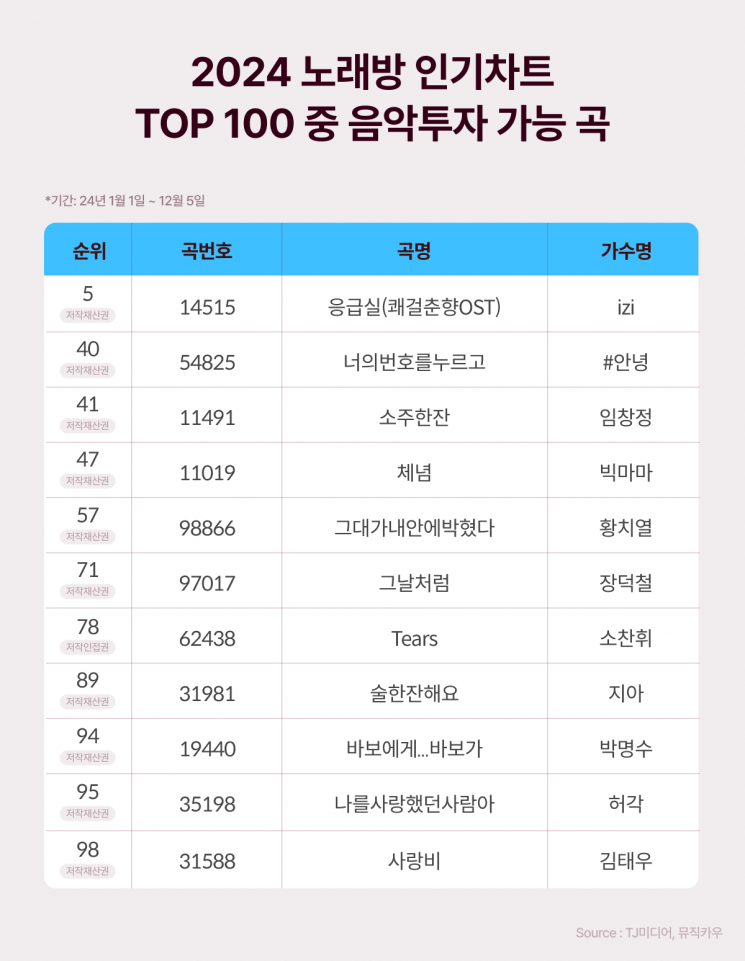 Songs available for music investment among the 2024 Karaoke Popularity Chart TOP 100. [Table = Musicow]
If a song is consistently loved, its copyright royalties continue to be generated, becoming a stable source of income. Accordingly, songs listed on the karaoke popularity chart have steady royalty flows and can be used as reliable indicators for investors.
An industry insider explained, "As music consumption methods diversify, karaoke has now established itself not just as a singing space but as a music trend and investment hub. This change signifies that karaoke favorites are recognized not only for singing enjoyment but also as investment products, representing a continuous revenue model for music and suggesting new cultural and economic possibilities."
© The Asia Business Daily(www.asiae.co.kr). All rights reserved.
![Clutching a Stolen Dior Bag, Saying "I Hate Being Poor but Real"... The Grotesque Con of a "Human Knockoff" [Slate]](https://cwcontent.asiae.co.kr/asiaresize/183/2026021902243444107_1771435474.jpg)


















