Defense Acquisition Program Administration: "Verification of Test Evaluation and Flight Safety"
The military has completed a partial performance upgrade project by introducing the latest components to the domestically produced unmanned aerial vehicle RQ-101 (hereinafter Songgolmae) currently in operation, and it has been put into service. It is expected that some of the operational difficulties caused by aging and discontinued parts will be alleviated.
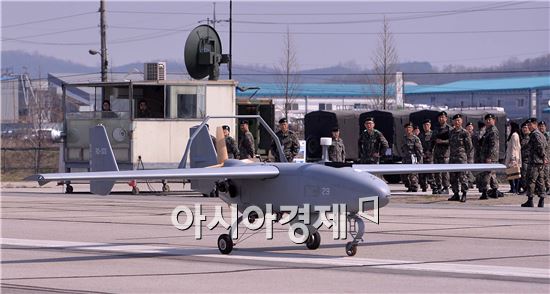 The Songgolmae drone used by our military
On the 7th, the Defense Acquisition Program Administration explained, "We developed aircraft parts with the latest technology to replace the aging parts, and completed all performance verifications including test evaluations and flight safety," adding, "By replacing all key discontinued parts, we solved the shortage of repair parts for Songgolmae operating in the frontline areas."
Songgolmae has been produced by Korea Aerospace Industries (KAI) since 1999. This unmanned aerial vehicle, deployed to corps-level units since 2002, performs missions providing real-time video intelligence on North Korean troops, equipment, and moving targets. Recently, it has faced operational difficulties due to aging and discontinued parts.
Meanwhile, Songgolmae measures 4.8 meters in length, 1.5 meters in height, and has a wingspan of 6.4 meters. It can fly at speeds of 120 to 150 km/h and has an operational radius of 80 km. Once airborne, it can loiter at an altitude of up to 4 km for 4 hours, collecting video intelligence on North Korean forces.
Songgolmae consists of launch control equipment, ground control equipment, ground relay equipment, and ground tracking equipment. It can be transported on a vehicle equipped with a mobile launcher and flown near the Military Demarcation Line (MDL). Using the mobile launcher extends the operational radius to 110 km. While flying over our territory, it can capture images up to 20 km north of the MDL during the day and up to 10 km at night. Songgolmae’s video detector allows viewing of terrain information, the altitude of the aircraft, and weather conditions.
In actual operations, the collected video can be transmitted in real time to all units. North Korea’s unmanned reconnaissance aircraft cannot transmit real-time video or be remotely controlled, and their night mission capabilities are limited. After reconnaissance missions, the aircraft is operated by using radio equipment to land on the airfield runway. A parachute inside the fuselage deploys upon landing.
© The Asia Business Daily(www.asiae.co.kr). All rights reserved.
![Clutching a Stolen Dior Bag, Saying "I Hate Being Poor but Real"... The Grotesque Con of a "Human Knockoff" [Slate]](https://cwcontent.asiae.co.kr/asiaresize/183/2026021902243444107_1771435474.jpg)










