Canadian Prime Minister Justin Trudeau announced on the 6th (local time) that he will step down from his position as Prime Minister. Having been in power for nearly 10 years, Trudeau has faced strong resignation pressures from both ruling and opposition parties amid a cabinet no-confidence crisis ahead of the inauguration of Donald Trump's second U.S. administration on the 20th.
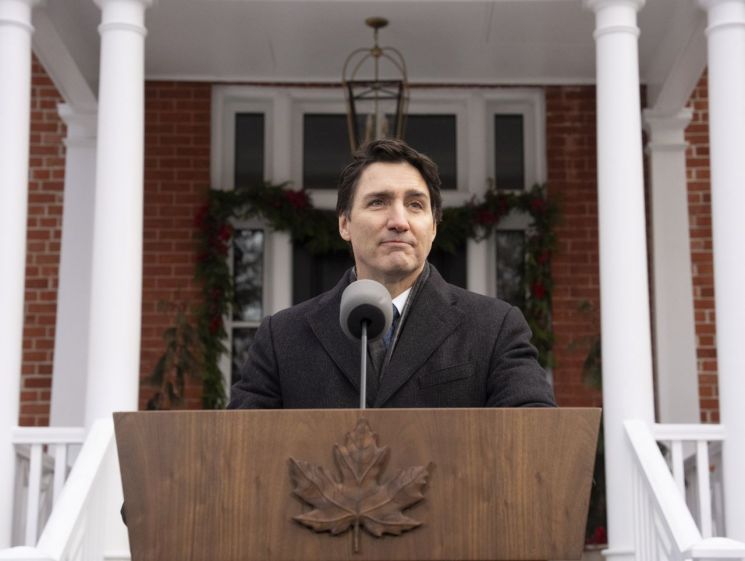
On the same day, Trudeau held a press conference in front of the Prime Minister's residence in Ottawa and stated, "Despite my best efforts, Parliament has been paralyzed for months," adding, "I will step down as party leader and Prime Minister after the party (the ruling Liberal Party) elects a new leader." He said, "This country deserves to choose a real option in the next election," and "If there must be internal fighting, it has become clear that I cannot be the best choice in the next election."
Along with this, Trudeau also declared a parliamentary recess until March 24. Originally, the Canadian House of Commons was scheduled to resume sessions on the 27th, with the opposition planning to push a cabinet no-confidence motion. Trudeau added that he made this decision after much consideration with his family during the year-end holidays.
This resignation announcement was virtually anticipated. Trudeau, who took office in November 2015 at the age of 44, was once known as the "Obama of Canada" and enjoyed high popularity. However, following the pandemic, public dissatisfaction grew due to high inflation, rising housing prices, and immigration issues, causing his approval rating to plummet to a regime-collapse level of around 17%. This is less than half of the main opposition Conservative Party's 47%. According to a poll released last month by Ipsos, 73% of Canadians believe Trudeau should step down as party leader. This sentiment was shared by 43% of Liberal Party supporters as well.
In particular, Trump's return to the White House has further intensified the pressure on Trudeau to resign. In the same survey, only 14% of Canadians believed Trudeau was the most suitable to respond to President-elect Trump. Earlier, Trump had threatened to impose a 25% tariff on all Canadian products from day one of his inauguration if Canada did not resolve border issues and trade imbalances. In response, Trudeau rushed to Mar-a-Lago, Trump's Florida residence, but at a dinner, he was mocked with remarks like "Become the 51st state of the United States."
Moreover, last month, the sudden resignation of former Deputy Prime Minister and Finance Minister Chrystia Freeland, who had clashed with Trudeau over issues such as the "Trump tariffs," dealt a fatal blow to Trudeau's leadership. The New Democratic Party (NDP), a coalition partner, promptly announced plans to submit a no-confidence motion against the government. About 20 members within the ruling Liberal Party have signed a letter calling for Trudeau's resignation.
Trudeau's resignation announcement is expected to increase uncertainty in Canadian politics for the time being. Canadian law mandates elections by October, but an early general election is highly likely. The Guardian reported, "A fierce political battle over the Prime Minister's position will ensue," adding, "Trudeau's resignation decision came amid growing political unease in Canada ahead of Trump's re-election." The Wall Street Journal (WSJ) also assessed that "With Trump's return, Canada will face a more uncertain economic future."
Locally, potential successors to Trudeau include former Deputy Prime Minister Chrystia Freeland, former Bank of Canada Governor Mark Carney, Finance Minister Dominic LeBlanc, and Foreign Minister M?lanie Joly.
Meanwhile, President-elect Trump commented on Trudeau's resignation announcement, saying, "Many people in Canada would love to become the 51st state (of the U.S.)." In a post on Truth Social, he claimed, "The U.S. cannot bear the massive trade deficits and subsidies Canada needs to survive," adding, "Trudeau realized this and resigned." He also wrote that if Canada were annexed by the U.S., it would be safe from threats posed by Russian and Chinese ships, concluding, "Together, what a great nation we would be."
© The Asia Business Daily(www.asiae.co.kr). All rights reserved.

















