"Support for Discount Sales and Extension of Allocated Tariff Application Period"
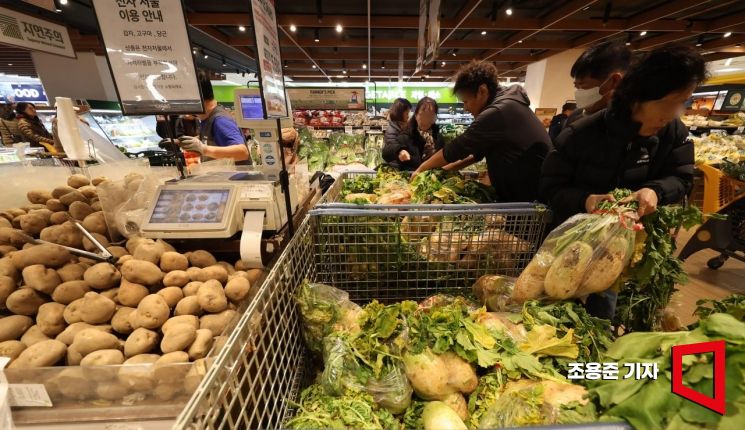
Song Miryeong, Minister of Agriculture, Food and Rural Affairs, announced on the 6th, "The government will thoroughly manage the market to ensure there is no shortage of supply by importing napa cabbage and radish and expanding the cultivation area for spring crops."
Minister Song stated, "If illegal distribution activities such as hoarding and price collusion due to rising agricultural product prices are detected, they will be severely punished."
As the prices of napa cabbage and radish have been rising due to poor crop conditions during the winter, signs of distribution volume control are emerging, such as increased storage demand from distributors and kimchi manufacturers expecting further price increases in production areas.
Accordingly, Minister Song visited the vegetable shipment control facility of Seoadong Nonghyup in Andong City, Gyeongbuk Province, on the same day to inspect the condition of stored napa cabbage and directly observe the market shipment situation.
Minister Song requested, "There is a tendency among distributors in production areas and kimchi manufacturers to increase stored quantities and reduce market supply due to expectations of further price increases. This could lead to a price crash caused by oversupply of napa cabbage and radish in spring, so distributors in production areas should actively ship their stock to the market, and kimchi manufacturers should refrain from excessive storage of processed products."
According to the Korea Agro-Fisheries & Food Trade Corporation (aT), the average retail price of napa cabbage on this day was 5,211 won per head, up 64.8% and 38.8% compared to one year ago and the average year, respectively. The average year price is the three-year average excluding the highest and lowest prices from 2020 to last year. Radish was priced at 3,330 won each, 84.3% more expensive than a year ago and 58.7% higher than the average year.
The Korea Rural Economic Institute forecasted that the cultivation area for spring napa cabbage this year will increase by 4.7% compared to last year and 2.5% compared to the average year. The spring radish cultivation area is also expected to increase by 6.3% and 2.9% compared to last year and the average year, respectively. If the cultivation area expands while there is a large amount of stored stock, there is a risk of a sharp price drop.
An official from the Ministry of Agriculture, Food and Rural Affairs said, "The government and related agencies will continue to implement supply and demand measures," and added, "The supply shortage of napa cabbage and radish is not expected to last long."
To reduce the burden on consumers, the government decided to support up to 40% discount sales of napa cabbage and radish at marts and traditional markets until the 29th of this month. Additionally, the government will release more than 200 tons daily of 10,550 tons of napa cabbage and radish from available government stocks at Garak Market, and plans to expand supply of contract cultivation quantities through Nonghyup.
The import tariff quota period for radish has been extended until next month, and the period for the napa cabbage import tariff quota, which ended last month, will also be extended further.
© The Asia Business Daily(www.asiae.co.kr). All rights reserved.
![Clutching a Stolen Dior Bag, Saying "I Hate Being Poor but Real"... The Grotesque Con of a "Human Knockoff" [Slate]](https://cwcontent.asiae.co.kr/asiaresize/183/2026021902243444107_1771435474.jpg)
















