Enabling Inference and Decision-Making
Market Size Expected to Expand to 55 Trillion Won in 10 Years
Need to Solve the Problem of Insufficient Training Data
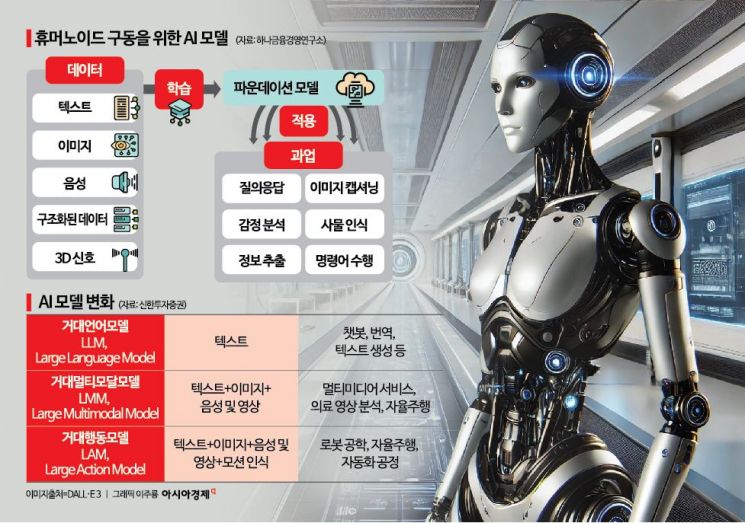
Large Action Models (LAM) are gaining attention as a way to accelerate humanoid artificial intelligence (AI). Learning and recognizing movements beyond text and images has become the key to humanoid development. If robots that think like humans and perform physical actions emerge, they are expected to be applied in various fields such as robotics, autonomous driving, and automated processes.
LAM is an AI model that learns human behavior patterns to enable robots to perform independent actions. Through LAM, humanoids can learn human movements and carry out tasks autonomously. LAM, which corresponds to the brain in humanoid development, is considered the most urgent research task.
LAM is a core element among the brain’s various functions that enables learning, reasoning, and decision-making like humans. Robots move hardware in the most efficient way. When given a command like "Pick up the cup and move it to the side," the robot plans the most efficient way to extend its robotic arm to the cup, grasp it with its fingers, and move it. This process is called "path planning." LAM fundamentally improves path planning and can build multiple methods for a single command. As a result, it makes the best decisions in response to variables, evolving to make different decisions for the same task like a human.
LAM is being led by global big tech companies. Tesla has solidified its position as a leader in LAM based on achievements in Full Self-Driving (FSD) and other areas. This is expected to enable the commercialization of robots that demonstrate natural human-like movements. Tesla’s second-generation Optimus is skilled at picking up fragile eggs with its fingers and performing squats by bending its knees at 90 degrees. It can also climb slopes covered with dirt. Even if it slips and staggers, it quickly regains balance and continues walking.
Google has open-sourced its robot AI model, and if research institutions worldwide utilize it, the accumulation of robot-related data is expected to accelerate. NVIDIA has identified the next phase after the generative AI boom as "Physical AI" and has released the AI platform "GROOT" for humanoid development.
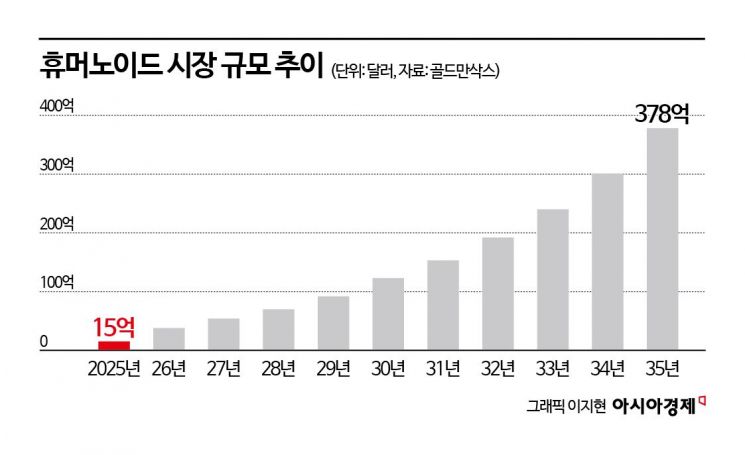
The market size for humanoids trained with LAM is expected to grow. Goldman Sachs analyzed that the humanoid market could increase from $1.5 billion (approximately 2.2 trillion KRW) this year to $37.8 billion (approximately 55.5 trillion KRW) by 2035. This is because humanoids that have learned behaviors can be used in various fields including manufacturing.
The Hana Financial Research Institute stated, "The supply structure based on cheap labor is becoming difficult," and added, "Companies are exploring manufacturing automation using robots to respond to labor shortages, intensified supply chain uncertainties, and increased demand for on-demand products due to personalized consumers."
Professor Seong-Yeop Lee of Korea University’s Graduate School of Technology Management said, "Significant changes may first appear in B2B (business-to-business) markets such as industrial sites and delivery."
However, there are many challenges to overcome, such as the lack of robot AI training data, to create AI models suitable for humanoids. Unlike existing LLMs and LMMs, AI models for humanoids require physical learning data that reflects the real world, including human behavior.
An industry insider said, "In the case of LAM, behavioral data must be trained, but unlike text data, the data itself is almost non-existent, so there could be more severe data shortage issues than when developing LLMs."
Researcher Seung-Yoon Yang of Eugene Investment & Securities emphasized, "Capital inflow into the domestic robot industry is less than overseas. We should not only look at timelines of one year or ten years but move with a long-term perspective."
© The Asia Business Daily(www.asiae.co.kr). All rights reserved.
![Clutching a Stolen Dior Bag, Saying "I Hate Being Poor but Real"... The Grotesque Con of a "Human Knockoff" [Slate]](https://cwcontent.asiae.co.kr/asiaresize/183/2026021902243444107_1771435474.jpg)

















