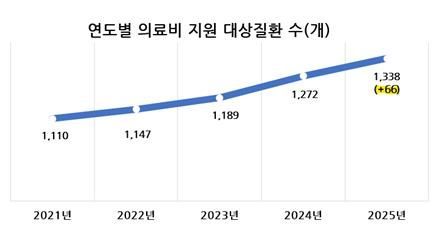
This Year’s Eligible Diseases Increased from 1,272 to 1,338
Income Criteria Changed from Adult Median Income 120% & Child 130% or Less to a Uniform 140%
The scope of medical expense support projects for nationally managed rare diseases and severe intractable diseases will be expanded, and the income criteria for patient households will be relaxed.
On the 6th, the Korea Disease Control and Prevention Agency announced that in 2025, the 'Medical Expense Support Project for Rare Disease Patients' will enhance the guarantee of medical expense support and application convenience for patients and their families by expanding the target diseases, relaxing the income criteria for patient households, and improving the application methods.
The Medical Expense Support Project for Rare Disease Patients is a program that supports out-of-pocket expenses for low-income health insurance subscribers who meet income and property criteria among registered rare disease patients with special calculation exceptions, in order to alleviate the excessive medical expense burden on rare disease patients and their families.
First, this year, the target diseases of the Medical Expense Support Project for Rare Disease Patients will be expanded from the existing 1,272 to 1,338 with an addition of 66 diseases. The support criteria for medical expenses for rare disease patients, which previously differed between adults (below 120% of the standard median income) and children (below 130% of the standard median income), will now uniformly support medical expenses for rare disease patients and their families if their income is below 140% of the standard median income, regardless of age. Patients with the relevant diseases who meet the income criteria will be able to receive treatment without any out-of-pocket payment for covered medical services.
Additionally, while previously only medical certificates specifying the disease name as the primary diagnosis were accepted for medical expense support applications, from now on, support will be available based on the final diagnosis name regardless of whether it is a primary or secondary diagnosis. Furthermore, written applications, which were previously only possible by visiting a branch of the National Health Insurance Service, will be expanded to include mail and fax submissions, enhancing convenience for rare disease patients and their caregivers.
Ji Young-mi, Director of the Korea Disease Control and Prevention Agency, stated, "We expect that the expansion of medical expense support for rare disease patients will provide practical help to patients and their families." She added, "We will continue to discover and designate nationally managed rare diseases, link support systems, and strive to create a better treatment environment."
© The Asia Business Daily(www.asiae.co.kr). All rights reserved.
![Clutching a Stolen Dior Bag, Saying "I Hate Being Poor but Real"... The Grotesque Con of a "Human Knockoff" [Slate]](https://cwcontent.asiae.co.kr/asiaresize/183/2026021902243444107_1771435474.jpg)
















