Final runoff voting on the 7th-8th, results announced on the evening of the 8th
Both are hardliners... government opposition expected to intensify
Kim Taek-woo backed by support from the Korean Intern Resident Association
Joo Soo-ho has strengths in broad connections and media response skills
The next president of the Korean Medical Association (KMA) will be decided on the 8th after a runoff vote. In the election held from the 2nd to the 4th, Kim Taek-woo, chairman of the National Council of City and Provincial Medical Associations, and Joo Soo-ho, representative of the Future Medical Forum (in ballot order), who ranked first and second in the vote share, will face off in the runoff. Both are classified as hardliners against the government regarding the medical crisis.
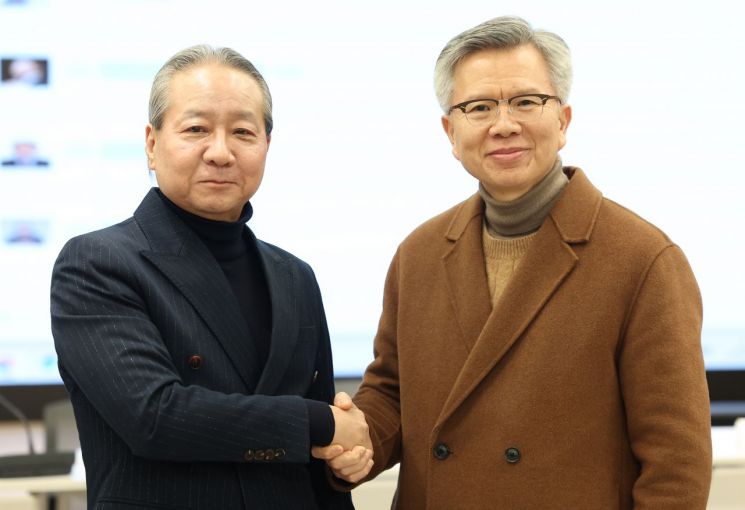 On the afternoon of the 4th, after counting the votes for the 43rd president election of the Korean Medical Association at the Korean Medical Association in Yongsan-gu, Seoul, Kim Taek-woo, president of the National Association of Metropolitan and Provincial Medical Associations (right), and Joo Soo-ho, representative of the Future Medical Forum and former president of the Korean Medical Association, are shaking hands. Photo by Yonhap News
According to the KMA Central Election Commission on the 6th, the results of the vote counting for the "43rd Korean Medical Association President By-election," conducted from the 2nd to the 4th among KMA members eligible to vote (51,895 people), showed that candidates Kim Taek-woo and Joo Soo-ho advanced to the runoff vote. Out of 29,295 voters (56.45%) who participated, Kim secured 27.66% (8,103 votes), placing first, and Joo came in second with 26.17% (7,666 votes).
Since no candidate received a majority in the first round, the runoff vote will be held electronically from the 7th to the 8th. The winner will serve as president from the moment of confirmation until April 30, 2027.
Candidate Kim graduated from Gyeongsang National University College of Medicine and is a surgical specialist. After the resignation of the executive led by former KMA president Lee Pil-soo in February last year, he served as the chairman of the Emergency Committee to Block Medical School Expansion. Next month, he was also suspended from medical practice for three months on charges of instigating collective action by residents. In 2021, he acted as chairman of the KMA Emergency Committee to Block the Nursing Act. He currently serves as the chairman of the Gangwon Provincial Medical Association and the chairman of the National Council of 16 Metropolitan and Provincial Medical Associations.
Since immediately after the first vote, he has been urging the government to halt its medical reform efforts. Kim said right after the vote counting, "I earnestly request the government to temporarily suspend the second phase of the ongoing medical reform plan," adding, "Since the president is currently absent, it is appropriate to temporarily suspend all policies that the president had been pursuing."
He added, "If elected, I will lead the KMA to normalize healthcare, education, and the association itself, as promised."
Candidate Joo graduated from Yonsei University College of Medicine and is also a surgical specialist. During the 2000 medical separation crisis, he entered the KMA leadership as the spokesperson for the Medical Rights Acquisition Struggle Committee (Uijeongtu), a government opposition organization. Later, in 2007, he was elected as the 35th KMA president and was credited with stabilizing the then-divided executive branch in a short period. In March, while serving as the media publicity chairman of the KMA Emergency Committee, he became the first KMA executive to be summoned by the police on charges including instigating resident resignations.
Joo also emphasized medical student education issues and future reductions in medical school quotas immediately after the vote counting. He stressed, "Since the class of 2024 has already graduated and the recruitment of new students for the 2025 academic year is underway, the most important issue is how to handle medical student education starting from the new semester in March next year."
He added, "It is appropriate to stop recruiting new medical students for the 2026 academic year and allow existing medical students to attend classes normally in 2025 and 2026 in two phases," and said, "The approximately 1,500 students added in 2025 should be reduced by 500 students annually over three years in 2027, 2028, and 2029, or by 300 students annually over five years to reach zero base. This is the only way to resolve the current situation."
With only hardline candidates remaining, the medical community is expected to vote for those who show strength in government opposition and related struggles. Resident A, who resigned from a training hospital in Seoul, said, "The key issue seems to be the negotiation power against the government and how much support they can provide to residents and medical students." Another resigned resident B said, "I consider problem-solving ability and determination regarding the current situation as the most important."
Resident C, who resigned from a training hospital in Gyeonggi Province, said, "It is important whether the candidate has a firm ideology about medical issues and can implement it," adding, "Most of those who recently held the presidency seem to have used the KMA presidency as a stepping stone to enter politics. This time, I think the evaluation will focus on practical problem-solving ability."
Opinions on the strengths of candidates Kim and Joo were divided. Kim is supported by the Korean Intern Resident Association (Daejeonhyeop), while Joo's strengths lie in his broad network and media response skills.
Specialist D, working at a hospital in Seoul, explained, "Kim is expected to cooperate smoothly with the Daejeonhyeop emergency committee and has stable administrative skills without exposing weaknesses, while Joo has a strong network in the medical community and excellent media response skills." He added, "Park Dan, chairman of the Daejeonhyeop emergency committee, who openly supports Kim, publicly criticized the other four candidates during the election period, so supporters of the eliminated candidates may vote for Joo in the runoff due to emotional reasons."
A also said, "Resigned residents and medical students generally seem to support Kim, while their senior generation tends to support Joo."
Meanwhile, the other three candidates who did not advance to the runoff are indirectly expressing their intentions. After the vote counting, candidate Kang Hee-kyung changed her profile picture on her personal SNS (social networking service) account to photos of the other four candidates except Kim Taek-woo. According to the medical community, candidate Lee Dong-wook's camp is also reportedly showing support for a specific candidate after elimination. According to KMA regulations, candidates who ran for president are prohibited from endorsing any candidate until the runoff vote.
© The Asia Business Daily(www.asiae.co.kr). All rights reserved.

















