UNIST Professors Min Dooyoung, Kwon Taehyuk, and Min Seungkyu Team Identify Blue Light Protein Damage Pathway That Evades Antioxidant System
The process by which blue light damages cellular proteins by evading the antioxidant system has been revealed.
A research team led by Professors Min Doo-young, Kwon Tae-hyuk, and Min Seung-gyu from the Department of Chemistry at UNIST (President Park Jong-rae) identified a new pathway through which cellular proteins are damaged by blue light.
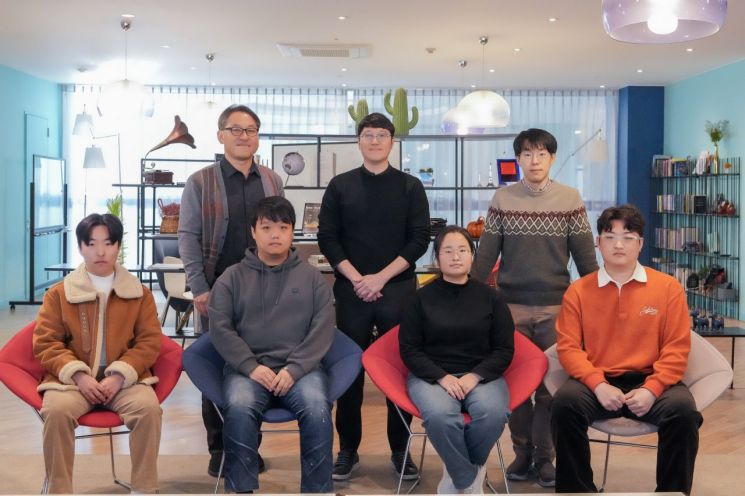 Research team, (from top left clockwise) Professors Taehyuk Kwon, Dooyoung Min, Seungkyu Min, Mingyu Park, Seoyoon Kim, Eojin Kim, and researcher Sungho Kim. Provided by UNIST
Blue light is emitted from sunlight, LED-based display devices, and indoor lighting. As a high-energy visible light, it cannot be effectively blocked by common ultraviolet blockers and has the characteristic of passing through the cornea and lens of the eye to reach the retina.
Once blue light reaches the body, it is known to cause oxidative damage to cellular proteins, potentially harming skin and eye health. Oxygen dissolved in the body absorbs blue light and transforms into highly reactive reactive oxygen species (ROS), which then roam between cellular proteins, oxidatively damaging their surfaces. The intracellular antioxidant system can neutralize these reactive oxygen species to reduce protein damage.
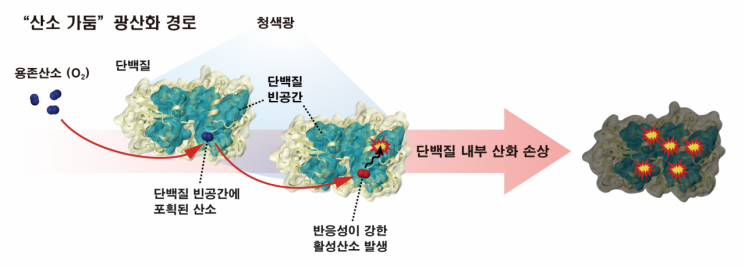
However, the protein damage pathway discovered by the research team occurs inside the protein where the antioxidant system cannot reach. Oxygen trapped inside the protein interacts with specific amino acids, absorbs the energy of blue light, and is converted into reactive oxygen species. These generated reactive oxygen species move within the protein and ultimately cause protein damage.
The research team discovered this pathway by focusing on the structure of proteins. Proteins have a complexly folded amino acid chain structure with countless spaces in between, which can trap small molecules. Using various experiments, calculations, and statistical and bioinformatics approaches, they verified this from multiple angles and named this protein damage pathway the “oxygen-confined photooxidation pathway.”
Professor Min Doo-young stated, “We discovered a fundamentally completely different new protein damage pathway from the conventional ones and confirmed that it can universally affect proteins throughout the cell.”
He added, “The newly discovered protein damage pathway may be a hidden principle behind aging and disease induction in skin and eye tissues caused by blue light.”
The research results were published on the 30th of last month in the international journal Nature Communications. The research was conducted with support from the National Research Foundation of Korea and Ulsan National Institute of Science and Technology.
© The Asia Business Daily(www.asiae.co.kr). All rights reserved.


















