Last Year’s Public Exports Totaled $133.026 Billion
Exports to the US Reached $127.791 Billion
Impact of Changes in Korea-China Division of Labor and US-Centered Supply Chain Restructuring
"In the Trump 2.0 Era, Need to Increase Mutually Complementary Trade with the US"
Last year, the gap between South Korea's exports to China and the United States recorded its smallest level in 21 years since 2003. China has maintained its position as South Korea's largest export market over the past 21 years, following its accession to the World Trade Organization (WTO) in 2001 and the implementation of the Korea-China Free Trade Agreement (FTA) in 2015. However, due to sluggish domestic demand in China and strengthened self-reliance in intermediate goods, the Korea-China supply chain division of labor system has been shaken, leading to a decline in exports to China. Meanwhile, exports and investments to the U.S. have simultaneously increased amid U.S.-China tensions and the global supply chain restructuring.
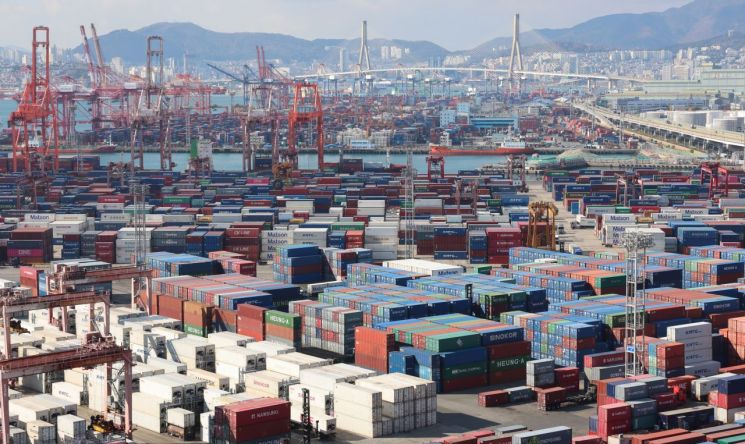
According to the Korea International Trade Association on the 6th, exports to China last year rose by 6.6% compared to 2023, reaching $133.026 billion, ranking first among the top 10 regions. Exports to the U.S. increased by 10.45% to $127.791 billion, placing second after China. Exports to the U.S. set new records for seven consecutive years up to last year and maintained positive growth for eight consecutive years. As a result, the export gap between China and the U.S. was recorded at $5.235 billion, the narrowest since 2003 ($891 million).
The export gap between China and the U.S. was $891 million in 2003 when exports to China first surpassed those to the U.S., and it steadily widened to a record high of $89.45 billion in 2018. In 2018, exports to China amounted to $162.125 billion, more than twice the $72.72 billion exported to the U.S. Since then, the export gap between China and the U.S. sharply narrowed to $62.859 billion in 2019, $58.449 billion in 2020, $67.011 billion in 2021, $46.023 billion in 2022, and $9.122 billion in 2023.
This reflects a decrease in exports to China and an increase in exports to the U.S. Monthly export figures last year for China and the U.S. fluctuated around $10 billion, suggesting a possible shift in trade rankings between China and the U.S. Exports to China peaked at $162.9 billion in 2021 but then declined to $155.7 billion in 2022, $124.8 billion in 2023, and $133.0 billion in 2024. This change is due to sluggish domestic demand in China and increased self-sufficiency in intermediate goods, altering the Korea-China trade structure.
Historically, South Korea exported intermediate goods such as parts and materials to China, which then manufactured finished products for the global market, allowing South Korea to share in China's economic growth benefits. In fact, exports to China first exceeded $100 billion in 2010, ten years after China joined the WTO, and peaked in 2021 following the implementation of the Korea-China FTA in 2015, before starting to decline.
Conversely, exports to the U.S. have shown an increasing trend. Notable growth was seen in major export items such as automobiles (+8.2%), semiconductors (+122.8%), general machinery (+3.6%), and computers (+196.8%). Domestic conglomerates like Samsung, SK, Hyundai Motor, and LG have expanded investments in advanced industries such as semiconductors, secondary batteries, and electric vehicles in the U.S., driving increased exports of related machinery and intermediate goods. The expansion of AI server investments by U.S. big tech companies has also contributed to semiconductor export growth.
Jang Sang-sik, Director of the International Trade and Commerce Research Institute at the Korea International Trade Association, said, "The U.S., with its large consumer market, has diversified export items including IT, machinery, and petrochemicals, driven by increased consumer goods and infrastructure investments. With growing local investments, exports of related intermediate goods have increased, resulting in a more stable export structure."
In the era of Trump 2.0, if U.S.-China tensions intensify and the U.S.-centered supply chain restructuring accelerates, expanding exports to China will become even more challenging.
Director Jang advised, "Considering future U.S.-China conflicts and China's moves to strengthen self-reliance, it will be difficult to sustain the growth of exports to China. Based on the Korea-U.S. alliance, we need to increase mutually complementary trade with the U.S. during the second Trump administration by strengthening the division of labor in advanced industries and supply chains."
© The Asia Business Daily(www.asiae.co.kr). All rights reserved.

















