The U.S. Republican Party is increasingly likely to bundle key campaign promises of President-elect Donald Trump, such as tax cuts and blocking illegal immigration, into a single bill to pass it through Congress at once, local media including the Wall Street Journal (WSJ) reported on the 5th (local time). This is analyzed as a judgment that it should be handled in a 'one-shot' manner early in the term when there is sufficient momentum.
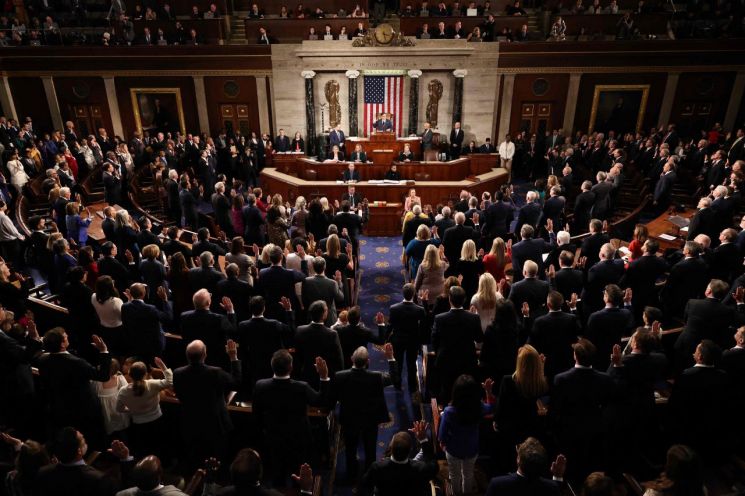
According to sources, Mike Johnson, a Republican Speaker of the House, stated at a meeting with Republican House members discussing congressional strategy the day before that Trump wants "one big, beautiful bill." In an interview with Fox News that day, he also confirmed that this single bill would include ▲budget necessary for large-scale deportation of illegal immigrants and border security ▲extension of Trump tax cuts ▲raising or abolishing the debt ceiling ▲reduction of federal government regulations ▲dismantling of the Deep State (entrenched bureaucratic groups within the federal government).
Initially, Republican leadership including Senate Majority Whip John Thune had focused on prioritizing border security issues such as blocking illegal immigration among Trump’s campaign promises and planned to pursue other promises through separate bills in stages. The logic was to first handle border security early in the term to secure definite results and postpone complex tax and debt ceiling issues to later. Senator Lindsey Graham, chairman of the Senate Budget Committee, reiterated this existing stance on Fox News that day, emphasizing that border security should be addressed first rather than combining heterogeneous issues into one bill.
However, the Republican Party cannot ignore the fact that the tax cuts enacted during Trump’s first term in 2017 will expire at the end of this year. Jason Smith, chairman of the House Ways and Means Committee, has argued that if tax cuts are handled as a separate bill, there is a risk it might never pass later, so it should be bundled and processed early in the term. Given that the Republicans currently hold a slim majority in the House, the explanation is that tax cuts should be extended early in the term when political momentum is sufficient.
The WSJ reported, "The tax cuts are set to expire at the end of this year. If Congress does nothing, taxes will increase for 62% of households," adding, "The Republican Party cannot accept that outcome." Some within the party also express concerns that uncertainty surrounding the tax cuts could slow corporate investment. A source explained that Trump has started to put more weight on a single bill since mid-last month, intending to maintain unity within the entire Republican Party and emphasize the importance of tax cuts through this approach.
The Republican Party plans to use the budget reconciliation procedure whether it is a single bill or separate bills. In this case, the Democrats in the Senate cannot use a filibuster (unlimited debate), allowing the Republicans to pass the bill with just their majority seats. The current Senate composition is 53 Republicans and 47 Democrats. In the House, if two members preparing to join the Trump administration resign, the composition is expected to be temporarily 217 Republicans and 215 Democrats until special elections are held.
The WSJ emphasized the importance by stating, "From afar, the debate over whether it is one bill or two may seem like a complicated legislative semantic issue," but "that choice will determine the atmosphere and schedule of the busy first year of the term." It also predicted, "The single bill approach is an attempt to unify heterogeneous factions within the Republican Party," and "delicate negotiations over several months may be necessary to find a policy balance that satisfies most."
© The Asia Business Daily(www.asiae.co.kr). All rights reserved.
![Clutching a Stolen Dior Bag, Saying "I Hate Being Poor but Real"... The Grotesque Con of a "Human Knockoff" [Slate]](https://cwcontent.asiae.co.kr/asiaresize/183/2026021902243444107_1771435474.jpg)
















