US Health Authorities Recommend Attaching 'Carcinogen' Warning Labels on Alcoholic Beverages
A call has been made to legally mandate warning labels on alcoholic beverages stating that "alcohol causes cancer." On the 4th, Yonhap News reported that Vivek Murthy, the U.S. Surgeon General (SG) and head of the Public Health Service Commissioned Corps (PHSCC), urged for alcohol-related warning labels. This follows findings that alcohol consumption increases the risk of at least seven types of cancer, including breast, colon, and liver cancer. Contrary to past beliefs, research has solidified in the medical community that even less than one drink per day can cause cancer.
 There has been a call in the United States to legally mandate warning labels on alcoholic beverages stating that "Alcohol causes cancer." (This photo is not directly related to the article.) Pixabay
In a statement released alongside a report, Vivek Murthy, U.S. Surgeon General (SG) and head of the Public Health Service Commissioned Corps (PHSCC), explained, "Alcohol consumption ranks third among preventable causes of cancer in the United States, following tobacco and obesity." In the U.S. alone, there are 100,000 cancer cases annually attributed to alcohol consumption, with 20,000 deaths each year. Additionally, alcohol-related traffic accident fatalities exceed 13,500 annually.
When all other conditions are equal, comparing women who drink two drinks per day to those who abstain, 5 out of 100 women and 3 out of 100 men who drink develop cancer at higher rates.
The New York Times (NYT) reported that for decades, U.S. health authorities' dietary guidelines stated that alcohol consumption of one drink per day for women and two drinks per day for men was not harmful to health. However, as medical consensus has shifted, it is highly likely that the guidelines scheduled for revision in 2025 will be updated accordingly.
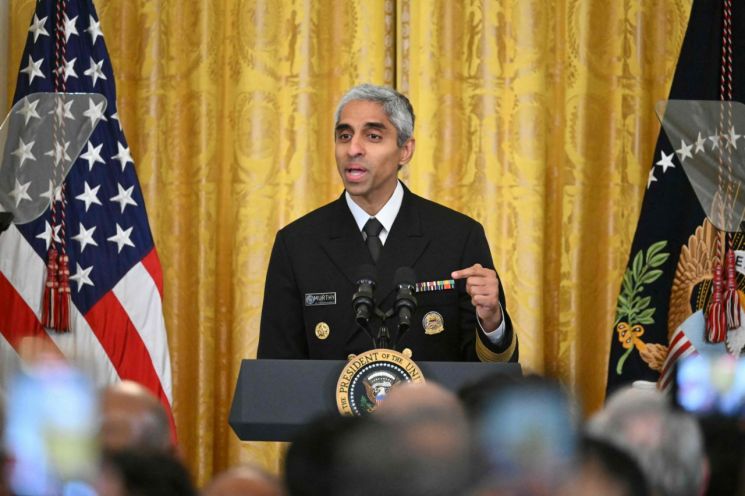 Vivek Murthy, U.S. Secretary of Health and Human Services, is giving a speech in the East Room of the White House in Washington, DC, on October 28 last year (local time). Photo by AFP Yonhap News
Previously, tobacco underwent a similar process. The U.S. Surgeon General's office released a report in 1964 stating that tobacco causes cancer, and the following year, legislation was enacted mandating warning labels on tobacco products.
Since 1988, alcohol warning labels have been mandatory and have been implemented without changes, but they do not mention cancer risks. The labels only warn about risks such as birth defects during pregnancy, impaired judgment when driving or operating machinery, and general health risks.
However, lobbying by the alcohol industry remains a variable. Immediately after Murthy's report was released, stock prices of major European and American alcohol companies fell, with some dropping more than 3%. Moreover, Murthy is expected to step down when the new administration takes office and be replaced by Janette Nesheiwat.
Some speculate that former President Trump, who does not drink alcohol, might be favorable toward related policies. Robert Kennedy Jr., the nominee for Secretary of Health and Human Services, quit drinking decades ago.
© The Asia Business Daily(www.asiae.co.kr). All rights reserved.
![Clutching a Stolen Dior Bag, Saying "I Hate Being Poor but Real"... The Grotesque Con of a "Human Knockoff" [Slate]](https://cwcontent.asiae.co.kr/asiaresize/183/2026021902243444107_1771435474.jpg)

















