Ministry of Land, Infrastructure and Transport: "Need to Split Pilot Sections and Discuss Local Government Funding"
Local Governments: "Difficult for Local Governments to Share Project Costs"
"Project Feasibility Report Covered Long Sections..."
Position That Financial Input Is Difficult Due to Equity Considerations
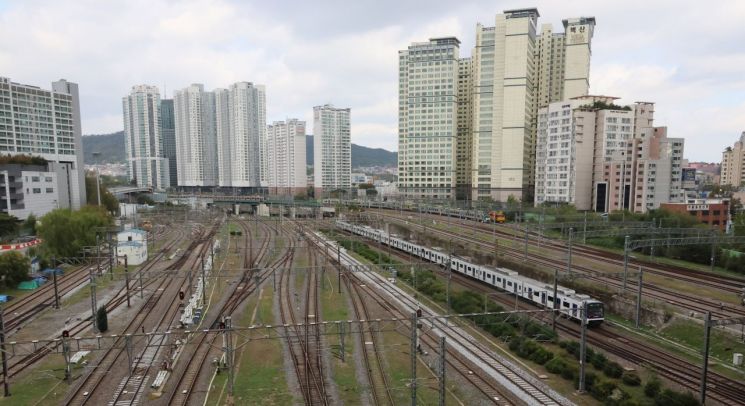
The pioneering project to relocate above-ground railroads underground, like the Gyeongui Line Forest Trail, is currently at a standstill due to cost-sharing issues between the Ministry of Land, Infrastructure and Transport (MOLIT) and local governments. While MOLIT is urging to divide the project sections further and accelerate the pace in line with the project's intent, local governments are resisting, arguing that the government's demand to split sections not originally planned forces them to allocate local budgets as well. Some experts warn that if the tug-of-war between the two sides prolongs, the significance of the pioneering project could diminish.
Government's Sudden 'Section Splitting' Causes Confusion
Local governments such as Seoul City, Incheon City, and Gyeonggi Provincial Government stated on the 6th that the government has started splitting project sections ahead of designating the railroad underground pioneering project, and that the project should proceed without additional local budget input. They explained that since the beginning of the project last year, the sections were defined so that underground relocation could be funded solely by development profits.
An official from Incheon City said, "We proposed project sections based on feasibility studies, but MOLIT insists on further splitting the sections. This lowers feasibility and may make it difficult to secure underground project costs from the development profits above. Ultimately, it seems to imply that local funds must be injected."
A Gyeonggi Provincial Government official also said, "The railroad underground project has been prepared by the government since early last year to be funded by development profits, but since last week, discussions about local government financial burdens have started. If local funds must be used in a project involving trillions of won, it becomes a heavy burden for local governments."
A Seoul City official added, "Since the Gyeongwon Line does not generate as much profit as the Gyeongbu Line from above-ground development, the plan was to proceed with both lines simultaneously to cover the shortfall in the Gyeongwon Line's project costs. The project is feasible only if both proceed together; if done separately, the Gyeongwon Line's feasibility decreases."
The railroad underground project involves relocating railroads underground within urban areas. It is promoted under the 'Railroad Underground Special Act' effective from the 31st. The principle for funding is to use profits gained from developing commercial facilities above the railroad. Additionally, local governments are allowed to subsidize part of the project costs.
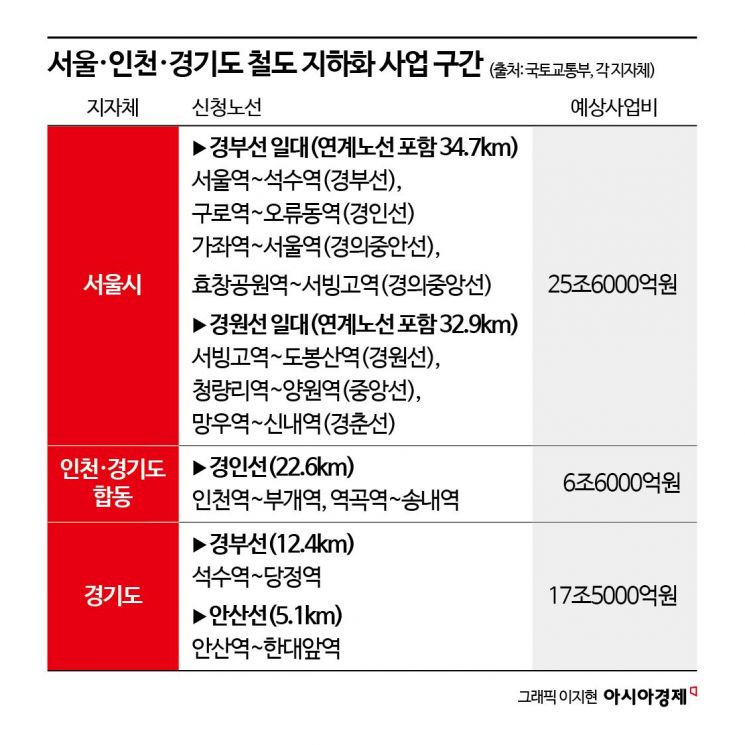
According to MOLIT, Seoul City plans to invest a total of 25.6 trillion won to relocate 34.7 km of the Gyeongbu Line area and 32.9 km of the Gyeongwon Line area underground. Incheon City, jointly with Gyeonggi Provincial Government, will take charge of a 22.6 km section of the Gyeongin Line, with a total project cost of 6.6 trillion won. Gyeonggi Provincial Government will invest 17.5 trillion won to underground 5.1 km of the Ansan Line and 12.4 km of the Gyeongbu Line.
Pioneering Project Means 'Doing It Quickly'... Local Governments Also Need to Share Costs
MOLIT holds the position that only some sections proposed by local governments should be designated as pioneering projects. Given the enormous project costs, it also believes that cost-sharing plans with local governments must be negotiated.
Yoon Jin-hwan, Director of the Railroad Bureau at MOLIT, said, "The purpose of this railroad underground pioneering project is to attempt a project that has never been done before and to apply improvements to the main project. In this context, setting a long project section goes against the purpose of the pioneering project." He added, "Although the underground project is funded by development profits above, we need to verify whether the underground costs can actually be covered by these profits. We should first proceed with some sections that have high feasibility as pioneering projects, and according to the Special Act, local governments should share part of the shortfall."
MOLIT postponed the announcement of the pioneering project from the end of last year to this year, judging that additional consultations with local governments are necessary regarding project section selection and local fund input.
Will MOLIT and Local Governments Narrow Differences Through Consultation?
Each local government plans to continue consultations with MOLIT. A Seoul City official said, "There can be differences in positions between local and central governments. Even if the project sections are split, we will prioritize sections with feasibility and discuss how to handle parts with relatively low feasibility."
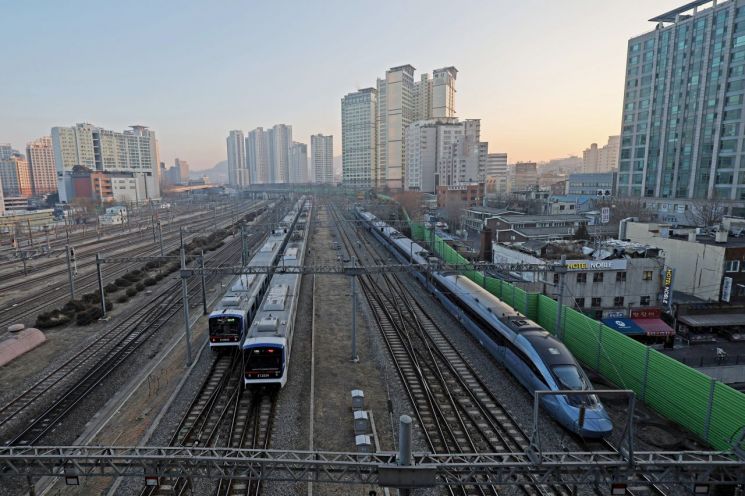
An Incheon City official explained, "We proposed project sections based on feasibility, but if only some sections proceed and project costs fall short, national government support is necessary. Otherwise, it just means using local funds, so we hope this will be considered during consultations." A Gyeonggi Provincial Government official added, "From MOLIT's perspective, the sections are too long and need to be split, but considering feasibility, this was an unavoidable measure, and we will discuss this with MOLIT."
Regarding opinions that local governments should inject finances to cover the shortfall, Director Yoon opposed. He said, "Most local governments promoting railroad underground projects are in the Seoul metropolitan area, which already has sufficient railroad infrastructure. Injecting finances into these projects raises fairness issues when considering regions with insufficient railroad infrastructure."
Meanwhile, MOLIT plans to enact subordinate legislation such as enforcement decrees and rules for the Railroad Underground Special Act this month. Without these subordinate laws, it is difficult to implement the project solely based on the Special Act, so this work is underway based on the project promotion process so far.
© The Asia Business Daily(www.asiae.co.kr). All rights reserved.



















