"No prior notice and other pilots likely unaware"
"Muan Airport always at risk of bird strikes," testimony reveals
Flight instructors and pilots who frequently fly at Jeonnam Muan International Airport testified that they were not aware in advance of the existence of the concrete mound for the localizer (azimuth facility) installed on the runway. In particular, they unanimously described Muan Airport as an airport where the risk of bird strikes is always present. Pilot and flight instructor A, who has used Muan Airport for seven years, told Yonhap News on the 2nd, "Over the years of takeoffs and landings, I only visually confirmed the mound from the air and naturally thought it was a dirt pile; I never imagined it was made of concrete."
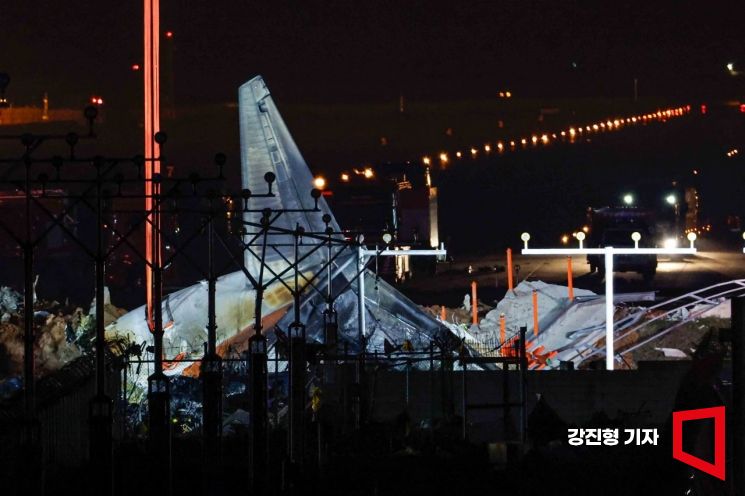 On the 29th, a Jeju Air passenger plane carrying 181 passengers collided with the outer wall of the runway while landing at Muan International Airport, causing a fire that resulted in a major disaster with most passengers dead. Firefighters are searching for missing persons among the wreckage of the accident aircraft on the runway at Muan International Airport, Jeonnam. Photo by Kang Jin-hyung
He continued, "The fact that it is a 2-meter-high, 4-meter-thick concrete block is not indicated on airport charts or anywhere else, and since we never received any separate guidance, other pilots were also unaware of it." Regarding bird strikes, which are cited as one of the causes of the recent Jeju Air accident, the pilots said they always paid close attention to flocks of birds through the ATIS (Automatic Terminal Information Service) weather information system and others.
A said, "On average, about once a year, there was damage caused by bird strikes on parts like the wings," adding, "We always check weather conditions via radio frequencies, and recently, Muan Airport has issued daily bird activity advisories, and controllers would notify us if there were birds on the runway." He further explained, "Small birds tend to avoid small aircraft on their own, but large birds like eagles or hawks are not afraid, so pilots have to avoid them themselves. In the case of the accident aircraft, since the plane was large, it would have been much more difficult to cope with bird strikes," he estimated.
"Risk of Bird Flock Collisions Always Present, Airport Busy with Training and Education, Controllers Overwhelmed" Testimony
There was also testimony that the airport was busier than expected due to the influx of domestic flight trainees and students, making controllers quite busy. A said, "Many think Muan Airport is quiet, but in fact, it is extremely busy," adding, "There are very few airports in the country where training is possible, so almost all training institutions conduct flight education here."
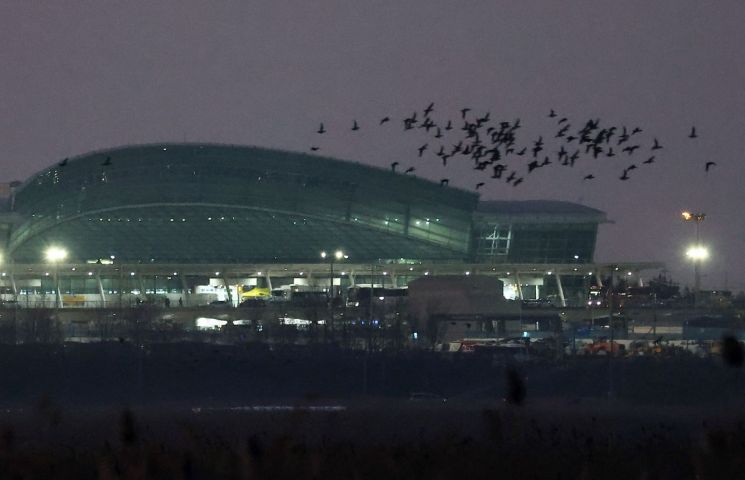 On the afternoon of the 1st, birds are flying near Muan International Airport in Muan-gun, Jeollanam-do. Photo by Yonhap News.
Civilian pilot B, who also uses Muan Airport, said, "Almost all aviation departments of universities such as Jungwon University, Korea National University of Transportation, Chodang University, Kyungwoon University, and Cheongju University use Muan Airport as a flight training ground," adding, "Trainees and pilots are relatively less experienced compared to captains of national carriers, so communication is not smooth. Controllers must have been even busier."
The Jeju Air accident aircraft received a bird strike warning from the control tower at 8:57 a.m. on the 29th of last month, and just two minutes later, at 8:59 a.m., declared a 'Mayday' due to a bird strike during the first landing attempt and tried to go around. During the second landing attempt, the aircraft performed a belly landing but collided with the concrete mound for the azimuth facility installation, causing an explosion and damage. The accident resulted in 179 passengers and others dead and 2 crew members injured.
© The Asia Business Daily(www.asiae.co.kr). All rights reserved.


















