Gyeonggi Province is stepping up crackdowns on the distribution of substandard food products and illegal discharge of wastewater ahead of the Lunar New Year.
The Gyeonggi Province Special Judicial Police announced on the 3rd that from the 6th to the 17th, they will conduct intensive investigations at 360 locations, including food manufacturing and processing businesses and medium to large supermarkets, to proactively block illegal manufacturing and distribution of fraudulent and substandard food products targeting the holiday demand, as well as illegal wastewater discharge occurring during food manufacturing and processing.
The main investigation items include ▲false labeling of origin ▲violation of standards and specifications ▲violation of labeling standards ▲failure to conduct mandatory self-quality inspections ▲storage or use of products past their consumption date ▲failure to report wastewater discharge facilities, among others.
In particular, investigations will cover not only food-related sectors with high demand during the Lunar New Year such as rice cakes, dumplings, tofu, traditional Korean sweets (Hangwa), nuts, and processed fruit and vegetable products, but also environmental wastewater issues such as compliance with reporting the installation of wastewater discharge facilities at food manufacturing and processing businesses and improper operation of water pollution prevention facilities.
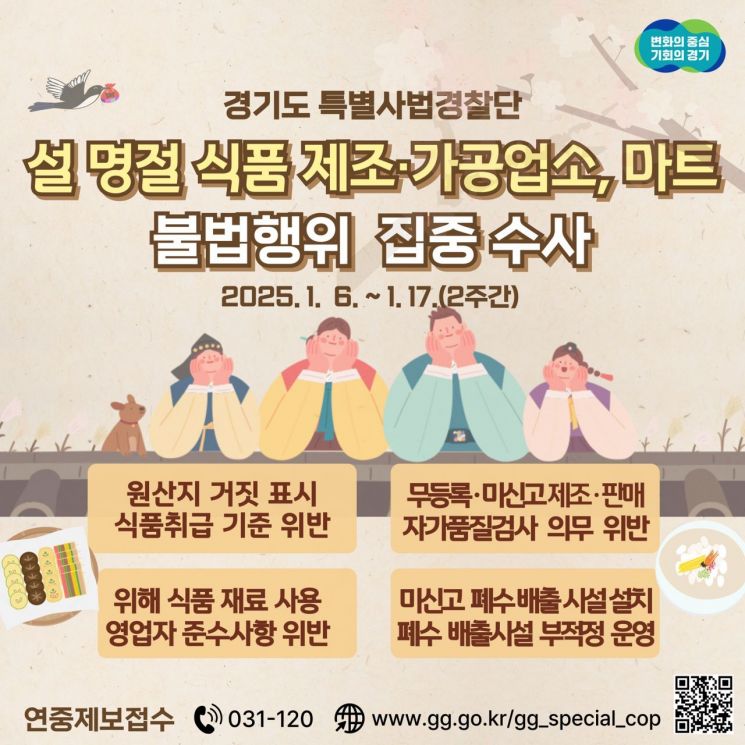 Gyeonggi-do Special Investigation Police Unit will crack down on illegal activities ahead of the Lunar New Year holiday. Photo by Gyeonggi-do
Under the current Food Sanitation Act, storing products past their consumption date or failing to conduct self-quality inspections can result in imprisonment for up to three years or a fine of up to 30 million won. Violations of business operator compliance requirements, such as failure to prepare production/work logs and raw material transaction documents, are also punishable by imprisonment for up to three years or a fine of up to 30 million won.
Additionally, the Origin Labeling Act stipulates imprisonment for up to seven years or a fine of up to 100 million won for false or misleading labeling, while the Water Environment Conservation Act imposes imprisonment for up to five years or a fine of up to 50 million won for failure to report wastewater discharge facilities when required.
Gi Do, head of the Gyeonggi Province Special Judicial Police, emphasized, "We will fundamentally block criminal acts that harm residents through illegal food distribution or illegal wastewater discharge ahead of the Lunar New Year holiday. We will also do our best to create a safe environment by providing guidance documents on legal compliance to prevent violations caused by minor negligence such as lack of awareness or carelessness by business owners."
© The Asia Business Daily(www.asiae.co.kr). All rights reserved.

















