"'Designed to be easily broken' is the upper part of the dune, not the dune itself"
At the time, the client was Korea Airports Corporation, and the project approval was by Busan Regional Aviation Administration
Ministry of Land, Infrastructure and Transport conducts on-site inspections at airports nationwide from the 2nd to the 8th
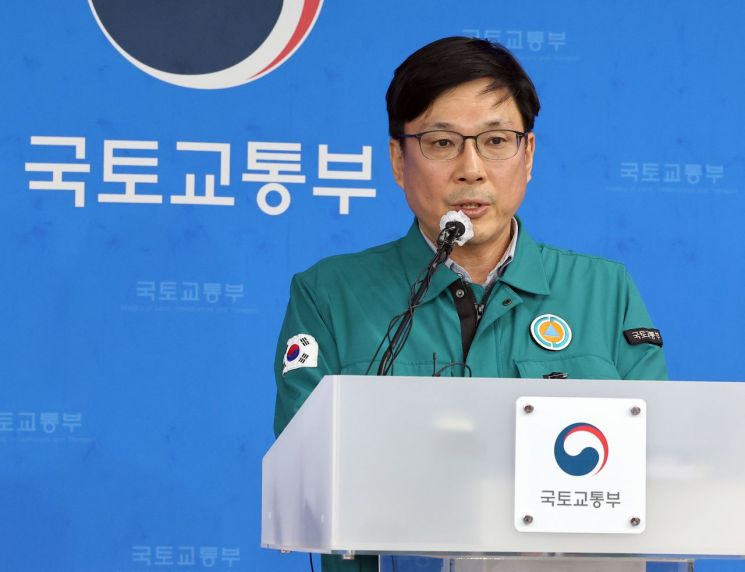 Joo Jong-wan, Director of the Aviation Policy Office at the Ministry of Land, Infrastructure and Transport, is briefing on the passenger plane crash accident at Muan International Airport in Jeonnam at the Government Complex Sejong. Photo by Yonhap News
It has been revealed that the part designed to be 'easily breakable' during the localizer (azimuth facility) improvement project at Jeonnam Muan International Airport was not the concrete embankment but the upper part of the embankment, such as the antenna.
Joo Jong-wan, Director of the Aviation Policy Office at the Ministry of Land, Infrastructure and Transport, said at a briefing on the Muan Airport passenger plane crash held at the Government Sejong Complex on the 2nd, "According to inquiries with the client, during the improvement project, the foundation materials such as rails and antennas on top of the embankment were designed to be easily breakable."
The concrete embankment at Muan Airport is about 2 meters high and has been identified as a cause that increased the scale of damage in the recent passenger plane crash. The crashed passenger plane collided consecutively with the localizer and the outer wall after landing on the fuselage without reducing speed. It was pointed out that the damage to the aircraft was worsened because the concrete embankment was protruding at the time.
In particular, unlike the design in 2020 which used easily breakable materials, the embankment was constructed with concrete, causing controversy. The client for the improvement project was Korea Airports Corporation, and the project approval was carried out by the Busan Regional Aviation Administration. According to the task instruction at the time, it was stated that "when designing instrument landing facilities such as equipment antennas, towers, and foundations, 'easily breakable' should be considered."
Director Joo explained, "The client instructed that visible parts such as antennas on top of the embankment should be made easily breakable."
Additionally, from today until the 8th, the Ministry of Land, Infrastructure and Transport will conduct on-site inspections of navigation safety facilities at airports nationwide. Director Joo said, "Through this inspection, we plan to identify areas where system improvements are needed," and added, "Based on this, we will seek improvement measures through gathering opinions from experts and others in the future."
Meanwhile, regarding the disclosure of the Cockpit Voice Recorder (CVR) contents, which were converted to audio files this morning, the Ministry drew a line, stating, "This is a matter to be discussed with the Accident Investigation Committee." Director Joo said, "The Accident Investigation Committee is legally required to ensure objectivity and fairness in the investigation, so the Ministry of Land, Infrastructure and Transport is not in a position to receive detailed investigation information," and explained, "Important matters such as the transfer of the Flight Data Recorder (FDR) to the U.S. are shared with the Ministry as part of coordination."
© The Asia Business Daily(www.asiae.co.kr). All rights reserved.

















