Ring-shaped object 2.4m in diameter, weighing 499kg
Falls in Kenyan village... "No safety threat"
A massive space debris weighing nearly 500 kg fell in a village in southern Kenya.
On the 1st (local time), foreign media including the US CBS broadcast, citing the Kenya Space Agency (KSA), reported that on the 30th of last month, a metal ring-shaped object about 2.4 meters in diameter and weighing 499 kg fell in Mukuku village, Makueni County. This object is a huge circular shape with densely arranged grooves like gears on the outside and soldering marks connecting parts in between.
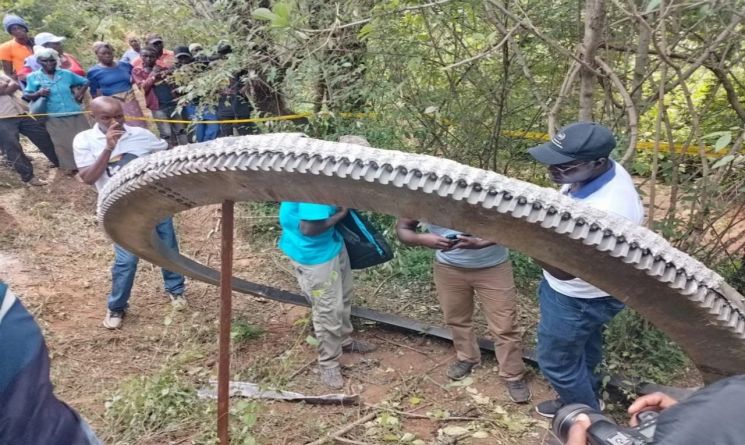 An object suspected to be space debris that crashed in a village in southern Kenya on the 30th of last month (local time). Social media (SNS)
KSA stated that this object is presumed to be a ring separated from a space rocket launch vehicle. They added that the ring appears to have been designed to burn up upon re-entry into the atmosphere or to fall in uninhabited areas. KSA explained, "We are recovering the fallen debris for further investigation," and "However, the fallen object does not pose a threat to public safety."
Accidents involving space debris falling to the ground occur quite frequently around the globe.
In 2022, part of SpaceX's Dragon capsule fell on a sheep farm in southern Australia. Also, in February last year, the Earth observation satellite ERS-2, weighing about 2.3 tons, reached the end of its life and re-entered the atmosphere. The European Space Agency (ESA) was on high alert regarding the crash site, fearing it would not burn up and would fall to the ground.
In March of the same year, an object believed to be space debris fell on a house in Naples, Florida, USA, piercing the ceiling and floor of the home, but fortunately, there were no casualties. The homeowner, Otero, said in an interview with local media, "When that unidentified object hit the ceiling, my son, who was in another room, heard a tremendous impact sound," adding, "At first, I couldn't believe the story, but on the other hand, I thought the object was a meteorite." Otero, who was traveling at the time of the accident, ended the trip early and hurried back home, only to find out that the object was not a meteorite. The object was a cylindrical metal piece weighing less than 1 kg and had an artificial appearance.
After photos of the object were shared on social networking services (SNS), an expert who knew the object's identity came forward. Jonathan McDowell, an astrophysicist at the Harvard-Smithsonian Center for Astrophysics, diagnosed the object as part of the EP-P battery pallet that NASA dropped from the International Space Station in March 2021, three years before the accident. At that time, NASA expected the 2-ton pallet to burn up completely upon entering Earth's atmosphere. However, McDowell shared a capture from a space object tracking site and estimated that "this object likely re-entered over the Gulf of Mexico between Cancun, Mexico, and Cuba." Subsequently, Otero filed a lawsuit against NASA.
Meanwhile, the US Federal Aviation Administration (FAA) warned in a 2023 report that space debris could cause human or property damage once every two years by 2035. Most space debris burns up in the atmosphere upon entering Earth, but some do not disappear and fall to the ground. NASA currently estimates that 95% of objects orbiting Earth are space debris, and the European Space Agency (ESA) estimates the total mass of space debris to be about 11,500 tons.
© The Asia Business Daily(www.asiae.co.kr). All rights reserved.
![Clutching a Stolen Dior Bag, Saying "I Hate Being Poor but Real"... The Grotesque Con of a "Human Knockoff" [Slate]](https://cwcontent.asiae.co.kr/asiaresize/183/2026021902243444107_1771435474.jpg)
















