Professor Kwon Oh-hoon’s Team Develops Micro-sample Temperature Measurement Technology
Improved Thermometer Materials Enable Real-time Video Observation Application
A technology that can simultaneously observe the ultrafine structure and temperature changes of materials in real time has advanced.
It is expected to be used in the development of advanced materials by analyzing the correlation between the unique structure of samples and their thermodynamic properties.
The research team led by Professor Oh-Hoon Kwon of the Department of Chemistry at UNIST (President Jongrae Park) announced on the 2nd that they have developed a versatile 'nano thermometer' capable of precisely measuring the temperature of micro samples inside a transmission electron microscope.
 (From left) Researcher Wonwoo Park (first author), Professor Ohhoon Kwon, Researcher Yejin Choi. Provided by UNIST
The developed nano thermometer measures temperature by analyzing the cathodoluminescence spectrum emitted when nanoparticles acting as thermometers are hit by an electron beam.
The transmission electron microscope uses an electron beam as the light source to observe the microstructure of samples, and this electron beam is also utilized for temperature measurement.
Previously developed nano thermometers could be used alongside real-time (in situ) observation of microstructural changes using transmission electron microscopy, but they required recalibration each time depending on the intensity of the electron beam, which was cumbersome.
In this study, the research team improved the reliability and versatility of the thermometer by changing the nano thermometer material. They chose dysprosium ions (Dy3+) as the cathodoluminescent material.
First author Wonwoo Park explained, “The distribution of quantum states appearing in the cathodoluminescence spectrum of dysprosium ions follows a Boltzmann distribution that depends only on temperature, regardless of the intensity of the electron beam.” The Boltzmann distribution is a statistical distribution that explains the phenomenon where the proportion of high-energy quantum states increases as temperature rises.
The team doped dysprosium ions into yttrium vanadate (YVO4), which can withstand the high energy of the electron beam, and synthesized nano thermometer particles about 150 nm (nanometers, 10^-9 m) in size. When measuring the surrounding temperature by changing it from approximately -170℃ to 50℃ with the developed thermometer, the measurement error was within about 4℃.
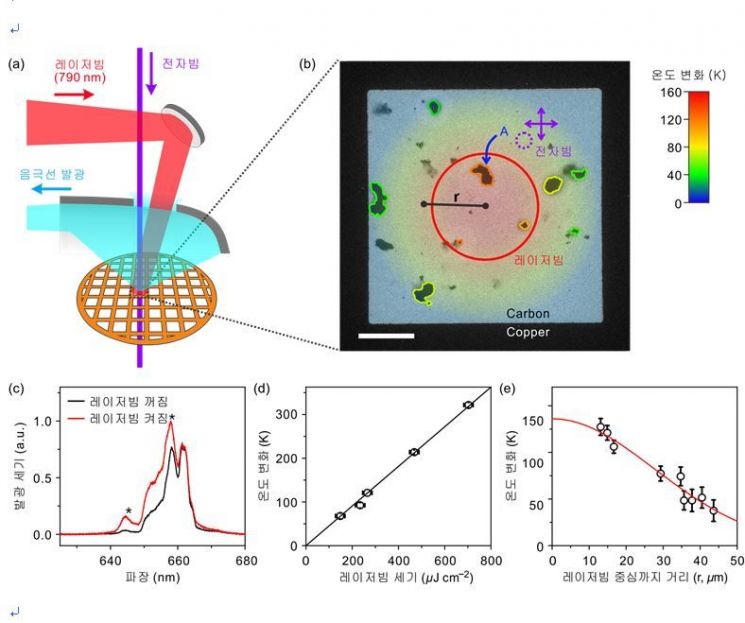
They also succeeded in raising the temperature by irradiating the sample with a laser beam and tracking the spatial distribution of temperature changes. This result proves the validity of the technology that can simultaneously observe temperature and structural changes in real time due to external stimuli.
Professor Oh-Hoon Kwon said, “By newly designing the material of the nano thermometer, we greatly improved the reliability of temperature measurement and secured versatility,” adding, “It will also contribute to the development of secondary battery materials and display materials that are sensitive to temperature changes during charging and discharging.”
This research involved Dr. Pavel K. Olshin as a co-first author, and Yejin Kim, a UNIST graduate who joined the Department of Chemistry at Seoul National University last year, as a co-author.
The research results were published on the 10th of last month in ACS Nano, a prestigious journal in the field of nanotechnology. The research was conducted with support from the Samsung Future Technology Development Program and the National Research Foundation of Korea.
© The Asia Business Daily(www.asiae.co.kr). All rights reserved.


















