Selected Goyang-si, Uijeongbu-si, Dongducheon-si, Pocheon-si, Namyangju-si
Transforming flood control centers into nature- and people-centered waterfront parks
Proactive support as a catalyst for the Great Northern Gyeonggi Renovation
Gyeonggi Province announced on the 2nd that it selected five cities?Goyang (Gongneungcheon), Uijeongbu (Buyongcheon, Jungnangcheon), Dongducheon (Dongducheoncheon), Pocheon (Pocheoncheon), and Namyangju (Saneungcheon)?for the Gyeonggi Northern Low-Carbon Riverside Park Project, which was open for applications from northern cities and counties since September, at the Gyeonggi Provincial Government Northern Office on the 31st.
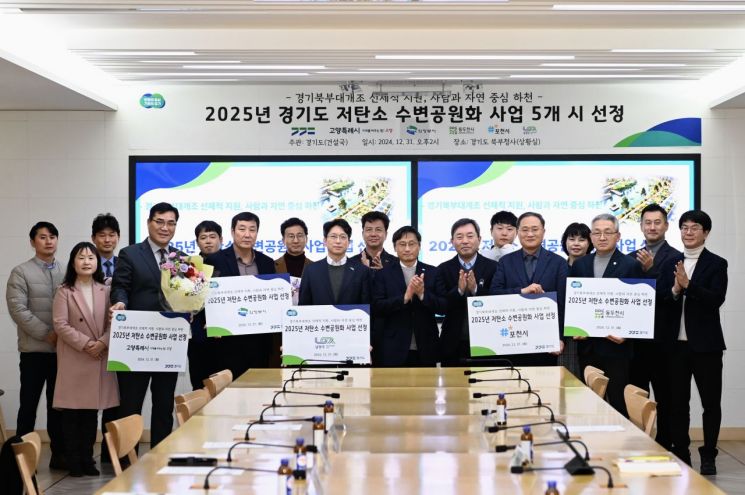 Gyeonggi Province held a commemorative photo session with attendees after selecting five cities and counties for the Low-Carbon Riverside Park Project for Local Rivers in Northern Gyeonggi, which was open for applications from northern cities and counties since September, at the Northern Government Building of Gyeonggi Provincial Office on the 31st. Photo by Gyeonggi Province
The Gyeonggi Northern Low-Carbon Riverside Park Project is part of the Gyeonggi Northern Grand Renovation initiative led by Governor Kim Dong-yeon. Unlike previous river projects focused mainly on disaster prevention, this project centers on people and nature, aiming to create riverside parks where residents can enjoy the rivers in their daily lives.
Goyang City, which was finally selected for this low-carbon riverside park project, plans to develop a low-carbon riverside park along 2 km of Gongneungcheon, featuring a bicycle path, vegetated retention ponds, and an observation deck for botanical gardens.
Uijeongbu City plans to establish 12 facilities, including five rest areas, a 1,000㎡ swimming pool utilizing recycled water, lighting facilities, and a music garden along the already maintained Buyongcheon and Jungnangcheon.
Pocheon City intends to create three low-carbon riverside parks in the midstream area of Pocheoncheon, consisting of a circular plaza, a water play area, and a fragrance garden.
Dongducheon City will renovate or newly install deck walkways along 4 km of Dongducheoncheon for local residents and tourists who use the existing Wangbang and Tapdong valleys, and plans to install streetlights and CCTVs for safety.
Additionally, Namyangju City plans to build a 1 km-long walking trail along Saneungcheon, connecting bicycle paths through Dasan New Town to Wangsukcheon and the Han River.
Going forward, the province plans to form an advisory committee consisting of city and county officials, residents, and local river advisory committee members to complete the park construction by December 2026.
In creating the low-carbon riverside parks, Gyeonggi Province aims to implement ESG (Environmental, Social, and Governance) management policies by using low-carbon materials and equipment from the early stages of the project to reduce carbon emissions. The project also plans to enhance citizens’ quality of life by creating plazas and water playgrounds, realizing the philosophy of Humonomics in rivers during the 8th term of the provincial government.
Oh Hu-seok, Deputy Governor for Administration, stated, “The goal is to move beyond traditional flood control projects to create spaces where people can walk along rivers, rest in shelters, and stay?spaces that residents want.” He added, “We will also strive to develop these areas as tourist attractions to aid regional economic development and consider expanding the low-carbon riverside park project to the southern region based on residents’ responses.”
Earlier, in October, Gyeonggi Province selected Anseong, Yangpyeong, Gapyeong, and Paju through a public contest to create RE100 parks utilizing abandoned river sites. These parks allow residents to directly experience renewable energy, support energy-vulnerable groups with the generated power, and use the surrounding areas for public purposes, and the projects are currently underway.
© The Asia Business Daily(www.asiae.co.kr). All rights reserved.
![From Hostess to Organ Seller to High Society... The Grotesque Scam of a "Human Counterfeit" Shaking the Korean Psyche [Slate]](https://cwcontent.asiae.co.kr/asiaresize/183/2026021902243444107_1771435474.jpg)
















