'Streamlining Reconstruction Procedures' Amendment to the Provincial Road Act Passed
Relaxation of Commercial Property Owner Consent Requirements
Private Rental Housing Act Amendment Also Passed
Cancellation of Rental Deposit Not Allowed if Tenant Not at Fault
Measures for Tenant Protection Established
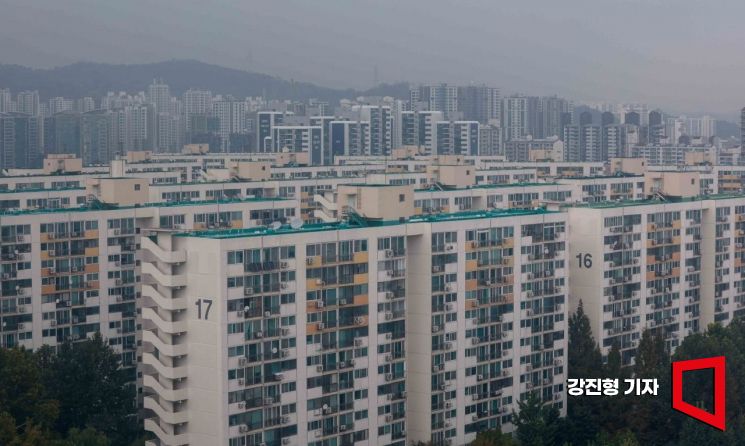 On the 15th, Seongsan Sijeong Apartment in Seongsan-dong, Mapo-gu, Seoul. Seongsan Sijeong Apartment is a complex completed in 1986, consisting of 33 buildings with up to 14 floors and 3,710 households. Photo by Jin-Hyung Kang aymsdream@
Starting from April next year, the resident consent rate requirement for establishing reconstruction associations will be lowered from 75% to 70%, and the consent requirement for commercial property owners will be eased from more than half to more than one-third, accelerating the pace of reconstruction projects. The Ministry of Land, Infrastructure and Transport announced that the amendment to the Urban and Residential Environment Improvement Act, which simplifies the maintenance project procedures, passed the National Assembly plenary session on the 1st.
This is a measure announced by the Ministry of Land last year through the '8·8 Measures.' It will take effect three months after the law is promulgated, starting in April next year. The amended law also expands the range of facilities that can be constructed through reconstruction projects. Currently, when reconstructing mixed-use residential buildings in quasi-residential and commercial areas, only officetels could be built besides housing and welfare facilities. However, going forward, office and cultural facilities permitted in the designated use areas can also be constructed. It explicitly states that in reconstruction projects in areas including Yeouido and Jamsil, which include quasi-residential zones, not only housing but also office facilities, MICE (Meetings, Incentives, Conventions, and Exhibitions) facilities, and exhibition halls can be included.
The scope of integrated reviews and approval agenda for project implementation plan approval will be expanded. The integrated review will now include performance-oriented design evaluation under the 'Firefighting Facilities Installation and Management Act' and disaster impact assessment under the 'Natural Disaster Countermeasures Act.' For the approval agenda, conformity verification of convenience facility installation standards under the 'Act on the Promotion of Convenience for the Disabled, the Elderly, and Pregnant Women' has been added.
Currently, within 120 days from the date of the project implementation plan approval announcement, the estimated burden amount and the application period for sale must be notified to the association members. This period will be shortened to 90 days. However, considering the project site circumstances, it can be extended once by up to 30 days.
Until now, local governments estimated the burden for each landowner when establishing maintenance plans, but going forward, the estimation will be changed to only representative types according to housing types and main floor areas.
Meanwhile, the amendment to the Private Rental Housing Act, which prohibits cancellation of rental deposits unless the tenant is at fault, also passed the plenary session. As a result, tenants whose rental deposits were canceled due to fraudulent acts by rental business operators, such as submitting false documents, can now be protected. According to the amended law, tenants who have already suffered damages can also be retroactively compensated.
© The Asia Business Daily(www.asiae.co.kr). All rights reserved.

















