Expert Points Out "High Unemployment Rate and Slow Economic Growth Cause Delayed Marriages"
The Chinese government is reportedly conducting a nationwide campaign to encourage childbirth in order to address the severe low birthrate crisis, promoting dating, marriage, and childbirth.
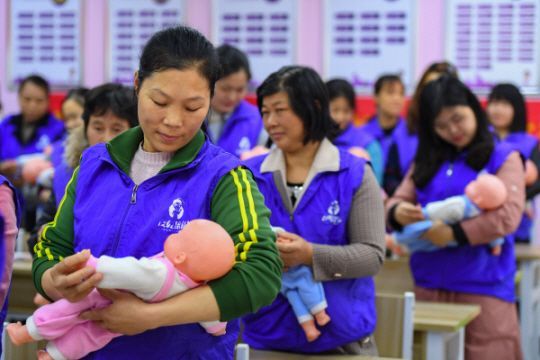 Trainees learning infant nursing skills at a vocational training school in Changsha County, Changsha City, Hunan Province, central China, on April 9 last year. Photo by Xinhua News Agency
Recently, major foreign media reported that local governments in China have been calling married women in their 20s and 30s to inquire about their pregnancy plans, providing cash support to parents, and encouraging them to have two or more children. In line with these policies, the National Health Commission of China has also urged universities to establish "Marriage and Love Education Courses." The aim is to promote systematic knowledge about marriage and childbirth through theories of love and analysis of real-life cases. In some regions, incentives are promised for giving birth to a second child to encourage childbirth. A resident of Zhejiang Province stated, "Officials said that if you have a second child, you can receive a subsidy of up to 100,000 yuan (about 20 million won)."
In October, the State Council of China announced a plan to build a "childbirth-friendly society" as part of economic stimulus measures, putting significant effort into encouraging childbirth. State-run media regularly publish articles related to "the benefits of having children," and the People's Daily reported that childbirth is beneficial to maternal health and helps prevent diseases such as cancer.
Foreign media, citing experts, analyzed that "official policies alone to increase birthrates are unlikely to persuade the younger generation to start families," adding, "especially with high unemployment and sluggish economic growth, young people are postponing marriage and childbirth." Wang Feng, a Chinese population statistics expert, also told foreign media in an interview that "the Chinese government's childbirth encouragement campaign is not showing results," pointing out that "young women face not only high living costs but also serious disadvantages if they quit their jobs to have children." He added, "The Chinese government is struggling to persuade today's young generation, the most well-educated in history, to have children."
Meanwhile, China is facing a serious population decline, with the number of deaths surpassing the number of births. Economist Ren Zeping emphasized, "China is facing three population crises: aging, low birthrate, and low marriage rate," and stressed, "The speed and scale of China's aging population are unprecedented."
The Chinese government implemented the one-child policy from the 1980s, then fully allowed the two-child policy in 2016, and introduced a three-child policy per family in May 2021. However, as living and education costs rose, the trend of avoiding marriage and childbirth deepened, and birthrates declined despite various incentives. The younger generation's perception of marriage itself has also changed compared to older generations. According to a report jointly released earlier this year by the China Family Planning Association, China Youth Network, and other organizations, young people in China do not consider marriage an essential part of life.
© The Asia Business Daily(www.asiae.co.kr). All rights reserved.

















