Trump and Musk Ignite H-1B Visa Expansion Debate at Year-End
12 of Top 20 Issuers Are US Big Tech Firms
Overseas Companies Face Challenges in Benefits
Need to Promote Korea-Specific Visa Issuance
U.S. President-elect Donald Trump and Tesla CEO Elon Musk have ignited a debate over expanding the H-1B visa for highly skilled foreign professionals, but it is unlikely that domestic conglomerates operating locally will benefit from the visa advantages. Most companies receiving H-1B visa approvals are U.S. big tech firms.
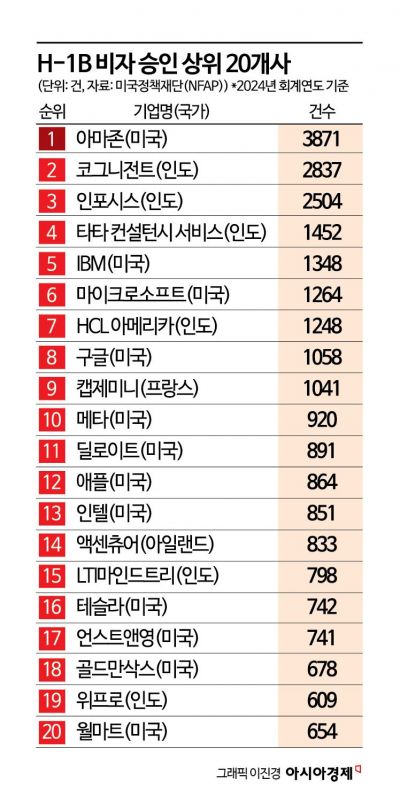
According to the National Foundation for American Policy (NFAP) on the 3rd, among the top 20 companies issuing H-1B visas in the last fiscal year, 12 were U.S.-based companies. Included were six India-based companies and two Europe-based companies. The company that utilized the most H-1B visas was the U.S. e-commerce company Amazon, with 3,871 cases during the same period. Following were 2nd place U.S. IT company Cognizant (2,837 cases), 3rd place Indian IT company Infosys (2,504 cases), 4th place Indian IT company Tata Consultancy Services (1,452 cases), and 5th place U.S. tech company IBM (1,348 cases). Tesla, operated by Musk, ranked 16th with 742 cases, more than doubling from 328 cases the previous year.
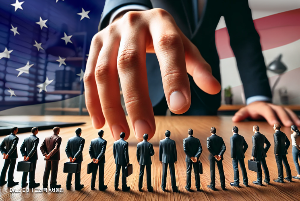
The H-1B visa is a professional visa issued to highly skilled foreigners with at least a bachelor's degree. Designed to attract talent in the fields of science, technology, engineering, and mathematics (STEM), this visa has become a key means for U.S. companies to recruit global talent. However, the annual quota is only 65,000, with an additional 20,000 quotas for those holding a master's degree or higher, making the approval competition fierce.
The dependence of U.S. big tech companies on H-1B visa issuance has generally increased. According to data from the U.S. Citizenship and Immigration Services (USCIS) under the Department of Homeland Security (DHS), the average number of H-1B approvals for four major U.S. companies?Amazon, Google, Microsoft, and Apple?rose from 8,372 during the 2013?2015 fiscal years to 27,929 during the 2022?2024 fiscal years, an increase of 233.6%.
Last month, Musk tweeted on X (formerly Twitter), "The reason I am in the U.S. with hundreds of other important people who built SpaceX, Tesla, and many other companies that made America strong is because of the H-1B visa," adding, "I am going to go to war over this issue," defending the H-1B visa. The next day, President-elect Trump publicly supported Musk's remarks in an interview with U.S. media, saying, "H-1B is a great program, and I have supported it."
This stance contrasts with his past actions emphasizing America First and pursuing anti-immigration policies. During President Barack Obama's administration, the rejection rate for new H-1B visa applications fell to 6%, but under Trump's first term, it surged to a maximum of 24%.
For Korean companies operating factories in advanced industries such as semiconductors and secondary batteries in the U.S., the H-1B visa is a means to attract talent. However, even if the issuance of H-1B visas increases under Trump's second term, it is unlikely that Korean companies will benefit. According to the U.S. Department of State and the Korea International Trade Association, the country-wise distribution of H-1B visa issuance for the 2023 fiscal year shows India overwhelmingly leading with 77.7%. China follows with 8.8%, then the Philippines at 1.2%, Korea at 0.84%, and Taiwan at 0.8%.
A senior official from a domestic semiconductor equipment company said, "All current discussions are aimed at domestic big tech companies," adding, "It will be difficult for foreign companies investing in the U.S. to benefit."
Within the industry, there is growing support for using this as an opportunity to strengthen policies for issuing professional visas exclusively for Koreans. There is an urgent call for the enactment of the 'Partner with Korea Act,' which has been steadily pursued mainly in the U.S. House of Representatives. This bill proposes allocating 15,000 'E-4' visas annually exclusively for Koreans, which carry the same effect as the H-1B visa. The purpose is to help Korean companies secure stable manpower locally in the U.S. The bill was first introduced in 2013 and has been pending for 12 years.
An official from the Korea International Trade Association said, "We need to actively conduct outreach activities targeting major U.S. investment regions of our companies to gain support for the bill," adding, "Furthermore, to expand economic cooperation between Korea and the U.S., it is necessary to secure support from the U.S. federal government as an agenda between the two governments."
Yoon Ji-hyun, a senior researcher at the Korea Institute for International Economic Policy, said, "As the U.S. strengthens its America First stance, the Trump second-term administration is likely to use the H-1B policy as a tool to gain negotiation advantages in trade and technology cooperation, so continuous observation is necessary."
© The Asia Business Daily(www.asiae.co.kr). All rights reserved.
![Clutching a Stolen Dior Bag, Saying "I Hate Being Poor but Real"... The Grotesque Con of a "Human Knockoff" [Slate]](https://cwcontent.asiae.co.kr/asiaresize/183/2026021902243444107_1771435474.jpg)

















