Prolonged Presidential Impeachment Crisis... Increased Exchange Rate Volatility
KDI "Defending Exchange Rate by Selling Foreign Reserves May Cause More Instability"
Concerns Over Prolonged Exchange Rate Strength Unlike During Park Geun-hye Impeachment
Rep. Kim Hyun-jung "Impeachment Trial Must Be Conducted Quickly"
Amid ongoing concerns over volatility and the rising trend in the won-dollar exchange rate due to the prolonged presidential impeachment crisis, there are claims that selling foreign exchange reserves to defend the exchange rate could trigger another foreign exchange crisis. Global investment banks (IBs) also forecast that the exchange rate will continue to rise, potentially surpassing the 1500-won level by September next year.
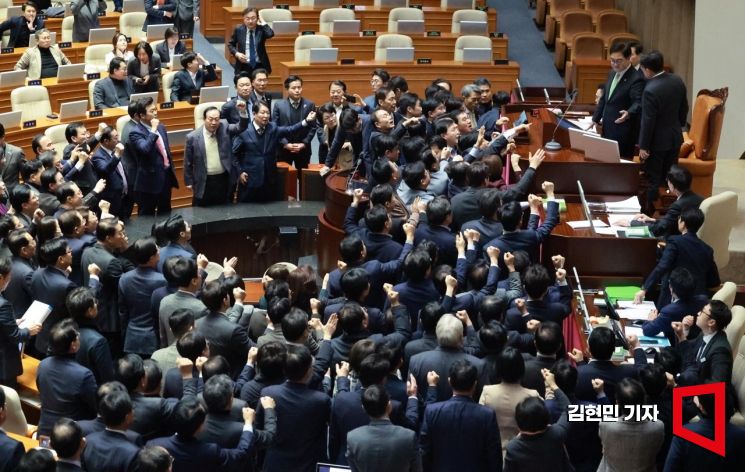 On the 27th, members of the People Power Party strongly protested Speaker Woo Won-sik during the plenary session of the National Assembly where the motion to impeach Prime Minister Han Duck-soo was submitted, raising issues about the required quorum for the impeachment motion to pass (majority of all members). Photo by Kim Hyun-min
According to a response submitted on the 31st by the Korea Development Institute (KDI) to Assemblyman Kim Hyun-jung (Democratic Party), a member of the National Assembly's Political Affairs Committee, KDI expressed concerns that "if foreign exchange reserves are used to maintain an exchange rate level disconnected from economic fundamentals to prevent the exchange rate from rising, the foreign exchange market could become more unstable." They added, "It is necessary to recall the experiences of many emerging countries that exhausted their foreign exchange reserves defending their exchange rates, which led to foreign exchange crises."
In particular, unlike the impeachment of former President Park Geun-hye eight years ago, there is an analysis that the won's strength could be prolonged. According to data submitted by the Korea Institute for International Economic Policy (KIEP) to Assemblyman Kim, the won-dollar exchange rate forecasts by overseas investment banks such as Citigroup and Standard Chartered from December 4 to 13, following the martial law declaration on December 3, show a rising trend based on median values: 1435 won in Q1 next year, 1440 won in Q2, and 1445 won in Q3. This suggests that the strong exchange rate could persist for over a year.
BNP Paribas and Nomura Bank predict that the exchange rate will rise each quarter in 2025, reaching 1445 won and the 1500-won range respectively by Q3. Additionally, Wells Fargo expects the exchange rate to surge to the 1460-won range by Q3. These forecasts revise earlier projections made before the martial law declaration, which anticipated a stable trend of 1315 won in Q4 this year, 1305 won in Q1 next year, and 1300 won in Q2, based on data as of November 8 this year.
The forecast that the exchange rate will remain strong and fluctuate around the 1500-won level until September next year differs from the situation during former President Park Geun-hye's impeachment. Around December 9, 2016, when Park's impeachment was passed, the exchange rate rose sharply to 1209 won but then declined from January 2017, falling to the 1130-won range by around March 10, when the Constitutional Court upheld the impeachment. Assemblyman Kim pointed out that the current political risk is greater than the state corruption scandal eight years ago and has had a worse impact on external credibility in terms of content and scale.
Through response materials submitted to Assemblyman Kim, the Bank of Korea analyzed that "the recent rise in the exchange rate has little effect on improving gross domestic product (GDP) but raises import prices, negatively affecting capital investment, which is highly dependent on imports." They also noted that "since August this year, foreign investors have continued net selling of domestic stocks, and concerns over domestic political uncertainty have increased, acting as an additional factor expanding the volatility of foreign investment." The Bank of Korea is known to have intervened in the market by selling dollars from foreign exchange reserves (smoothing operations) each time the exchange rate rose stepwise following the martial law incident.
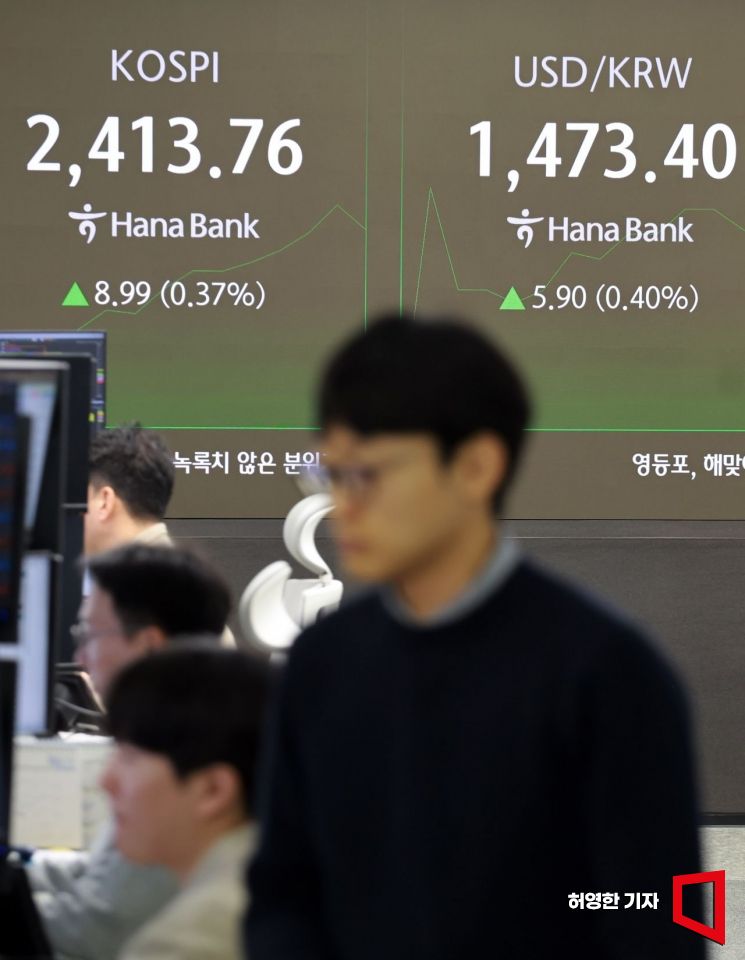 On the 30th, the last trading day of the year, the KOSPI and KOSDAQ started with a slight decline but then turned to a rebound. The won-dollar exchange rate rose again to the mid-1470 won range. Employees are working in the dealing room at the Hana Bank headquarters in Euljiro, Seoul. Photo by Heo Young-han
On the other hand, KIEP, like KDI, pointed out that prolonged large-scale dollar sales using foreign exchange reserves could rapidly reduce reserves and lower external credibility. KIEP also analyzed that raising interest rates to lower the exchange rate would increase interest burdens on households and businesses and could exacerbate an economic recession. This implies that government intervention could have side effects. KIEP proposed measures such as ▲expanding the scale of foreign exchange swaps and hedge ratios of the National Pension Service ▲utilizing currency swaps concluded with Japan, Switzerland, Australia, and Canada ▲establishing new bilateral currency swaps with the United States and Europe to reduce dollar demand arising from trade settlements.
Additionally, KIEP suggested temporarily raising the overseas securities investment income deduction limit, currently at 2.5 million won, and temporarily reducing capital gains tax when funds from the sale of overseas assets return to Korea to promote the inflow of domestic funds from overseas investments. They also proposed tax benefits for domestic securities investments under the Individual Savings Account (ISA) and strengthening the value-up system.
Meanwhile, Shinhan Bank's S&T Center, which currently maintains the exchange rate between 1300 and 1450 won (average 1360 won), acknowledged that upward forecasts are inevitable depending on recent domestic and international situations. The center stated, "Like during the impeachment crisis, volatility is expected to expand for the time being due to political uncertainty, and we are analyzing with a range of 1350 to 1500 won (average 1420 won) in mind." They diagnosed that "due to the impact of exchange rate fluctuations, South Korea's economic growth rate next year is likely to fall below 2%, entering a low-growth phase."
The Korea Institute for Industrial Economics and Trade also explained, "Amid expanding geopolitical uncertainty, factors such as the dollar's strength following Trump's election, and domestic political risks like the declaration of martial law and impeachment, the won-dollar exchange rate surged to 1474 won on the 30th despite three interest rate cuts by the U.S. Federal Reserve." They added, "If political uncertainty is not resolved and continues, a high exchange rate will persist in 2025." They further emphasized, "Financial authorities need to pursue policies to stabilize market sentiment and the exchange rate through foreign exchange reserve management and timely use of currency swaps."
In response, Assemblyman Kim expressed concern, saying, "There are bleak forecasts that the exchange rate could rise to the highest level since the financial crisis, reaching 1500 won." He warned, "If the exchange rate rises, it will cause enormous damage to the national economy through increased import raw material prices, soaring inflation, higher living costs, and contraction of domestic demand." He particularly pointed out, "The risk of foreign investor withdrawal, downgrade of national credit ratings, and economic growth slowdown are also increasing," and stressed, "To end the crisis quickly, the impeachment trial and punishment of Yoon Seok-yeol must be carried out as soon as possible."
© The Asia Business Daily(www.asiae.co.kr). All rights reserved.

![Clutching a Stolen Dior Bag, Saying "I Hate Being Poor but Real"... The Grotesque Con of a "Human Knockoff" [Slate]](https://cwcontent.asiae.co.kr/asiaresize/183/2026021902243444107_1771435474.jpg)
















