Gyeonggi-do, AIDT Budget Reduced from 52.9 Billion to 32.9 Billion Won
Impact of 'Educational Materials' Bill Passing National Assembly
Ministry of Education Maintains Stance to Exercise 'Reconsideration Request'
Education Offices Face Increased Confusion, "Likely to Treat as Unused"
The bill that downgrades the AI digital textbook promoted by the Ministry of Education to 'educational material' has passed the National Assembly, putting the budgets allocated by each education office at risk of adjustment. However, the Ministry of Education has not presented any countermeasures, stating it will exercise its 'request for reconsideration.'
An official from the Gyeonggi-do Office of Education explained on the 31st, "We submitted a budget of 52.9 billion KRW for AI digital textbooks, but the Budget and Accounts Committee cut 20 billion KRW, resulting in a budget of 32.9 billion KRW," adding, "It seems that the law passed by the National Assembly was reflected during the Budget and Accounts Committee's coefficient adjustment process."
The day before, the Gyeonggi Provincial Council held a plenary session and approved the '2025 Gyeonggi-do Education Special Account Revenue and Expenditure Budget' amounting to 2.364 trillion KRW. While most city and provincial budgets have been finalized, in the case of Gyeonggi-do, where budget deliberations were delayed, it appears that the amendment to the Elementary and Secondary Education Act passed by the National Assembly plenary session on the 26th had an impact.
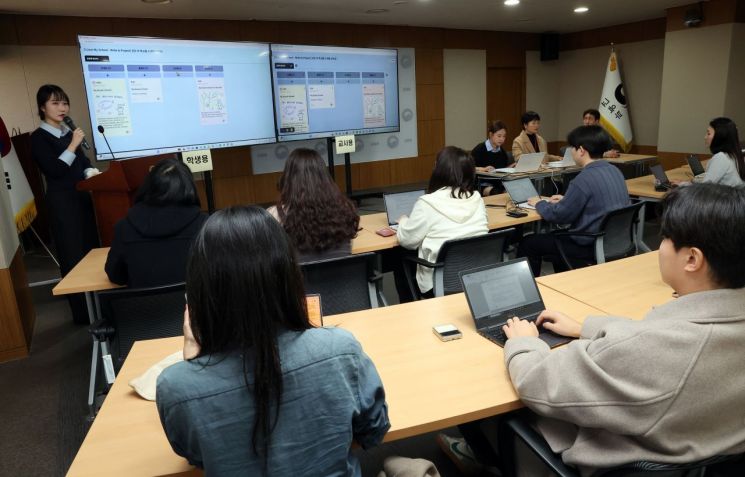
If the amendment is applied, the possibility of each school adopting digital textbooks is expected to decrease. Textbooks must be mandatorily designated by each school, but educational materials can be selected at the discretion of the school principal. Accordingly, the necessary budgets for each education office may also decrease. The Gyeonggi-do Office of Education, which has the largest number of students, allocated 32.9 billion KRW for AI digital textbook subscription fees, while the Seoul Metropolitan Office of Education allocated 25.6 billion KRW.
Since the government can decide whether to exercise a veto within 15 days after the amendment is transmitted, it is difficult to confirm the application of the law until mid-January at the earliest. Local education offices are in a state of confusion. An official from Education Office A said, "Currently, we are only following the Ministry of Education's guidelines, so it is difficult for us alone to adjust the budget," adding, "For now, we have told schools to select digital textbooks in February." He also added, "We are preparing communication networks and facility equipment so that we can proceed with the policy smoothly on our end."
An official from Education Office B also said, "The budget has already been finalized, so there are no plans for adjustment," but added, "If the Ministry of Education's direction or the education office's own plan is decided, supplementary budgets or adjustments may be possible."
Despite these concerns, the Ministry of Education maintains its position to request reconsideration. On the 26th, Lee Ju-ho, Deputy Prime Minister for Social Affairs and Minister of Education, stated at a briefing regarding the possibility of budget adjustments, "The Ministry of Education will request reconsideration and strive to maintain the textbook status of AI digital textbooks as a policy goal by any means," adding, "We will also persuade the National Assembly further to minimize confusion in the field."
© The Asia Business Daily(www.asiae.co.kr). All rights reserved.
![Clutching a Stolen Dior Bag, Saying "I Hate Being Poor but Real"... The Grotesque Con of a "Human Knockoff" [Slate]](https://cwcontent.asiae.co.kr/asiaresize/183/2026021902243444107_1771435474.jpg)
















