Route Change Due to Hydraulic System Failure
Multiple Diversions Also Caused by Landing Gear Issues
In the tragic accident involving a Jeju Air passenger plane at Muan International Airport, which resulted in the deaths of 179 passengers, it has been revealed that the same aircraft model made an emergency landing overseas.
According to the aviation news outlet Simple Flying on the 29th (local time), a KLM (Dutch airline) Boeing 737-800 passenger plane traveling from Oslo Gardermoen Airport in Norway to Amsterdam Schiphol Airport in the Netherlands made an emergency landing at Oslo Torp Sandefjord Airport the previous day.
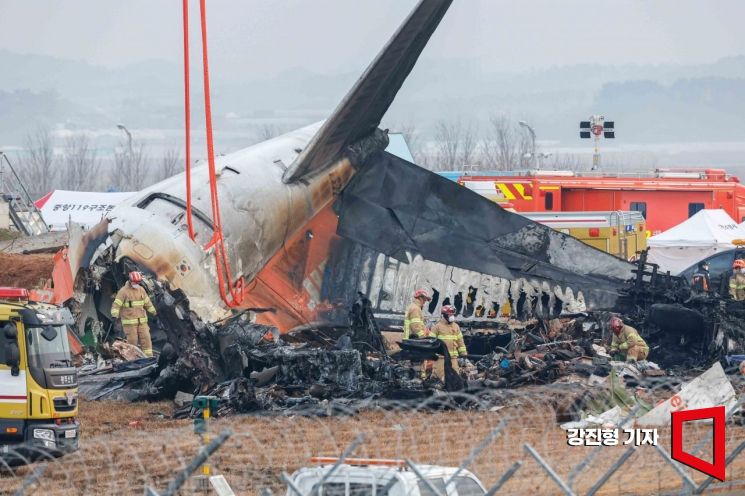 Firefighters are searching for belongings at the site of the Jeju Air passenger plane collision and explosion accident that occurred 30 days ago at Muan International Airport in Jeonnam. Photo by Kang Jin-hyeong
There were 182 people on board the aircraft, and it is reported that after a loud noise occurred, the flight path was changed to make an emergency landing. The plane came to a complete stop off the runway on a grassy area, and no casualties occurred during the landing. Investigations confirmed that the aircraft experienced a hydraulic system failure. Norwegian local media also reported that smoke was observed coming from the plane's left engine. The accident investigation committee is currently investigating the exact cause of the accident.
A similar incident occurred a few months ago. A Boeing 737-800 passenger plane operated by TUI Airways returned to its departure airport, Manchester Airport in the UK, after the landing gear failed to retract shortly after takeoff in July. In October, a Boeing 737-800 aircraft operated by Air India Express turned back two and a half hours after takeoff due to landing gear issues. This aircraft, carrying more than 150 passengers, departed from Tiruchirappalli Airport heading to Sharjah Airport in the United Arab Emirates but decided to return due to a hydraulic system failure that prevented the landing gear from retracting.
Meanwhile, Jeju Air flight 7C2216 attempted a belly landing on the runway at Muan Airport around 9:03 a.m. on the 29th, with the landing gear (aircraft wheels) not deployed. During the landing, the fuselage collided with the outer wall. The aircraft was subsequently broken apart and caught fire, with most of the fuselage engulfed in flames. There were 181 people on board, including 175 passengers and 6 crew members. According to the Fire Agency's tally, 179 people died and 2 were rescued. As a result, the Jeju Air passenger plane accident became the deadliest aviation accident in South Korea. The following day, Jeju Air flight 7C101, departing from Gimpo Airport to Jeju at 6:37 a.m., decided to return shortly after takeoff due to landing gear issues, heightening passengers' anxiety.
© The Asia Business Daily(www.asiae.co.kr). All rights reserved.

![Clutching a Stolen Dior Bag, Saying "I Hate Being Poor but Real"... The Grotesque Con of a "Human Knockoff" [Slate]](https://cwcontent.asiae.co.kr/asiaresize/183/2026021902243444107_1771435474.jpg)















