Year-End Strawberry Price Surge Nears 20,900 KRW per 1kg
Increased Strawberry Shipments Expected After January
Price Stability Forecasted
Winter fruit strawberries are soaring in price, approaching 29,000 won per 1kg. This is due to delayed transplanting of strawberry seedlings into fields caused by the summer heatwave, resulting in supply lagging behind demand. As prices continue to rise, consumers are expressing their burden, saying, "My child likes them, but I'm afraid to buy them."
According to the Korea Agro-Fisheries & Food Trade Corporation (aT) on the 31st, the average retail price of strawberries distributed by retailers as of the previous day was 2,863 won per 100g. Assuming a purchase of 1kg of strawberries, one would have to pay about 29,000 won. Strawberries, which began full-scale shipment earlier this month, were sold at 2,984 won per 100g as of the 9th. As the harvest volume increased, the price dropped to 2,527 won on the 18th, but it turned upward again toward the end of the year.
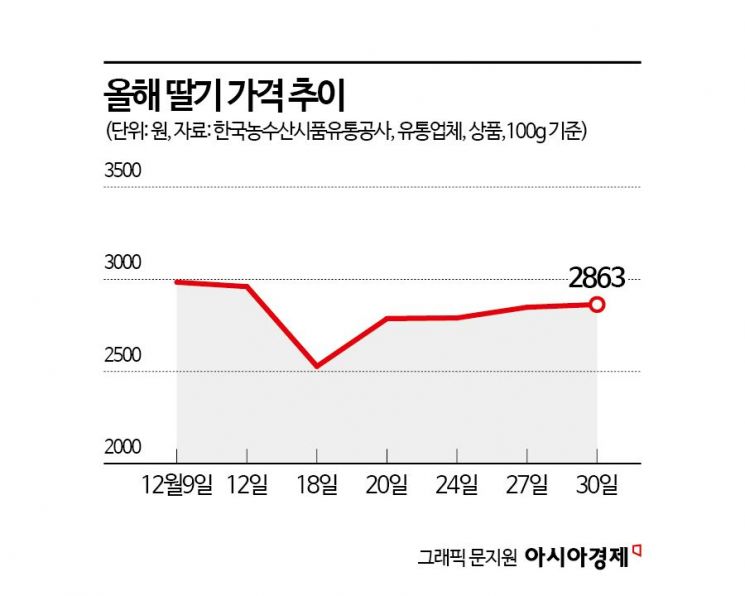
The sharp price increase toward the end of the year is due to a rapid rise in strawberry demand. At year-end, party demand such as Christmas increases the number of people seeking strawberries. The start of strawberry buffets hosted by major hotels in Seoul also influenced the price rise. Every year, strawberry prices tend to rise at year-end, but this year, the initial shipment price was higher, leading to an even greater increase.
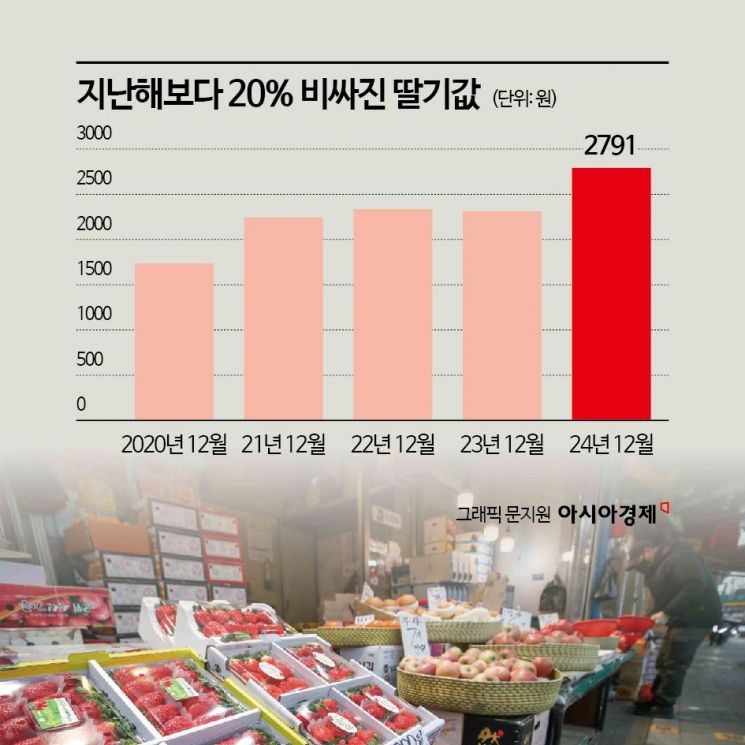
In fact, the price of strawberries in December last year was 2,310 won per 100g, but the average price this December was 2,791 won, an increase of over 20%. Compared to the average price of previous years (2,296 won), it is about 22% more expensive.
The reason strawberry prices are particularly high this year is due to the prolonged hot weather. Normally, transplanting is done in August and September, but this year the timing was delayed due to the heat. This led to a reduced initial shipment volume, causing strawberry prices to skyrocket. Especially in Chungnam, the main strawberry producing region, shipment volume was lower than expected, raising prices by about 15-20% compared to the previous year. A representative from a major supermarket explained, "Strawberries are 100% grown in greenhouses, but the heat in August and September this year prevented the seedlings from rooting well," adding, "Because of this, the volume dropped significantly."
To respond to the rising strawberry prices, distribution companies have taken individual measures such as securing additional production areas. Lotte Mart diversified strawberry production areas to regions not previously operated, including Gimcheon in Gyeongbuk and Jeongeup and Gochang in Jeonbuk, and expanded the operation of smart farm volumes that are less affected by climate change. Coupang expanded its strawberry purchasing regions from the existing five locations, including Nonsan in Chungnam and Jinju in Gyeongnam, to ten regions by adding Yeongam in Jeonnam, Miryang in Gyeongnam, and Sangju in Gyeongbuk. They plan to purchase 2,400 tons by April next year, double last year's purchase volume of 1,200 tons.
The industry expects prices to stabilize in January and February next year when strawberry volumes increase. This is typically the season when volumes rise, and currently, there is no heavy snowfall or adverse weather, so the crop condition is not poor. A representative from a major supermarket said, "Although year-end demand is high, January and February are the main strawberry seasons with the largest shipment volumes," and predicted, "As supply increases, prices will drop significantly compared to now."
© The Asia Business Daily(www.asiae.co.kr). All rights reserved.


















