Dunduk Raised Accident Concerns
Rare Cases of Concrete Protruding Structures
Ministry of Land to Investigate
Special Inspection of Accident Passenger Planes Planned
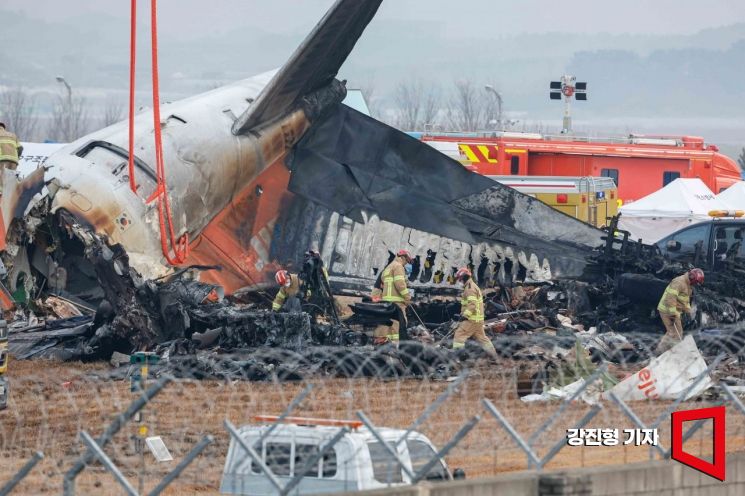 Firefighters are searching for belongings at the site of the Jeju Air passenger plane collision and explosion accident that occurred 30 days ago at Muan International Airport in Jeonnam. Photo by Kang Jin-hyung
The Ministry of Land, Infrastructure and Transport responded on the 30th to criticisms that the passenger plane collided with a concrete azimuth structure, exacerbating the accident at Jeju Air at Muan International Airport in Jeollanam-do, stating that "such structures are also installed at other domestic airports." They added, "We will thoroughly investigate the connection to the accident."
The Ministry, which oversees aviation safety, made this announcement during a briefing on the Muan passenger plane accident held at 10 a.m. at the Government Sejong Complex, chaired by Joo Jong-wan, Director General of the Aviation Policy Bureau of the Ministry.
Director Joo explained, "At Muan Airport, the azimuth facility (localizer) is installed about 251 meters from the end of the runway outside the runway end safety area," adding, "Similar concrete azimuth structures exist at Yeosu Airport and Cheongju Airport."
The azimuth facility is a type of antenna that assists aircraft in approaching the runway. It consists of a concrete foundation and antenna installed atop an earthen mound. While usually made of metal, it is rare for it to be constructed as a protruding concrete structure like at Muan Airport, leading to claims that it violates domestic and international regulations.
The Jeju Air passenger plane crashed after attempting to land, first hitting the azimuth facility and then a retaining wall, causing the fuselage to break in two and resulting in a disaster. Director Joo stated, "The azimuth facility cannot be installed arbitrarily; there are installation regulations, which we are currently reviewing," and added, "We plan to closely examine whether there are restrictions on materials or composition and the connection to the accident."
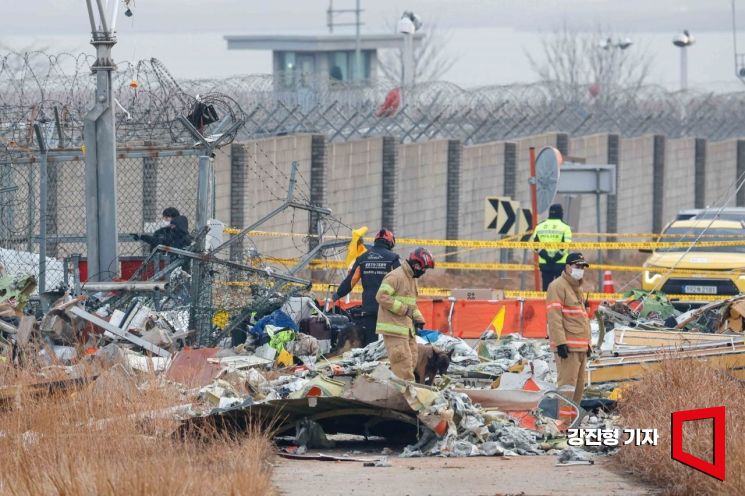 Firefighters are searching for fuel items at the site of the Jeju Air passenger plane collision and explosion accident that occurred on the 30th at Muan International Airport, Jeonnam. Photo by Kang Jin-hyeong
The Ministry explained the fuselage landing point of the accident aircraft, estimating it to be about one-third along the runway (2,800 meters) direction, stating, "It appears to have landed approximately 1,200 meters from the runway threshold." The fuselage then slid about 1,600 meters along the runway before colliding with the mound and outer wall.
Regarding the assumption that power was shut down during the fuselage landing, the Ministry said, "We will clarify this as we investigate the overall situation," adding, "We expect detailed information to be revealed based on black box records."
The Ministry also announced it will review whether to strengthen regulations related to bird strikes, identified as one of the causes of this accident, for the new airport currently under construction.
A Ministry official stated, "There are regulations to reduce bird strike risks in the airport strategic environmental impact assessment, and evaluations are conducted accordingly," adding, "For the new airport project, we will examine bird strike issues more thoroughly and work with experts to devise supplementary measures."
The Ministry will conduct a full inspection of the accident aircraft model, the Boeing 737-800 (B737-800). It will also carry out intensive safety inspections targeting Jeju Air, which operated the accident aircraft.
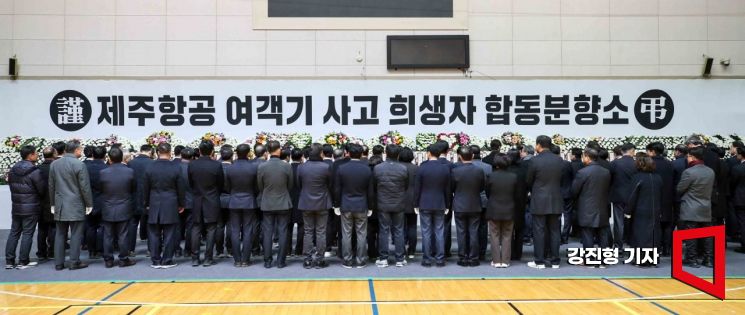 Amid the Jeju Air passenger plane disaster that resulted in 179 deaths, local residents visited the joint memorial altar set up at Muan Sports Park near Muan International Airport in Jeonnam on the 30th to pay their respects to the victims. Photo by Kang Jin-hyung
Director Joo said, "It is reported that 101 aircraft of the same model (B737-800) as the Jeju Air accident plane are operated in South Korea, and we are considering conducting special inspections first," adding, "We plan to review whether inspection and maintenance regulations before and after flights, including utilization rates, are being properly followed."
The Ministry will conduct a joint investigation into the cause of the accident with the U.S. National Transportation Safety Board (NTSB) and the aircraft manufacturer Boeing.
This model is operated by most domestic low-cost carriers (LCCs). Jeju Air operates 39 units, the largest number among domestic airlines, followed by T'way Air with 27, Jin Air with 19, Eastar Jet with 10, Air Incheon with 4, and Korean Air with 2. Since its launch in 1997, over 5,000 B737-800s have been sold worldwide. Due to its widespread use, there have been many reports of structural defects and accidents.
In 2019, the Ministry instructed domestic airlines operating Boeing 737 NG series aircraft to inspect for cracks in the fuselage structure. Cracks were found in nine aircraft, which were grounded. Earlier this year, the Ministry ordered safety inspections of 14 Boeing 737 Max 8 aircraft across five domestic airlines.
The Ministry stated, "It is true that Jeju Air's aircraft utilization rate is high, as shown by statistics," and added, "We plan to intensify aviation safety supervision by dispatching aviation safety inspectors to Jeju Air."
© The Asia Business Daily(www.asiae.co.kr). All rights reserved.



















