IMF Raises US Economic Growth Forecast to 2.8% for This Year
Strong Consumption Despite Labor Market and Election Uncertainties
Key Variable: Trump’s Second Term and Prolonged High Interest Rates
The U.S. economy is expected to dispel recession concerns such as prolonged high interest rates and election uncertainties this year, recording the most remarkable growth among the Group of Seven (G7) countries.
Bloomberg reported on the 29th (local time), citing the economic growth forecasts released by the International Monetary Fund (IMF) in July and October. In the October World Economic Outlook (WEO) update, the IMF raised the U.S. growth forecast by 0.2 percentage points from the previous estimate to 2.8%.
Among the G7, the U.S. is the only country with an IMF growth forecast exceeding 2%. Despite concerns over prolonged high interest rates throughout the first half of the year, signs of labor market cooling emerging in the second half, and uncertainties surrounding the U.S. presidential election, the growth engine is seen as still running strong. Following the U.S. are Canada (1.3%), France and the United Kingdom (each 1.1%), and Italy (0.7%), while Japan and Germany recorded 0.3% and 0%, respectively. Japan and Germany’s growth forecasts were downgraded by 0.4 and 0.2 percentage points, respectively, compared to the previous estimates.
Bloomberg stated, "Despite uncertainties such as the election, interest rate hikes, and labor market cooling, the U.S. economy showed solid growth this year," adding that it "will record the best performance among the G7."
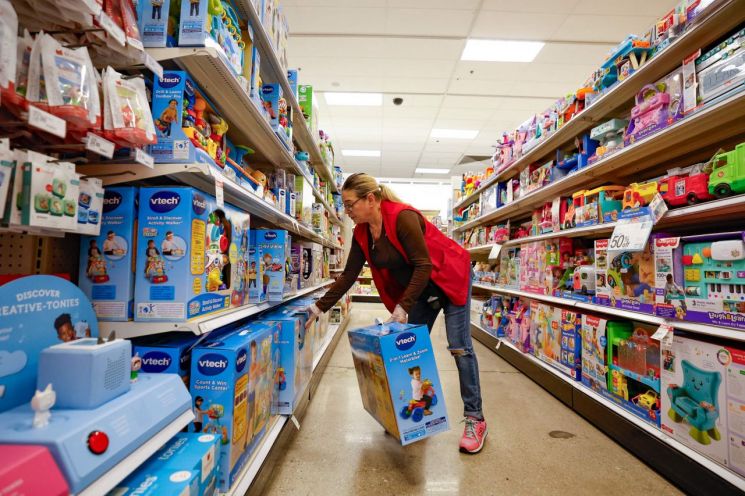
Robust consumer spending was cited as a key driver of U.S. economic growth. The U.S. real gross domestic product (GDP) in the third quarter increased by an annualized 3.1% quarter-on-quarter (final figure), surpassing both the preliminary and revised estimates (both 2.8%) as well as the second quarter growth rate (3.0%). The largest increase in personal consumption expenditures since early 2023 (3.7% in Q3) was identified as the main force behind this growth.
The increase in U.S. household net worth, which boosted disposable income, also helped lift consumption. According to the Federal Reserve (Fed), U.S. household net worth in the third quarter rose 2.9% from the previous quarter to a record high of $168.8 trillion (approximately 24,770 trillion KRW). Bloomberg explained, "Although employment slowed somewhat, wage growth outpaced inflation and asset values rose, supporting continued expansion in household spending."
The U.S. stock market, which set new records this year amid the artificial intelligence (AI) rally, also contributed to pushing household assets to all-time highs, benefiting the economy. The S&P 500 index, dominated by large-cap stocks, rose more than 25% from the beginning of the year, surpassing the average forecasts of major Wall Street institutions. The S&P 500, which closed up 24.23% last year, is showing its best performance since the dot-com bubble period of 1997?1998.
However, not all outlooks for the U.S. economy are rosy. One issue behind consumer spending, led by high-income households, is the problem of credit card loan defaults among low-income groups. According to data analytics firm BankRegData, the amount of bad delinquent loans forgiven by the U.S. credit card industry from January to September this year totaled about $46 billion, a 50% increase compared to the same period last year and the highest level since 2010.
Considering that such forgiveness is typically extended to those lacking debt repayment ability, this suggests that financial health has rapidly deteriorated among low-income Americans amid the era of high interest rates. Mark Zandi, chief analyst at Moody’s, said, "High-income households in the U.S. are doing fine, but the bottom one-third income group is facing financial constraints," adding, "Their savings rates are near zero." Bloomberg noted, "Consumers are still holding on, but some of the main drivers have lost momentum," highlighting the issue of depleted savings.
Additionally, the recent stagnation in the inflation slowdown trend and the fact that the U.S. benchmark interest rate remains high despite the Fed entering a monetary easing cycle since last September could hamper the U.S. economy. In particular, policies promised by President-elect Donald Trump, who will take office in January next year?such as tariff increases, illegal immigration bans, and tax cuts?could push prices up and prolong the high interest rate environment.
Odysseas Papadimitriou, head of consumer credit research at WalletHub, said that the broad high tariffs promised by President-elect Trump could lead to a rebound in inflation and high interest rates, calling it "a double problem for consumers in 2025." Bloomberg noted, "While Trump has pledged to revitalize domestic manufacturing, some economists and business circles believe his policies could raise prices and disrupt supply chains," adding, "Amid such uncertainties, capital expenditure growth among U.S. manufacturing firms is expected to remain modest."
© The Asia Business Daily(www.asiae.co.kr). All rights reserved.
![Clutching a Stolen Dior Bag, Saying "I Hate Being Poor but Real"... The Grotesque Con of a "Human Knockoff" [Slate]](https://cwcontent.asiae.co.kr/asiaresize/183/2026021902243444107_1771435474.jpg)


















