Expert Meeting on Sustainability Disclosure Held
Disclosure Standards and Roadmap to Be Announced in the First Half of Next Year
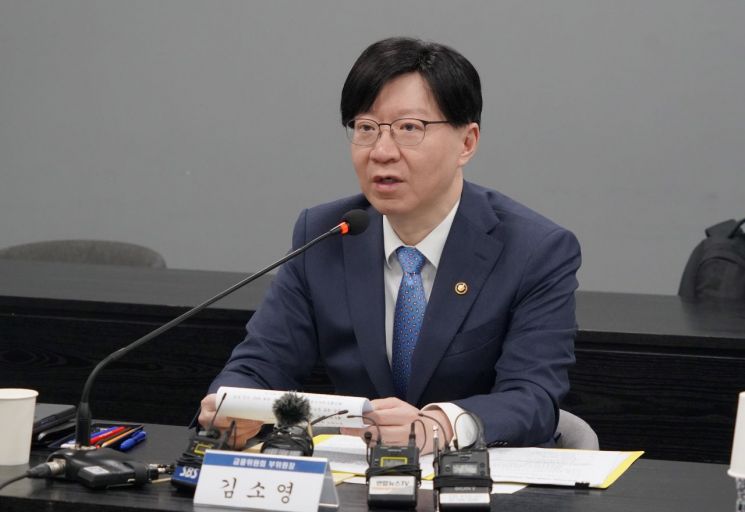
Kim So-young, Vice Chairman of the Financial Services Commission, announced on the 30th that "sustainable finance is an irreversible flow" and revealed plans to announce the schedule for the introduction of sustainability disclosures in the first half of next year.
On the morning of the same day, Vice Chairman Kim held an 'Expert Roundtable on Sustainability Disclosures' at the Korea Chamber of Commerce and Industry, emphasizing, "Both companies and investors need to move away from decision-making focused on ‘stranded assets’?assets that can rapidly lose investment value and turn into liabilities due to environmental changes?and consider a sustainable future." Stranded assets refer to assets that have become unable to generate profits or be economically utilized due to economic, environmental, or technological changes.
So far, the Financial Services Commission and the Korean Accounting Standards Board have disclosed a draft of sustainability disclosure standards in April and have been collecting opinions from companies and other stakeholders. The plan is to announce the disclosure standards and roadmap in the first half of next year.
Vice Chairman Kim pointed out, "In introducing sustainability disclosures, South Korea must consider its unique characteristics such as a high proportion of manufacturing and export dependence, but it is also necessary to take into account the predictability for companies preparing for disclosures."
She added, "Since various global investors such as Norway’s Government Pension Fund Global (NBIM) and the Netherlands’ pension fund (APG) have raised the necessity of sustainability disclosures, there is also a need to reflect this to enhance the possibility of capital inflow into our capital market."
She further explained, "As the policy uncertainties of major countries regarding sustainability disclosures are likely to decrease in the first half of next year, we will review and announce our country’s introduction schedule accordingly."
She also said, "We are considering support measures to reduce confusion among companies and improve the reliability of information," adding, "We plan to provide guidelines containing detailed judgment criteria on general principles such as financial materiality along with the disclosure standards."
She continued, "Regarding sustainable finance, to practically support investors’ decision-making, we will ensure that the ESG Rating Agencies Guidance, a self-regulation established by the ESG rating agencies’ consultative body, is well complied with, and we will improve the institutional foundation to enhance the transparency and reliability of the domestic sustainability evaluation market."
On the same day, the Financial Services Commission, along with related organizations including the Korean Accounting Standards Board, the Bank of Korea, the Financial Supervisory Service, the Korea Exchange, and KOTRA, reviewed major countries’ policy trends on sustainability disclosures and the impact of sustainability disclosures on domestic companies. They also discussed support measures for the establishment of the new system.
The experts attending the meeting agreed that although many countries have not yet finalized their disclosure systems internationally, it is necessary to promptly provide final guidance on disclosure standards and schedules to enhance predictability for investors and companies.
However, considering disclosure costs and litigation risks, there were opinions that while the implementation of Scope 3 disclosures, which impose a high burden on companies, is necessary, sufficient prior preparation is required to systematically manage related party data. Regarding Policy Disclosure No. 101, there were also opinions that the scope of information should be minimized whether it is excluded or included in the disclosure standards. Discussions were held on the need for broad exemptions from sanctions and liability for damages to alleviate the burden on companies in the early stages of system introduction.
The Korean Accounting Standards Board released a translated version of the 'Industry-Based Guidance on IFRS S2 Implementation,' a kind of guideline that had been highly requested by companies.
Meanwhile, the Korea Exchange recently announced that, based on an analysis of the implementation status of the ESG Rating Agencies Guidance conducted jointly with the ESG rating agencies’ consultative body, all three rating agencies affiliated with the consultative body (Sustinvest, Korea ESG Standards Institute, and Korea ESG Research Institute) comply with most of the guidance items. The Korea ESG Research Institute, which partially did not comply with one item, plans to improve its corporate feedback procedures starting from September next year.
© The Asia Business Daily(www.asiae.co.kr). All rights reserved.

















