The Japanese stock market is expected to close at its highest level since the bubble economy of the 1980s, based on the year-end closing day.
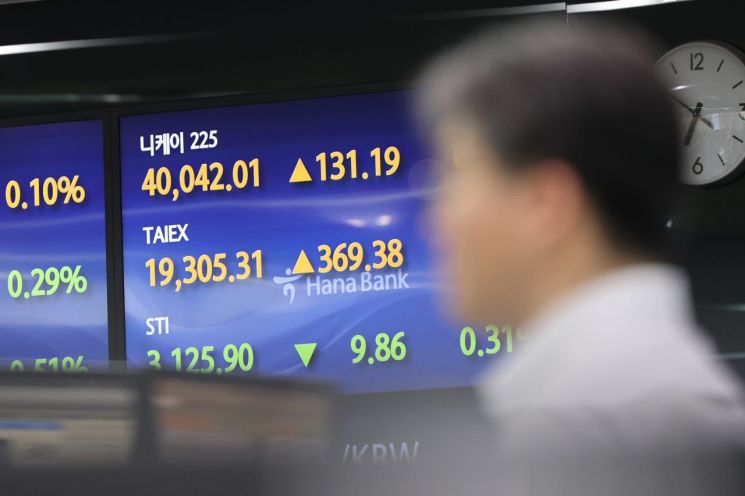 The Nikkei index is displayed on the status board of Hana Bank dealing room in Jung-gu, Seoul. / Photo by Yonhap News
The Nikkei 225 average price (Nikkei index) closed at 40,281 on the 27th, up 1.8%. If the Nikkei index does not plunge on the last trading day of the year, the 30th, it will set the highest record in 35 years based on the closing day since 1989, the final year of the bubble economy.
As of the 27th, the Nikkei index is up 20.3% compared to the beginning of the year. After closing at 38,915 in 1989, the Nikkei index entered a long-term downtrend until 2008, when the US-originated global financial crisis occurred following the collapse of the bubble economy. It plunged to around 7,162 immediately after the global financial crisis was triggered.
This year, the Nikkei index’s highest point was 42,224 (July 11). The rise in the Nikkei index was driven by expectations of interest rate cuts, a rising US stock market, and a "super yen depreciation," with the dollar-yen exchange rate reaching the 161 yen level.
The decline in the yen’s value is a factor boosting the performance of Japanese export companies included in the Nikkei index. The fact that this year’s Japanese stock market surpassed the levels recorded during the bubble economy era is attributed to corporate share buybacks, activist funds, and strong buying by individual investors.
In particular, experts pointed out that the rise in the Japanese stock market this year was led not by foreign investors but by retail investors. Foreign investors sold a net total of about $32 billion worth of stocks and futures combined this year.
© The Asia Business Daily(www.asiae.co.kr). All rights reserved.
![Clutching a Stolen Dior Bag, Saying "I Hate Being Poor but Real"... The Grotesque Con of a "Human Knockoff" [Slate]](https://cwcontent.asiae.co.kr/asiaresize/183/2026021902243444107_1771435474.jpg)











