KDCA Announces '2022 Cardiovascular Disease Incidence Statistics' Results
Myocardial Infarction Fatality Rate Decreases While Stroke Increases Again
The number of patients with myocardial infarction has increased by about 1.5 times over the past 10 years. During the same period, the number of stroke patients also increased by nearly 10%. These diseases are severe conditions that can lead to death if not diagnosed quickly and treated appropriately. They incur higher medical costs than other diseases and often cause serious disabilities due to aftereffects even if the patient survives.

According to the "2022 Cardiovascular and Cerebrovascular Disease Incidence Statistics" released by the Korea Disease Control and Prevention Agency on the 29th, the number of myocardial infarction cases increased by 48.7% over 10 years, from 23,509 cases in 2012 to 34,969 cases in 2022. By gender, the incidence of myocardial infarction in men was about 2.8 times higher than in women, with 25,944 cases in men compared to 9,025 in women.
The first occurrence of myocardial infarction was higher in men aged 0 to 79, while women aged 80 and above had more cases. Recurrent myocardial infarction was higher in men across all age groups. In 2022, the proportion of recurrent myocardial infarction among all myocardial infarction cases was 9.6%, up from 6.5% in 2012.
The incidence rate of myocardial infarction was 68.2 cases per 100,000 people, with 101.6 cases in men and 35.1 cases in women. By age group, the highest incidence was among those aged 80 and above, at 327.5 cases, and the incidence rate increased with age. Looking at the "age-standardized incidence rate of myocardial infarction," which adjusts for different age structures across regions and periods, it increased by 6.6% from 36.2 cases per 100,000 in 2012 to 38.6 cases in 2022, but has shown a decreasing trend since 2020.
In 2022, the age-standardized incidence rates of myocardial infarction by province (cases per 100,000 people) were highest in Jeonnam (53.4 cases) and Gwangju (45.2 cases), and lowest in Sejong (33.0 cases) and Ulsan (33.3 cases). Among men, Jeonnam had the highest rate (72.0 cases), while among women, Jeonbuk had the lowest (13.8 cases). Additionally, over the past 10 years, the incidence rate trends showed little change in the metropolitan area, Gangwon, and Chungcheong regions, whereas Gwangju and Jeonnam saw an increase in age-standardized incidence rates compared to 10 years ago.
The "30-day fatality rate," which refers to the proportion of deaths within 30 days after myocardial infarction occurrence, was 9.0% in 2022. After myocardial infarction, 7.5% of men and 13.2% of women died within 30 days, and among those aged 65 and older, 14.3% died within 30 days. The fatality rate was highest among those aged 80 and above, and according to annual trends, it has generally decreased over the past 10 years, according to the Disease Control and Prevention Agency.
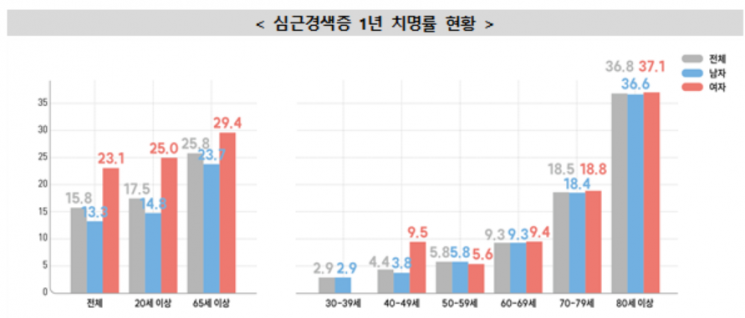
The "1-year fatality rate," which is the proportion of deaths within one year after myocardial infarction occurrence, was 15.8% in 2022. After myocardial infarction, 13.3% of men and 23.1% of women died within one year, with women having a higher rate than men. The 1-year fatality rate was also higher in older age groups but has generally shown a decreasing trend.
Stroke Cases Reach 110,000 Annually... 30-Day Mortality Rate at 8.2%
In the case of stroke, the number of cases in 2022 was 110,574, an increase of 9.8% compared to 100,673 cases in 2012. Also, men had about 1.2 times more cases than women, with 61,988 cases in men and 48,586 in women.
By occurrence type, the first occurrence and recurrent cases of stroke were higher in men aged 0 to 79, while women aged 80 and above had more cases. The proportion of recurrent stroke cases among all strokes in 2022 was 20.4%, up from 17.5% in 2012.
Stroke incidence rates also increased with age. In 2022, the stroke incidence rate was 215.7 cases per 100,000 people, with 242.7 cases in men and 188.9 cases in women. By age group, stroke cases among those aged 80 and above were 1,515.7 cases, more than twice the 743.2 cases among those aged 70 to 79.
The age-standardized incidence rate of stroke per 100,000 people was 114.6 cases in 2022, a 25.0% decrease from 152.7 cases in 2012. For men, it decreased steadily from 159.5 cases in 2012 to 124.7 cases in 2022, and for women, from 144.0 cases in 2012 to 100.6 cases in 2022.
By province, the age-standardized incidence rates of stroke in 2022 were highest in Jeonbuk (134.5 cases) and Chungbuk (131.2 cases), and lowest in Seoul (101.6 cases) and Sejong (104.8 cases). Among men, Jeonbuk had the highest rate (146.0 cases), while among women, Seoul had the lowest (88.4 cases). The trend of age-standardized incidence rates by province showed a decrease in all regions over the past 10 years, with the largest decreases in Sejong (from 168.1 to 104.8 cases) and Jeju (from 165.3 to 119.5 cases).
The proportion of deaths within 30 days after stroke occurrence was 7.9% in 2022, with 6.9% in men and 9.1% in women. The fatality rate was highest among those aged 80 and above at 12.7%, followed by 7.4% in those aged 0 to 19 and 6.7% in those aged 40 to 49.
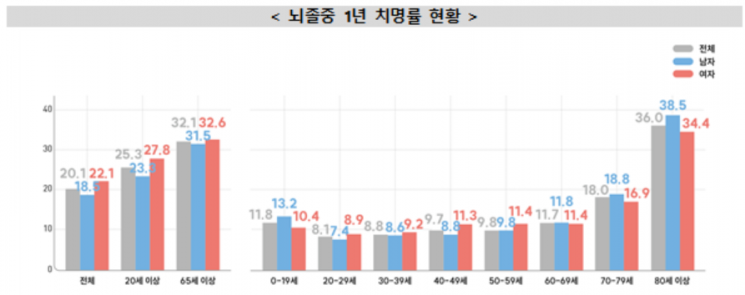
The "1-year fatality rate" after stroke occurrence was 20.1% in 2022. Within one year after stroke, 18.5% of men and 22.1% of women died, and among those aged 65 and older, 32.1% died within one year. The 1-year fatality rate for stroke had gradually decreased from 2011 to 2019 but showed an increasing trend again from 2020.
This statistic provides data on the scale of cardiovascular and cerebrovascular disease incidence in South Korea, and the Korea Disease Control and Prevention Agency plans to use it as basic data for future health and medical policies related to these diseases.
Ji Young-mi, Director of the Korea Disease Control and Prevention Agency, emphasized, "The cardiovascular and cerebrovascular disease incidence statistics are a very important project as they produce evidence to improve the prevention, management, and quality of treatment for major cardiovascular and cerebrovascular diseases. A rapid emergency medical system and a regional management system for severe cardiovascular and cerebrovascular diseases must be secured to enable quick transfer to appropriate medical institutions and emergency response when diseases occur, thereby increasing survival rates."
The "Cardiovascular and Cerebrovascular Disease Incidence Statistics" data can be viewed on the Korea Disease Control and Prevention Agency website, and from January next year, it will also be available through the Statistics Korea National Statistical Portal (KOSIS).
© The Asia Business Daily(www.asiae.co.kr). All rights reserved.



















