"AI Smarter Than Humans to Emerge Within 20 Years"
Geoffrey Hinton, a Nobel Prize-winning physicist known as the 'godfather' of artificial intelligence (AI), has once again warned about the dangers of the rapid development of AI.
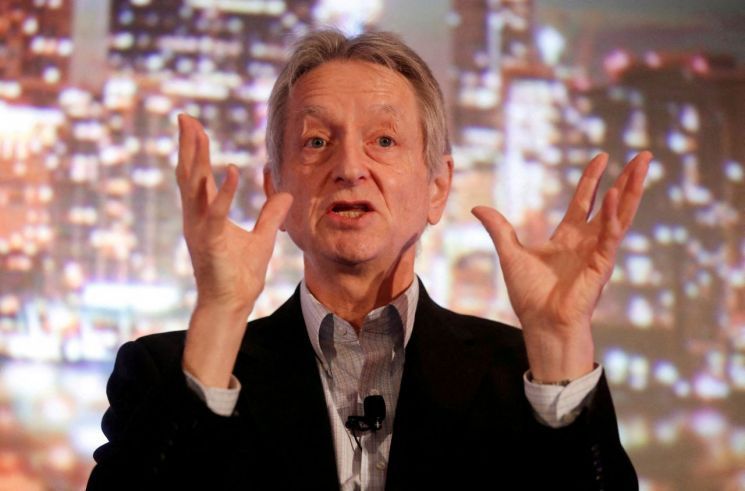
On the 27th (local time), the British daily The Guardian reported that Professor Hinton appeared on BBC Radio and expressed concerns that the rapid advancement of AI technology could pose a threat to the survival of humanity. He stated that the pace of technological change is much faster than expected and analyzed that there is a 10-20% chance that humanity could become extinct within the next 30 years due to AI.
Professor Hinton said, "Humanity has never faced something smarter than ourselves," and questioned, "How often does something more intelligent get controlled by something less intelligent?" He added, "Such cases are very rare," and said, "The only example I know of is a baby controlling its mother through the power of evolution."
He warned that compared to very powerful AI systems, humans are merely 'infants,' saying, "We will be like three-year-old children." Professor Hinton admitted that when he first started AI research, he did not expect development to progress this quickly, stating, "Most experts believe that AI smarter than humans will be developed within 20 years," and pointed out, "This is a very frightening prospect." He also noted on the 3rd that the probability of AI surpassing humanity emerging within 20 years is over 50%, and it could be born as early as five years from now.
Professor Hinton emphasized the need for government regulation, saying that the speed of technological development is much faster than he anticipated. He stressed, "Leaving it solely to profit-driven large corporations may not be sufficient," and added, "The only way to force large corporations to conduct more safety research is through government regulation."
He had previously claimed that there was a 10% chance that technological advancement could bring disastrous consequences to humanity, and this time he raised that figure to emphasize the risk.
Meanwhile, Professor Hinton was awarded the Nobel Prize in Physics this year in recognition of his contributions to establishing the foundations of AI machine learning. Known as a 'pioneer' in the AI field and having served as a vice president at Google, he left Google in April last year and has since been publicly warning about the dangers of AI, earning the label of a 'whistleblower.' He stated that he left Google to freely warn about the negative impacts AI could have on humanity.
© The Asia Business Daily(www.asiae.co.kr). All rights reserved.
![From Bar Hostess to Organ Seller to High Society... The Grotesque Con of a "Human Counterfeit" [Slate]](https://cwcontent.asiae.co.kr/asiaresize/183/2026021902243444107_1771435474.jpg)
















