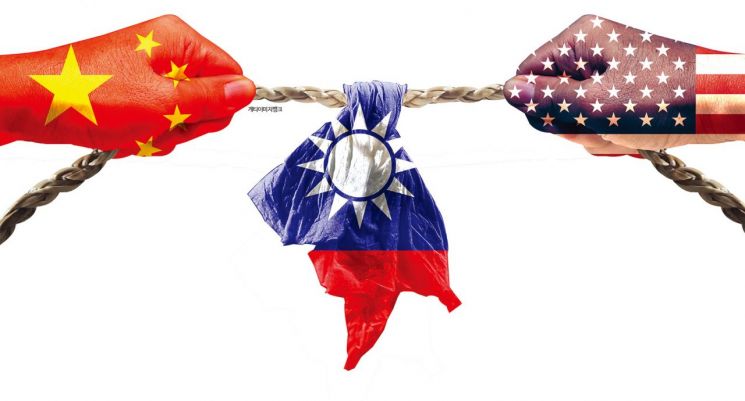
On the 27th, the Chinese Ministry of Foreign Affairs announced on its website that it would impose sanctions on seven U.S. defense industry companies, including a subsidiary of Boeing, and their executives. This move follows the enactment of the 2025 fiscal year National Defense Authorization Act (NDAA), which includes provisions for U.S. military support to Taiwan.
The Chinese Ministry of Foreign Affairs stated on the same day, "The United States recently announced large-scale arms support and sales to Taiwan, and the 2025 fiscal year NDAA contains provisions unfavorable to China," adding, "This seriously violates the 'One China' principle and the Three Joint Communiqu?s between China and the U.S. (agreements between the two countries regarding mutual non-interference and reduction of arms exports to Taiwan)."
In accordance with the Anti-Foreign Sanctions Law, China will sanction seven U.S. defense industry companies and their senior executives starting from today.
The targeted companies include Insitu, a Boeing subsidiary specializing in unmanned aerial vehicles and developer of the U.S. Department of Defense-operated drone "ScanEagle," as well as Hudson Technologies, Saronic Technology, Raytheon Canada, Raytheon Australia, Arcom, and Oceaneering International.
As a result of these sanctions, the assets of these companies and their executives within China will be frozen. Organizations and individuals within China are also prohibited from conducting transactions or cooperating with these companies.
The NDAA was passed by the U.S. House of Representatives and Senate on the 11th and 18th respectively, and came into effect on the 24th. It includes provisions for the U.S. to provide up to $300 million (approximately 443.1 billion KRW) worth of military supplies and training support to Taiwan.
Mao Ning, spokesperson for the Chinese Ministry of Foreign Affairs, mentioned the bill during a regular briefing, stating, "The relevant U.S. law is filled with Cold War-era 'zero-sum' thinking and ideological prejudice," and "It exaggerates the threat from China and encourages U.S. military support to Taiwan, threatening regional peace and stability."
She emphasized, "China urges the United States to comply with the One China principle and the Three Joint Communiqu?s and to immediately cease any actions to arm Taiwan in any form."
Additionally, Mao responded to the U.S. State Department's criticism of Hong Kong authorities' bounty on pro-democracy activists, stating, "Hong Kong affairs are entirely China's internal matters, and no external forces may interfere."
On the 24th, Hong Kong police placed bounties of 1 million Hong Kong dollars (approximately 190 million KRW) each on six pro-democracy figures for violations of the Hong Kong National Security Law. They also canceled the passports of seven other pro-democracy activists residing abroad in countries such as the United Kingdom and Australia.
The U.S. State Department called for an end to the use of the National Security Law in this manner. In a statement released the previous day, the U.S. State Department said, "The extraterritorial application of the Hong Kong National Security Law is a transnational repression that threatens U.S. sovereignty and the human rights and fundamental freedoms of people worldwide."
Meanwhile, Mao commented on the meeting between the foreign ministers of China and Japan, saying, "The foreign ministers of both countries agreed to maintain cooperation."
On the 25th, Japanese Foreign Minister Iwaya Takeshi met with Wang Yi, Director of the Office of the Central Foreign Affairs Commission of the Chinese Communist Party and Minister of Foreign Affairs, in Beijing. They agreed to hold a 'security dialogue' between senior officials in the diplomatic and defense sectors to facilitate communication on security matters between the two countries. They also agreed to promote Wang Yi's visit to Japan in the near future.
© The Asia Business Daily(www.asiae.co.kr). All rights reserved.

![Clutching a Stolen Dior Bag, Saying "I Hate Being Poor but Real"... The Grotesque Con of a "Human Knockoff" [Slate]](https://cwcontent.asiae.co.kr/asiaresize/183/2026021902243444107_1771435474.jpg)















