Highest Exchange Rate Since Financial Crisis
Rising Imported Raw Material Prices Inevitable
Some Companies Adjust Business Plans
"Will Food Prices Rise Further?" Concerns
Manufacturers with High Overseas Share Expect Windfall Benefits
As the won-dollar exchange rate approaches 1,500 won, reaching its highest level since the 2009 financial crisis, concerns are rising that food prices may increase further due to the rising cost of imported raw materials. Some food companies have begun considering adjustments to their business plans and other countermeasures.
According to the industry on the 30th, the won-dollar exchange rate opened at 1,475.0 won in the Seoul foreign exchange market in the morning, up 7.5 won from the previous trading day. On the 27th, it surged to as high as 1,486.7 won during the day. The exchange rate reaching the high 1,480 won range is the highest level in 15 years and 9 months since March 16, 2009 (1,488.0 won) during the financial crisis.
The rise in the exchange rate (depreciation of the won) generally affects the food industry as well. When the exchange rate rises, the import prices of raw materials such as wheat and raw sugar increase. Wheat is the raw material for flour, and raw sugar is the raw material for sugar used in ramen, bread, and snacks.
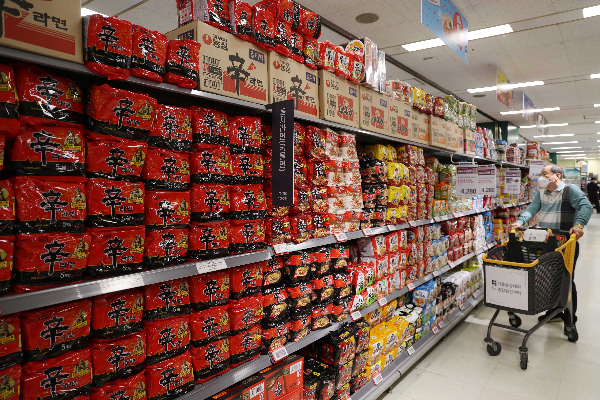
CJ CheilJedang, the largest food company in Korea that produces flour, sugar, and cooking oil, spent 663.1 billion won on raw sugar purchases through the third quarter of this year. It spent 228.1 billion won on wheat purchases. The cost of purchasing soybeans used to manufacture cooking oil and other products was 934.6 billion won. However, with the recent emergency situation this month causing the won-dollar exchange rate to rise, the cost of importing raw materials has inevitably increased, putting pressure on product costs.
Food companies typically hold raw material inventories ranging from 3 to 4 months depending on the item, but if this high exchange rate continues, the cost burden will inevitably increase. For example, CJ CheilJedang predicted in its third-quarter report that if the won-dollar exchange rate rises by 10%, assuming other conditions remain the same, its net profit after tax would decrease by 14.1 billion won. At that time, the exchange rate applied by CJ CheilJedang was 1,352 won. Considering the current won-dollar exchange rate is around 1,470 won, it has already risen by about 9%.
The rise in the won-dollar exchange rate hits food companies with a high domestic sales ratio particularly hard. If the high exchange rate continues to increase the cost of imported raw materials, manufacturers will have no choice but to adjust their business plans, including sales and operating profits, considering the rise in cost ratios. This is especially true for ramen manufacturers like Nongshim and Ottogi, which have a high domestic sales ratio. These companies are closely monitoring the potential price increases of wheat, palm oil, and soybean oil used in ramen and are reportedly adjusting their sales and operating profit targets for next year to reflect the exchange rate rise.
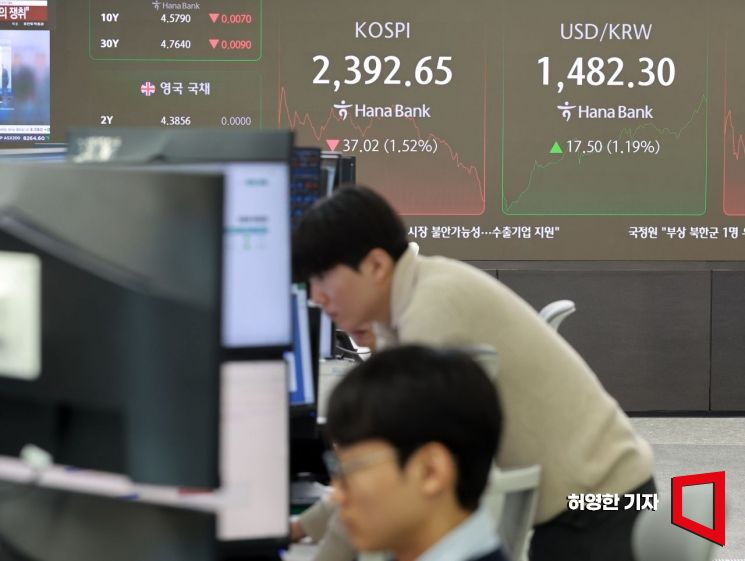 On the morning of the 27th, the won-dollar exchange rate surpassed 1,480 won. Exchange rates and other indices are displayed in the dealing room of Hana Bank in Euljiro, Seoul. Photo by Heo Young-han
Beverage manufacturers producing coffee drinks, juices, and others are also facing difficulties as the import prices of raw materials such as coffee beans and fruit juice concentrate rise. Except for white milk and some dairy products produced from domestic raw milk, most products are made from imported ingredients. An industry insider said, "Although the timing of imports varies, if the current high exchange rate continues, the cost burden will inevitably increase," adding, "Most companies planned their business around an exchange rate of about 1,350 won, but adjustments seem unavoidable."
If the rising cost of imported raw materials increases the burden on manufacturers, price hikes are an inevitable step. In fact, in a survey conducted earlier this month targeting CEOs of 22 major companies in the distribution industry about the economic outlook for 2025, 10 CEOs responded that "prices may be raised next year." They explained that while they are enduring as much as possible to ease the burden on consumers, if the high exchange rate goes beyond the current level, there is no effective alternative but to raise prices.
On the other hand, some food companies benefit from the high exchange rate. These are companies with a higher proportion of overseas business than domestic sales. Samyang Foods, which has created a 'Buldak Bokkeum Myun' (Hot Chicken Flavor Ramen) phenomenon in overseas markets such as the United States and Southeast Asia, is a representative example. As of the third quarter of this year, Samyang Foods' overseas sales amounted to 340.9 billion won, accounting for nearly 80% of total sales (439 billion won). In particular, Samyang Foods' overseas sales have been on a steep rise, increasing by 42.2% compared to the same period last year. Earlier this year, Samyang Foods stated in its business report that if the won-dollar exchange rate rises by 10%, net profit after tax is expected to increase by 6.1 billion won.
© The Asia Business Daily(www.asiae.co.kr). All rights reserved.
![Clutching a Stolen Dior Bag, Saying "I Hate Being Poor but Real"... The Grotesque Con of a "Human Knockoff" [Slate]](https://cwcontent.asiae.co.kr/asiaresize/183/2026021902243444107_1771435474.jpg)

















