Seoul City Holds Urban Planning Committee Meeting and Approves Revised New Construction Plan
Includes Infectious Disease Response and Trauma Center Facilities
The National Medical Center, completed in 1958, will be reborn as a comprehensive medical facility equipped with a Central Infectious Disease Hospital and a Central Trauma Center as it relocates to a newly constructed building.
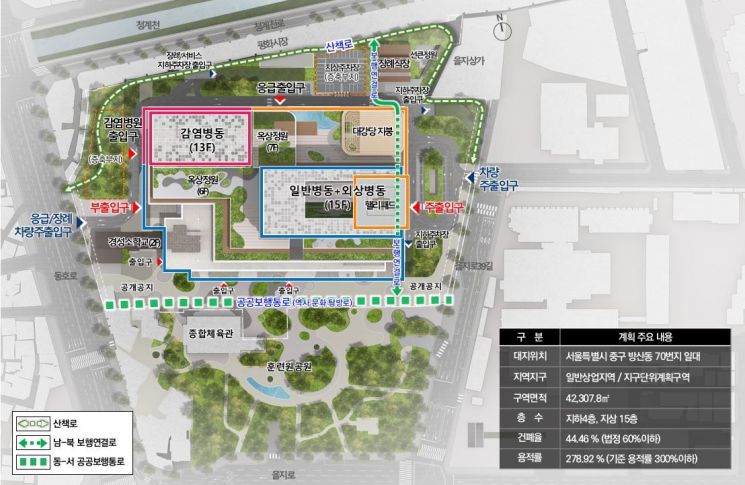 Site plan and architectural proposal for the relocation of the National Medical Center. (Provided by Seoul City)
On the 26th, Seoul City held the Urban and Architectural Joint Committee and announced on the 27th that it had approved the revision of the detailed development plan for the special planning zone on the former U.S. Army Corps of Engineers site within the 'Dongdaemun History & Culture Park District Unit Plan' area.
The plan is to relocate the National Medical Center, currently located between Dongdaemun Design Plaza (DDP) and Hunryeonwon Park, to the northern side of Hunryeonwon Park on the former U.S. Army Corps of Engineers site. The National Medical Center, which has been in operation for 66 years since its completion, will be modernized through this new construction and reborn as a key comprehensive medical facility in the city center.
The construction scale will be from four basement floors to 15 above-ground floors, with a total floor area of approximately 200,000 square meters. Following the COVID-19 pandemic, a Central Infectious Disease Hospital and a Central Trauma Center, which have strengthened infectious disease response capabilities, will also be established. The facility will have a total of 776 beds, including 526 general ward beds, 150 infectious disease ward beds, and 100 trauma ward beds. This is about 1.5 times the existing 500 beds, and it is expected to serve as the central institution for essential national medical care.
The southern part of the site adjacent to Hunryeonwon Park will be developed into an east-west public pedestrian passage and pedestrian green space. Pedestrian routes will also be connected in the north-south direction to link with the surrounding area, providing convenience for patients and guardians visiting the hospital as well as citizens, and offering a resting space. The Keij? Elementary School (opened in 1923), a modern architectural asset within the site, will be preserved and utilized as an exhibition hall, cafe, and lounge.
The National Medical Center, being newly constructed by the Ministry of Health and Welfare, is scheduled to complete design and architectural review next year, begin construction in 2026, and be completed by the end of 2028.
Jo Nam-jun, Director of the Seoul City Urban Space Headquarters, stated, "With the new establishment of the National Medical Center, the public healthcare environment will be significantly improved, and its function as the central institution of the national public healthcare system will be strengthened," adding, "It is expected to respond promptly to the essential medical needs for emergency and infectious diseases in the city center."
© The Asia Business Daily(www.asiae.co.kr). All rights reserved.
![Clutching a Stolen Dior Bag, Saying "I Hate Being Poor but Real"... The Grotesque Con of a "Human Knockoff" [Slate]](https://cwcontent.asiae.co.kr/asiaresize/183/2026021902243444107_1771435474.jpg)
















