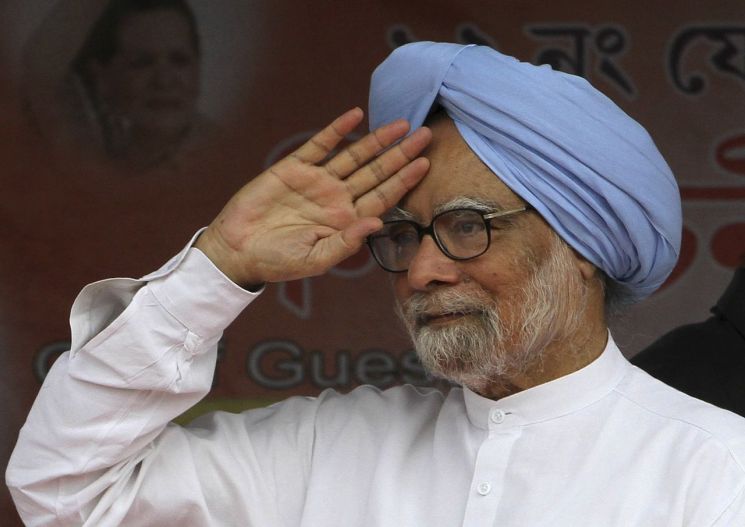
'The Architect of India's Economic Reforms,' former Indian Prime Minister Manmohan Singh, passed away on the 26th (local time) at the age of 92.
According to major foreign media including the AP News, former Prime Minister Singh suddenly lost consciousness at his home that day and was transported to an emergency room in a hospital in New Delhi, but ultimately passed away. He was reportedly undergoing treatment for age-related illnesses recently.
Singh, who earned a Ph.D. in Economics from the University of Oxford in the UK, is recognized as the key figure who led India's economic reforms in 1991, transforming the country from a socialist economic system to a market economy during his tenure as Finance Minister. He served as Prime Minister of India from 2004 to 2014.
Among his economic achievements during his premiership was maintaining a record-breaking average annual economic growth rate of over 8% from 2004 to 2010, despite the global financial crisis. The New York Times (NYT) praised Singh as the figure who laid the foundation for India to emerge as an economic powerhouse capable of competing with China. In 2009, during Singh's tenure, India became a founding member of BRICS (Brazil, Russia, India, China, South Africa), establishing a significant influence in emerging market economies.
His diplomatic achievements include the signing of the U.S.-India Civil Nuclear Cooperation Agreement, agreed upon in 2006 and officially enacted in 2008. This agreement, made with the George W. Bush administration, allowed the International Atomic Energy Agency (IAEA) to inspect Indian nuclear facilities in exchange for the U.S. providing nuclear technology and fuel to India. This deal enabled peaceful civilian nuclear trade between the U.S. and India for the first time in 30 years and marked the beginning of an alliance between the two countries, which had been strained since India's nuclear tests in 1998.
Singh was born in Amritsar, a Sikh city in the northern Indian state of Punjab, and was the first non-Hindu Prime Minister of India since its independence from Britain in 1947. Sikhs make up only 2% of India's population.
Throughout his public service career, he was known for his humble and sincere image and continues to be respected by many Indians, according to foreign media. However, in the latter part of his term, he faced criticism due to political conflicts and corruption scandals within his party, the Indian National Congress. Consequently, he announced he would not seek a third term. The Indian National Congress suffered a crushing defeat to Narendra Modi's Bharatiya Janata Party (BJP) in the 2014 general election.
On the same day, Prime Minister Modi expressed his condolences on X (formerly Twitter), stating, "(Former Prime Minister Singh) was one of the most respected leaders" and "he had a strong influence on our economic policies, including during his time as Finance Minister."
© The Asia Business Daily(www.asiae.co.kr). All rights reserved.

















