Jungoe Park Special Project Block 1 Halted
Material Prices Up 1.4 Times Compared to 4 Years Ago
Sales Price per Pyong Surpasses 6 Million Won
"Measures Needed for Soaring Construction Costs"
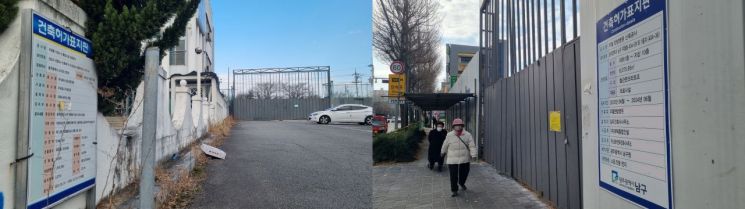 The screen golf construction site in Chipyeong-dong, Seo-gu, Gwangju (left), and the oriental medicine hospital construction site in Juwol-dong, Nam-gu, remain abandoned and halted. Photo by Min Chanki
Recently, the economic downturn and the rise in the KRW-USD exchange rate have led to increased construction costs, resulting in a growing number of 'construction suspension' sites in the Gwangju area.
In particular, some construction companies are facing bankruptcy, making it virtually impossible to resume construction, and most have halted projects due to management difficulties. This has raised concerns that unfinished buildings throughout the city may become urban eyesores left abandoned for extended periods.
Moreover, the situation is negatively affecting the private park development projects promoted by Gwangju City, prompting calls for urgent measures at the government and local government levels to stabilize the construction market.
According to Gwangju City and its five autonomous districts on the 27th, there are currently 15 sites in the region where construction has been suspended. Except for a few cases involving changes in project plans, most suspensions are due to the financial difficulties of construction companies, including six residential facilities such as multi-family housing and mixed-use complexes, and nine non-residential facilities.
Private construction sites are not required to report construction suspensions to the local government, and are only counted through individual reports, so there are likely more suspended construction sites that the authorities have not identified.
Local governments in Gwangju conduct surveys only on buildings that have been left abandoned for more than two years under the Special Act on the Maintenance of Long-Term Abandoned Buildings and related regulations.
In Buk-gu, the site for Block 1 of the non-park facility in the Jungoe Park development project, which was scheduled to begin construction in December last year, has only been cleared, with no actual construction taking place. The project was planned to cover a land area of 50,387 square meters, a building area of 7,228.38 square meters, a total floor area of 165,663.67 square meters, with nine buildings ranging from three basement floors to 29 above-ground floors, and 994 residential units.
The project developer, Jungoe Park Development Co., reportedly requested the suspension due to personal reasons. It is understood that no residents have yet been recruited for Block 1.
A representative from Jungoe Park Development stated, "If Blocks 1 to 3 are released simultaneously, we believe it will take time to sell, so we changed the construction plan for Block 1. Considering the construction costs for Block 1, we plan to proceed differently depending on the sales progress of Blocks 2 and 3," adding, "Most construction sites are burdened by increased construction costs due to rising material prices. This was also taken into account to some extent."
In Seo-gu, Gwangju, G Construction, which had been building a screen golf facility with a building area of 613.83 square meters and a total floor area of 3,940.08 square meters (one basement and four above-ground floors) since October last year, filed for court receivership earlier this year but eventually went bankrupt, resulting in the suspension of construction.
Additionally, the construction of a new Korean medicine hospital in Juwoel-dong, Nam-gu, which began in 2022, has effectively been abandoned since April due to the contractor's financial difficulties.
As material costs continue to soar, the burden on construction companies increases, leading to more construction suspensions.
According to the Korea Construction Association's construction material trends, the intermediate goods supply price index (2020=100) surged from 120.07 in December 2021 to 138.34 in December 2022, and 140.58 in 2023. This year, the index has consistently remained in the 140 range.
The supply price index for construction intermediates is commonly used as an indicator of material prices. An index in the 140 range means a 1.4-fold increase compared to four years ago, indicating a significant burden in material costs. The recent KRW-USD exchange rate has also surpassed 1,480 KRW, hitting new highs, suggesting that the price of imported raw materials will continue to rise.
As construction costs rise, the selling prices of new apartments in Gwangju are also soaring. According to the Korea Real Estate Board's regional average sales prices, the price per square meter for units under 60 square meters in Gwangju was 3.86 million KRW in 2021, 5.02 million KRW in 2022, 6.12 million KRW in 2023, and 6.22 million KRW in 2024, remaining above 6 million KRW since last year. For units between 61 and 85 square meters, the price was 5.18 million KRW in 2022, 5.68 million KRW in 2022, and 5.54 million KRW in 2023. For units over 85 square meters, the price was 6.49 million KRW in 2022, 6.88 million KRW in 2023, and 6.56 million KRW in 2024.
An official from a local construction company said, "Labor and raw material costs are rising day by day, so construction costs are also increasing. If construction sites are suspended due to contractors' financial difficulties, the damage will be passed on to developers and residents, leading to ongoing conflicts. Measures are needed to address the sharp rise in construction costs."
© The Asia Business Daily(www.asiae.co.kr). All rights reserved.

















