KNCAP, Changes and Additions to Evaluation Criteria Next Year
Starting next year, a plan to evaluate vehicle safety by assessing whether car doors can be easily opened even after external impacts such as accidents will be implemented. This comes as consumers increasingly worry that doors may not open when power supply is cut off due to the growing number of automotive electronic devices (electronic systems). In response to the rise in suspected sudden unintended acceleration incidents, pedal misoperation prevention devices will also be evaluated.
Kim Hyuk, an official from the Ministry of Land, Infrastructure and Transport, announced next year’s evaluation methods including these details at the KNCAP (Korean New Car Assessment Program) conference held on the 26th. KNCAP is a system that evaluates vehicles at a higher standard than legal safety requirements and informs the public of the results to encourage automakers to develop safer vehicles. It was introduced in Korea in 1999 and currently evaluates 20 items across 3 categories, assigning scores accordingly.
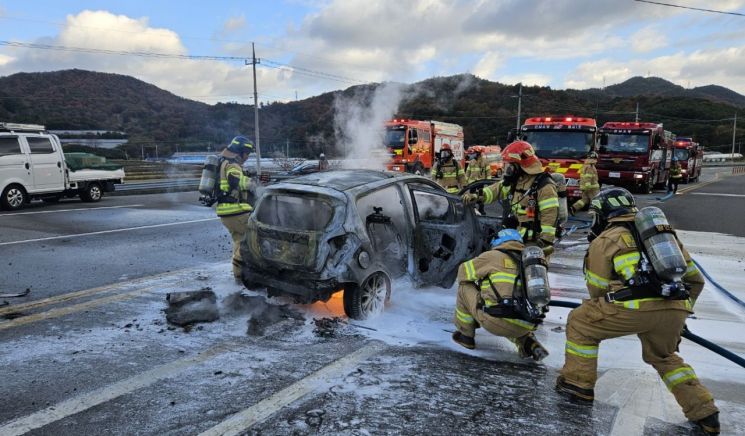
From next year, the evaluation will include safety in escape and rescue after collisions. Specifically, the ease of internal escape will be examined, with up to 2 points deducted. This includes checking whether the door opens after power is cut off, the number of operations required to open the door, and the installation location of the door opening controls. Additionally, whether the seatbelt buckle can be easily released after a collision will be assessed, with a 0.5-point deduction if the criteria are not met.
Up to 3 points will be deducted based on the evaluation of door opening from the outside after a collision. Similarly, it will be checked whether the door can be opened from outside when power is cut (-1.5 points) and whether a recessed door handle protrudes after a collision (-1.0 point). The maximum deductions are 2 points for internal escape and 4 points for external rescue, totaling 6 points.
The collision safety category has a perfect score of 100 points. This door opening evaluation is being attempted ahead of major overseas regions. Euro NCAP in Europe plans to implement a similar evaluation starting in 2026.
Regarding pedal misoperation prevention devices, it will be assessed whether a collision occurs during sudden acceleration from a stationary state at distances of 1m and 1.5m from obstacle vehicles in front and behind. To enhance the reliability of Event Data Recorder (EDR) data, the evaluation method reflects the need to assess data recording time and recording intervals.
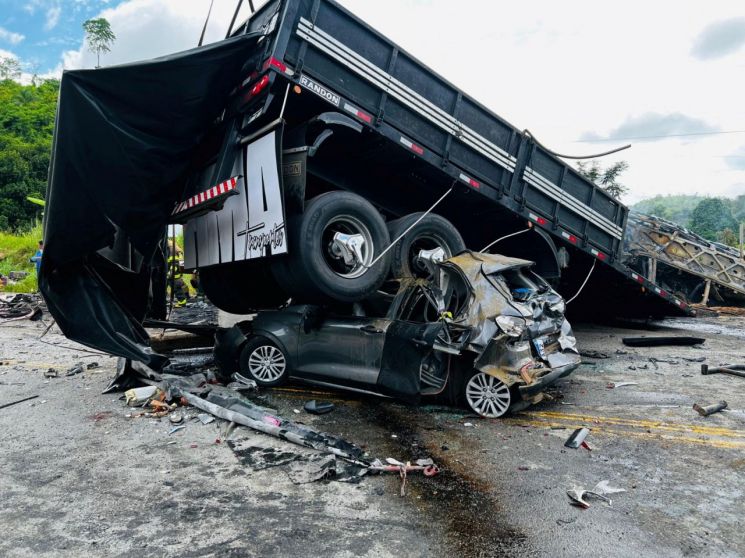
If the recording time of pre-accident driving information differs among recorded items, the unit score is given based on the item with the shortest pre-accident driving information recording time. Similarly, if the recording frequency per second differs by recording time, the score is given based on the lowest recording frequency per second. A total of 3 points are awarded. This evaluation falls under the accident prevention safety category, which also has a perfect score of 100 points.
In addition, the emergency notification device (e-call), which automatically alerts the manufacturer and others in the event of a vehicle accident, will be incorporated into the regular evaluation items, and the chest injury criteria for female passengers in the second row during frontal collisions will be strengthened. Furthermore, starting in 2026, fire safety after electric vehicle collisions will be evaluated. Currently, the electric vehicle safety category is worth 2.2 points, but from the year after next, a new category with a total of 100 points will be created exclusively for electric vehicles.
Meanwhile, the Ministry of Land, Infrastructure and Transport plans to conduct a pilot project to enable the battery management system (BMS) to immediately notify fire authorities if abnormal phenomena such as temperatures exceeding certain thresholds are detected, as a measure to prevent electric vehicle fires.
© The Asia Business Daily(www.asiae.co.kr). All rights reserved.
![Clutching a Stolen Dior Bag, Saying "I Hate Being Poor but Real"... The Grotesque Con of a "Human Knockoff" [Slate]](https://cwcontent.asiae.co.kr/asiaresize/183/2026021902243444107_1771435474.jpg)

















