Sharp Sells Osaka Sakai Factory to Sekisui Chemical
Japan's Only TV LCD Manufacturing Plant Closes Amid Competition from Korea and China
SoftBank Converts to Data Center, Sekisui Chemical to Advanced Solar Cell Factory
Sharp's Osaka Sakai City factory in Japan is being sold to Sekisui Chemical following SoftBank. The Sakai City factory was the only plant in Japan manufacturing liquid crystal display (LCD) panels for TVs, but it closed after operating at a loss. The companies acquiring the factory have all presented plans to transform the site into a hub for new industries. The Japanese government is also showing strong determination to reclaim industry leadership by supporting investments this time around.
On the 26th, Nihon Keizai Shimbun (Nikkei) reported that Sharp sold part of its Osaka Sakai City factory to Sekisui Chemical. The sale amount was 25 billion yen (approximately 232.7 billion KRW).
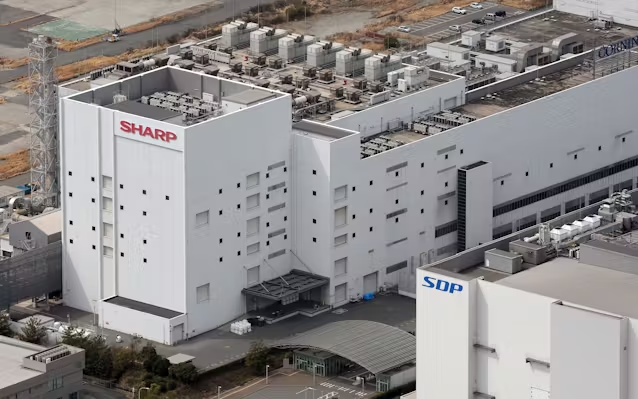
Through this contract, Sekisui Chemical will acquire the site of the former solar cell factory, which has been inactive since November 2019, along with related energy facilities. Sekisui Chemical plans to take over the site in October next year and convert it into a factory for mass-producing next-generation perovskite solar cells. Perovskite is a thin-film type of solar cell that can be easily installed on walls or curved surfaces such as gymnasium ceilings where traditional solar panels are difficult to install, earning it the name "next-generation solar cell."
Nikkei stated, "The new perovskite factory is expected to be built on the demolished site of Sharp's Sakai factory," adding, "The production capacity of the new factory, which will start operations in 2030, is estimated at 1 million kilowatts (kW) per year based on cell power generation capacity, equivalent to the output of one nuclear power plant."
On the 20th, Sharp signed a contract to partially sell land worth about 100 billion yen (approximately 930.8 billion KRW) to SoftBank. SoftBank plans to build an artificial intelligence (AI) data center on the acquired land, taking over 60% of the total land area, including the panel factory, power supply, and cooling facilities.
The data center is scheduled to begin construction next year and start operations in 2026. SoftBank also announced plans to purchase and use NVIDIA's next-generation AI semiconductor "B200" from the United States for data processing. The data center to be established at the Sakai City factory site is expected to function as a major hub overseeing the Kansai region of Japan.
As news spreads that the Sakai City factory will be transformed into a hub for new industries, the industry is keenly watching whether Japan's resurgence can succeed. The Sakai City factory is seen as an example reflecting a facet of Japanese industry that led the sector in the 2000s but was pushed into history. Japanese electronics giants such as Sharp and Sony led the LCD panel sector in the 2000s but withdrew from the business one after another due to competition from Korea and China. The Sakai City factory was the last domestic company producing LCDs but ultimately had to decide to halt production in August due to continued losses.
The Japanese government has also expressed strong determination not to repeat past failures and to lead the industry. The Ministry of Economy, Trade and Industry decided to subsidize Sekisui Chemical, which has entered mass production of cutting-edge batteries including the purchase of Sharp's former factory, with 160 billion yen (approximately 1.4897 trillion KRW), accounting for 50% of the total investment. Although Japanese companies already dominated the existing silicon-type solar cell market, they were gradually losing ground to low-cost Chinese competitors.
Moreover, six Chinese companies have plans to build perovskite factories, so the Japanese government aims to quickly succeed in mass production and seize the initiative. Nikkei added, "Starting with Sekisui Chemical, Japan appears to be rushing mass production to avoid falling behind in commercialization."
Meanwhile, Sharp plans to actively invest the funds obtained from this sale into its brand business centered on home appliances.
© The Asia Business Daily(www.asiae.co.kr). All rights reserved.

















