Ministry of Culture, Sports and Tourism Announces 3rd Basic Plan for Museum and Art Gallery Promotion
AI Curators and Immersive Content for Artwork Experience
Large Cultural Facilities Clustered in Paju and Sejong
"Closing Cultural Gaps by 2028"
The Ministry of Culture, Sports and Tourism announced the '3rd Basic Plan for the Promotion of Museums and Art Galleries (2024?2028)' on the 26th, aimed at revitalizing local areas and leading the future through the development of museums and art galleries. This plan presents 12 policy tasks under four major strategies to support the enhancement of cultural enjoyment for the public, with the vision of 'Museums and Art Galleries that Live and Breathe with the People.'
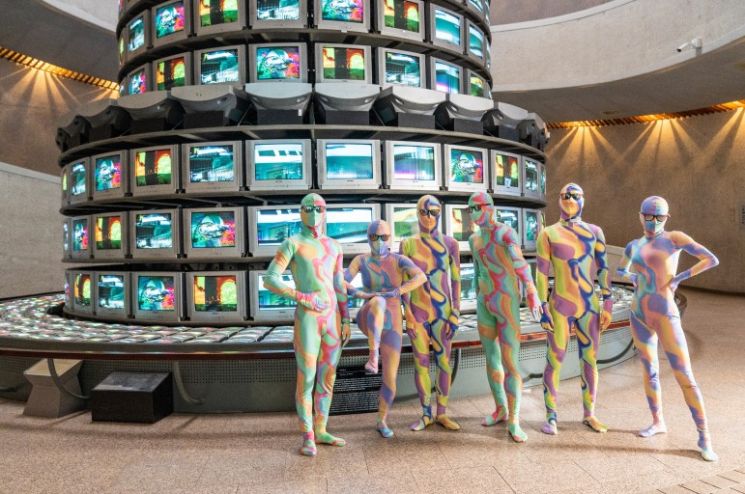 On-site scene of MMCA Live X MBG at the National Museum of Modern and Contemporary Art, Gwacheon.
 [Photo by National Museum of Modern and Contemporary Art]
The 3rd Basic Plan is characterized by reflecting the values newly emphasized in the definition of 'museum' revised by the International Council of Museums (ICOM) in 2022, such as inclusiveness, sustainability, and community participation, while also considering the role of museums and art galleries in response to social and cultural changes in Korea.
First, under the strategy of 'Museums and Art Galleries Growing with the Value of Culture,' a large-scale museum cultural cluster will be established in Paju. This site will include the National Folk Museum and the Performing Arts Support Center, among others. Efforts will also be made to cultivate professional personnel by strengthening re-education for curators and expanding practical experience opportunities for young professionals.
To reduce regional cultural disparities, a National Museum Complex will be developed in Sejong City. By 2028, facilities such as the Children's Museum, Urban Architecture Museum, Design Museum, Digital Cultural Heritage Center, and National Archives Museum will be sequentially established. From 2026, the preliminary feasibility assessments required for establishing public museums and art galleries will be transferred to metropolitan local governments to support the expansion of cultural facilities tailored to regional characteristics.
Customized programs responding to demographic changes also stand out. For children, age-specific exhibitions and programs linked to the Neulbom School will be provided, while for the elderly, history lectures and healing programs will be expanded. The 'Multicultural Package' project for multicultural families will be expanded, and sensory maps and customized guide kiosks for people with disabilities will also be introduced.
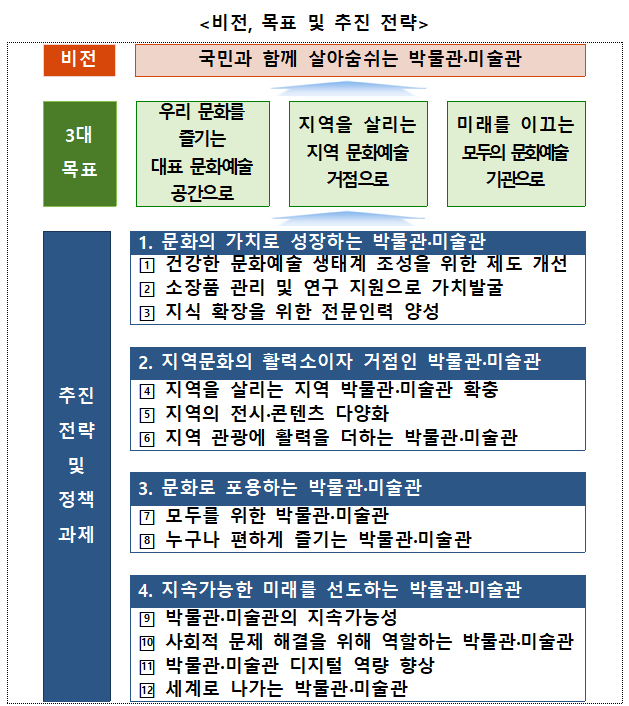 The 3rd Basic Plan for the Promotion of Museums and Art Galleries: Vision, Goals, and Implementation Strategies. [Graphic = Ministry of Culture, Sports and Tourism]
Digital transformation to respond to future changes will also accelerate. Generative AI will be used to provide visitor-tailored curating, and telepresence technology will be developed for ultra-realistic content experiences. To ensure sustainable operation of private museums and art galleries, consulting for conversion to corporate status will be supported, and the art payment-in-kind system, to be implemented from 2024, will be activated.
International exchanges will also be strengthened. Support will be provided for the operation of Korean rooms in overseas museums, and an ODA project will be promoted to package and support the national museum and art gallery system for developing countries. Additionally, the 'K-Museum' brand will be developed to promote the globalization of Korean museums.
Song Yun-seok, Director of Regional Culture Policy at the Ministry of Culture, Sports and Tourism, stated, "Through this basic plan, museums and art galleries will be reborn as spaces that embody new values of inclusiveness, sustainability, and community participation beyond mere exhibition spaces. We will spare no policy support to ensure that all citizens can enjoy high-quality culture close to home."
Meanwhile, this plan is a statutory plan based on Article 5 of the 'Museum and Art Gallery Promotion Act,' revised in June 2023. The Ministry of Culture, Sports and Tourism established the plan through policy seminars, advisory meetings, and surveys of related parties.
© The Asia Business Daily(www.asiae.co.kr). All rights reserved.


















