Control Tower 'Number One' Sign Indicating Takeoff Order
Pilot and Co-Pilot Interpret as 'Takeoff Clearance'
Control Tower and Nearby Passenger Aircraft Unaware of Movement
The aircraft collision and fire accident that occurred last January at Haneda Airport in Tokyo, Japan, was found to have happened because the Japan Coast Guard aircraft captain misunderstood the air traffic controller's use of the term 'number one' as a takeoff clearance.
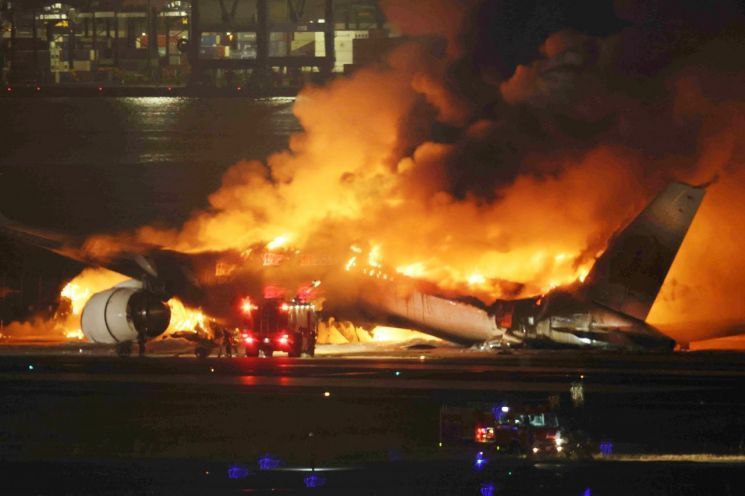 In January, a collision between aircraft occurred at Haneda Airport in Tokyo, Japan. Photo by Yonhap News
On the 25th, public broadcaster NHK reported that the Japan Transport Safety Board announced the interim investigation results of the aircraft collision accident at Haneda Airport in Tokyo. The captain of the Japan Coast Guard aircraft, which collided with a Japan Airlines (JAL) passenger plane that was landing at the time, stated that when he heard the controller's instruction to move up to just before the runway and the term 'number one,' meaning the takeoff order, he thought it meant to enter the runway.
In other words, the controller used the expression 'number one' before the collision accident to indicate that the takeoff order was first and instructed movement, but the Japan Coast Guard aircraft captain misunderstood this as a 'takeoff clearance.' After the controller's instruction, the captain and first officer of the Japan Coast Guard aircraft repeated the instruction together and told each other "no problem." It was also analyzed that the accident occurred because neither the controller nor the JAL pilot noticed the movement of the Japan Coast Guard aircraft.
Meanwhile, the Haneda Airport aircraft collision accident on January 2 occurred when the JAL passenger plane attempting to land and the Japan Coast Guard aircraft attempting to take off entered the runway simultaneously. At the time of the accident, all 379 passengers on the JAL passenger plane escaped safely, but 5 of the 6 people on board the Japan Coast Guard aircraft died.
The crew members on the JAL passenger plane reportedly evacuated passengers quickly through the escape slides (emergency exits attached to the aircraft doors that rapidly inflate by injecting gas into the slides to allow quick evacuation) while adhering to the '90-second rule.' The passengers on board also calmly followed the crew's instructions, which is believed to have enabled everyone to escape without fatalities.
© The Asia Business Daily(www.asiae.co.kr). All rights reserved.

![Clutching a Stolen Dior Bag, Saying "I Hate Being Poor but Real"... The Grotesque Con of a "Human Knockoff" [Slate]](https://cwcontent.asiae.co.kr/asiaresize/183/2026021902243444107_1771435474.jpg)















