Jigeumdonong District in Namyangju-si, Gyeonggi-do, will undergo a complex high-density development combining residential, commercial, and welfare facilities with an investment of 1.2 trillion KRW by 2031.
Gyeonggi-do announced on the 26th that Jigeumdonong District in Namyangju-si was selected as a candidate site for the Residential Regeneration Innovation District in the second half of 2024 through the review of the Ministry of Land, Infrastructure and Transport's Urban Regeneration Special Committee.
The Residential Regeneration Innovation District is a project promoted by the public sector to revitalize deteriorated residential areas. In the designated district, a regional hub integrating residential, welfare, and convenience functions will be established. Once selected as a candidate site, the project budget will be finalized after the main competition next year.
Jigeumdonong District in Namyangju-si is an area densely populated with old and poor-quality buildings. Although redevelopment projects were promoted within the redevelopment promotion district to improve the residential environment, it was converted into a preservation management zone in 2013 due to residents' opposition. Since then, urgent urban regeneration is needed due to a lack of infrastructure, fire safety issues caused by narrow alleys, and widening disparities with surrounding areas.
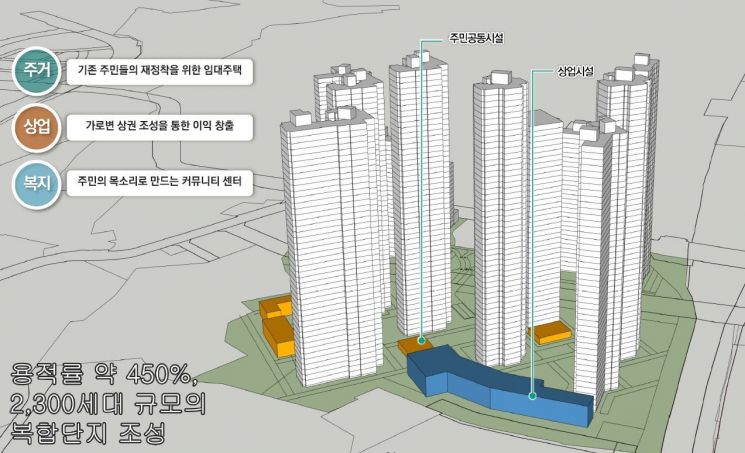 Plan for the Residential Regeneration Innovation District Project in Jigeumdonong, Namyangju-si, Gyeonggi-do. Provided by Gyeonggi-do.
Once the Residential Regeneration Innovation District project is implemented, a complex high-density development combining residential, commercial, and welfare functions will proceed in the Dasan-dong 4039-3 area. In particular, the necessary social overhead capital (SOC) for the region will be supplied. The project will be carried out in phases until 2031, with a total project cost of 1.2174 trillion KRW.
Gyeonggi-do expects that this Residential Regeneration Innovation District project will increase housing supply through the renovation of old residential areas and create hub spaces for apartment-type village community activities such as childcare, leisure, and welfare, thereby restoring urban functions and laying the foundation for balanced development.
Gyeonggi-do plans to provide continuous support to enhance the completeness of the project going forward.
Ahn Seong-hyun, head of the Gyeonggi-do Regeneration Planning Team, said, "The selection of this candidate site is an important starting point to fundamentally improve the residential environment of the declining original downtown and resolve residents' long-standing demands. We expect this to become a new model case for expanding housing supply through urban regeneration."
Gyeonggi-do has achieved the selection of 71 sites nationwide, the highest number in the country, by applying for government urban regeneration public projects to revitalize declining original downtown areas within the province. Accordingly, urban regeneration projects in the province now total 91 sites, including 20 Gyeonggi-do-type urban regeneration projects.
© The Asia Business Daily(www.asiae.co.kr). All rights reserved.

















