Ministry of National Defense, "Conscripts Not on Active Duty or Reserve May Not Be Able to Enlist Next Year"
The Ministry of National Defense is pushing for a revision of the directive that classifies some candidates for medical officer selection as 'non-active duty selectees,' and as a result, a significant number of resigned medical residents who have not yet served are expected to find it difficult to enlist next year.

On the 24th, the Ministry of National Defense and the Military Manpower Administration told Asia Economy, "Those who are not selected as active duty (military doctors) by the Ministry of National Defense and are also not selected as supplementary service personnel (public health doctors, conscription examination doctors, specialized research personnel) by the Military Manpower Administration among the 'enlistment candidates' may not be able to enlist next year and may have to wait their turn."
Earlier, the Ministry of National Defense initiated a revision of the "Directive on the Selection and Enlistment of Medical and Veterinary Officers," which classifies some candidates for medical officer selection as 'non-active duty selectees (tentative name)' for management purposes. This is interpreted as an effort to adjust the situation after a large number of medical residents who resigned in protest against the government's medical school expansion policy in February this year applied to enlist all at once next year, and to prepare for a future shortage of military doctors.
However, a Ministry of National Defense official explained, "The directive revision aims to clarify the selection procedures according to the authority of selection for active duty (Ministry of National Defense) and supplementary service (Military Manpower Administration). The 'non-active duty selectee' classification is a specification of the classification method that the Ministry of National Defense has been performing within its existing authority, not the creation of a new category."
The candidates for medical officer selection are those who have completed a prescribed course at training hospitals and are selected and managed before being commissioned as officers. The Ministry of National Defense first selects active duty personnel from among the candidates for medical officer selection, and any excess personnel are classified as supplementary service by the Military Manpower Administration. However, if thousands of resigned medical residents simultaneously wish to enlist and all remaining personnel, except those already assigned as military doctors under current regulations, are placed in supplementary service, they cannot be selected as military doctors later, which will cause a shortage of military doctors in 2 to 3 years.
According to the Military Manpower Administration, as of the end of October this year, about 3,000 medical residents who resigned from training institutions are candidates for medical officer selection, and if they all wish to enlist at once, this number greatly exceeds the usual annual demand of about 1,000.
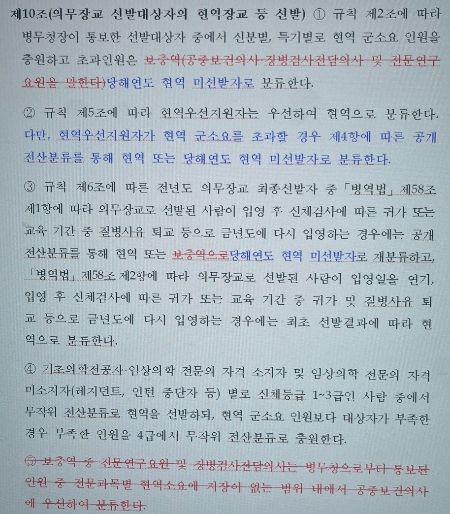 Partial amendment to the "Regulations on the Selection and Enlistment of Mandatory and Contract Officers." Provided by the reader
As news spread that the Ministry of National Defense is pushing for such a directive revision, the resigned medical residents who were originally preparing to enlist in March 2025 criticized, saying, "The government is trying to overwork cheap military doctors and public health doctors."
Park Dan, emergency committee chairperson of the Korean Intern Resident Association, said, "The government is rushing to revise the directive to waste medical personnel," and added, "If there is a problem with the supply and demand of military doctors and public health doctors, instead of wasting personnel by making them wait for enlistment or overworking cheap military doctors and public health doctors, the government should allocate budgets to military hospitals and health centers to formally hire doctors."
A resigned medical resident A from a regional training hospital lamented, "It is an intention to utilize resigned medical residents according to the government's preferences," and said, "They say they will no longer receive training, but the government is trying to create a new leash by making a classification called 'non-selectees.'"
There was also a claim that medical officer candidates should be allowed to serve as regular soldiers. Medical resident B, who resigned from a training hospital in Seoul, said, "Doctors who have started training become candidates for medical officer selection involuntarily and without choice," and added, "Since the situation has changed due to the government's medical school expansion policy, the government should broaden options, such as creating a way to serve as regular soldiers."
Park, the emergency committee chairperson, also emphasized, "From the perspective of adhering to the existing principle in the medical officer candidate oath that 'one must enlist on the nearest enlistment date' and from the perspective of reducing the medical personnel gap period, it is reasonable to send all volunteers for active duty as active duty soldiers," and stressed, "In Korea, any male citizen can serve as an active duty soldier if they wish, whether as a social service agent, judicial officer candidate, or even a U.S. permanent resident."
© The Asia Business Daily(www.asiae.co.kr). All rights reserved.
![Clutching a Stolen Dior Bag, Saying "I Hate Being Poor but Real"... The Grotesque Con of a "Human Knockoff" [Slate]](https://cwcontent.asiae.co.kr/asiaresize/183/2026021902243444107_1771435474.jpg)

















