Through the application of insulation film, a 7% reduction in power consumption was achieved, and installing IoT electric blinds resulted in a 1.6% decrease in power usage... In 2024, the number of users at smart shelter bus stops increased by 174,000 compared to the previous year, equivalent to carbon reduction by planting 2,086 pine trees annually... Designed as energy-saving from the initial design stage to enhance energy efficiency, with solar panels installed to enable energy production
Seongdong-gu, Seoul (Mayor Jung Won-oh) has found that the ‘Seongdong-type Smart Shelter’ also has a positive impact on reducing greenhouse gas emissions.
The district designed the ‘Seongdong-type Smart Shelter’ as an energy-saving model from the initial design stage to enhance energy efficiency. The entrance door was installed off-center to the left or right to create an air pocket. The air pocket helps prevent the cool or warm air inside from escaping outside.
Additionally, a 1kWh solar panel was installed to maintain lighting during power emergencies, ensuring energy productivity. By applying insulation film, a 7% reduction in power consumption was achieved, and installing IoT electric blinds resulted in a 1.6% reduction in power consumption. In terms of carbon reduction, one smart shelter is equivalent to planting three pine trees, and annually, it corresponds to planting 162 pine trees.
Analyzing the change rate of bus passengers at stops with and without smart shelters over five years from 2020 to 2024 shows that stops with smart shelters had a 1.8%p to 16.9%p (average 6.5%p) higher boarding rate. Even in 2020, when ridership was declining due to COVID-19, the decrease rate of passengers at stops with smart shelters was lower.
Referring to the ‘Guidelines for Applying Reduction Factors by Local Government Greenhouse Gas Reduction Projects’ announced by the Korea Environment Corporation in October this year, the number of users at smart shelter-installed stops in 2024 increased by 174,000 compared to the previous year (estimated as of December).
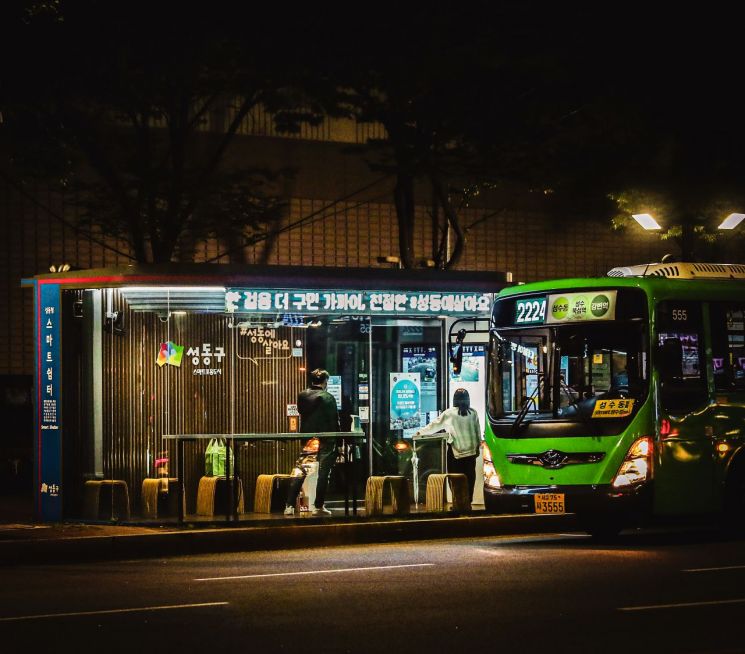
This corresponds to a carbon reduction equivalent to planting 38 pine trees per smart shelter, or 2,086 pine trees annually, confirming the eco-friendliness of the smart shelters.
Seongdong-gu started operating smart shelters by installing eight shelters in August 2020 and currently operates 55 smart shelters.
They not only protect public transportation users from abnormal weather conditions such as heatwaves, cold waves, fine dust, and exhaust fumes but also serve as shelters for pedestrians.
In October, 28 medium-sized smart shelters were designated as cold wave (heatwave) shelters, and their locations were registered on Google Maps to improve accessibility so that anyone can easily search for and use the smart shelters.
Jung Won-oh, Mayor of Seongdong-gu, said, “The ‘Seongdong-type Smart Shelter’ protects public transportation users from abnormal weather such as heatwaves and cold waves, enhances residents’ convenience, increases public transportation usage, and contributes to reducing carbon emissions and greenhouse gases. We will continue to promote various smart, life-oriented policies that bring positive changes to residents’ lives and enhance the city’s sustainability.”
© The Asia Business Daily(www.asiae.co.kr). All rights reserved.

















