"14.3% Find Normal Eating Difficult Without Dining Out"
Preference for Delivery and Takeout Over Restaurant Meals
One in three people under the age of 30 considers dining out not as a choice but as a necessity. As consumption patterns that prioritize convenience and cost-effectiveness become more common, the demand for dining out is expected to steadily increase in the future. However, while traditional dining out at restaurants has decreased, the number of people using delivery or takeout services has risen.
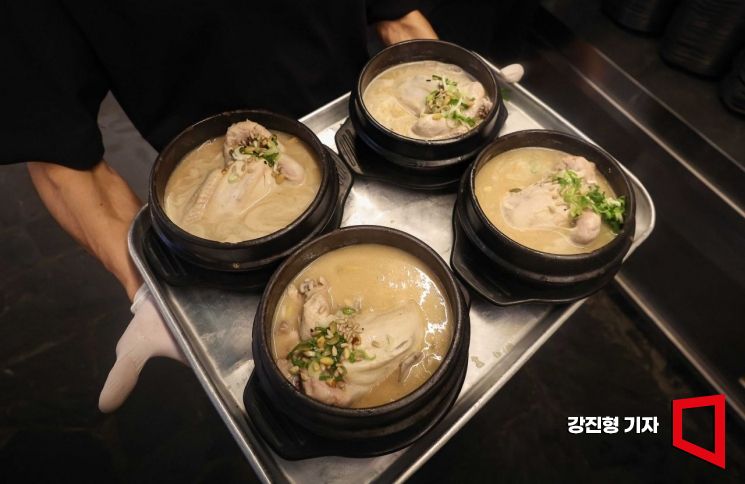 An employee is carrying Samgyetang at a Samgyetang restaurant in Jongno-gu, Seoul. Photo by Jinhyung Kang aymsdream@
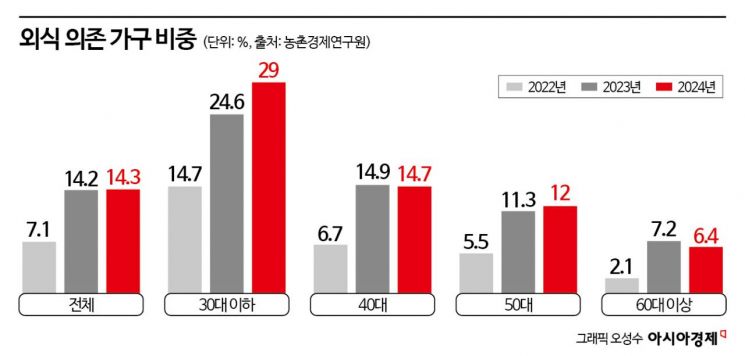
According to the Korea Rural Economic Institute on the 23rd, the proportion of households dependent on dining out, delivery, or takeout?those who said "normal eating habits are not possible without dining out or delivery/takeout"?was 14.3% this year. This figure has more than doubled compared to 7.1% in 2022 over two years. In particular, the proportion of household heads under the age of 30 who responded this way reached 29.0%.
As dependence on dining out increases, the share of dining-out expenses in total food expenditure is also rising. According to the Statistics Korea Household Income and Expenditure Survey, as of the second quarter of this year, the proportion of dining-out expenses in total food costs exceeded half at 51.3%. This is 1.7 percentage points higher than at the end of last year. The share of dining-out expenses, which was 43.9% in 2021, has steadily increased each year to 48.1% in 2022 and 49.6% last year.
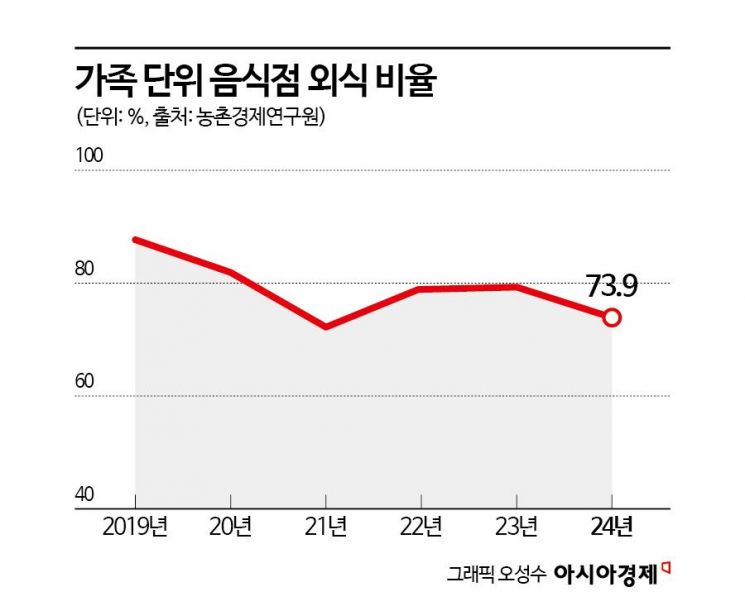
However, the nature of dining out is gradually shifting from the traditional concept of eating at external restaurants to dining out through delivery and takeout. In fact, the proportion of family-unit restaurant dining out this year was 73.9%, down 5.4 percentage points from 79.3% last year. Compared to 2019, when the restaurant dining out rate was 87.8%, it has dropped 14.3 percentage points over five years.
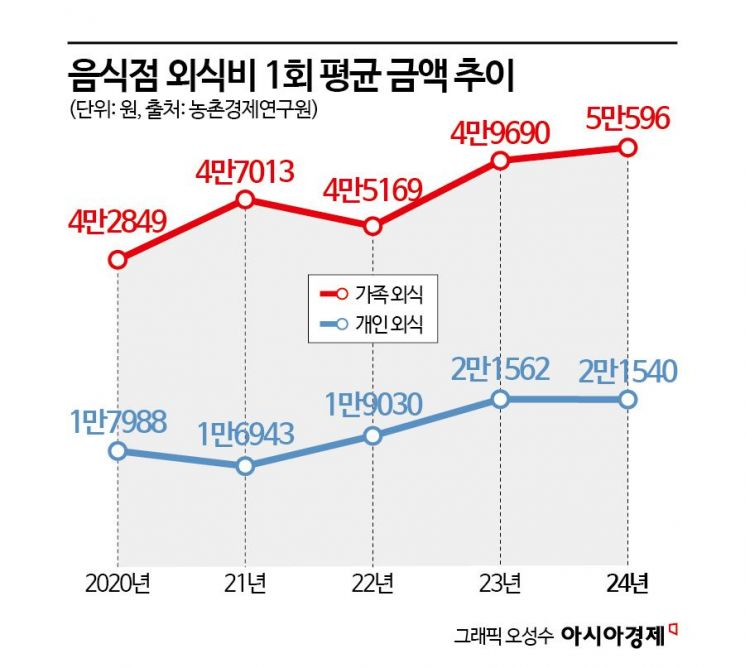
The biggest reason for the decline in restaurant dining out is, unsurprisingly, "price." This year, 38.2% of respondents said they do not dine out frequently because prices are expensive, nearly 10 percentage points higher than last year's 28.4%. The average cost per restaurant dining out occasion for families rose 13.1% from 44,745 KRW in 2019 to 50,596 KRW this year, surpassing the 50,000 KRW mark. During the same period, individual dining out expenses also increased 17.9%, from 18,262 KRW to 21,540 KRW. According to Statistics Korea, as of November this year, the Consumer Dining Out Price Index stood at 122.22, up 22.2% compared to the base year 2020 (=100), significantly exceeding the Consumer Price Index of 114.12.
Meanwhile, the response "because it is bothersome or unsafe," which was the biggest reason for not dining out until last year, decreased from 22.1% last year to 14.4% this year, and the answer "because it is not good for health" also dropped from 10.7% to 6.4%. On the other hand, the response "because of lack of time" increased from 16.7% to 21.4%, and those who answered "because it is crowded" rose from 4.8% to 6.5%.
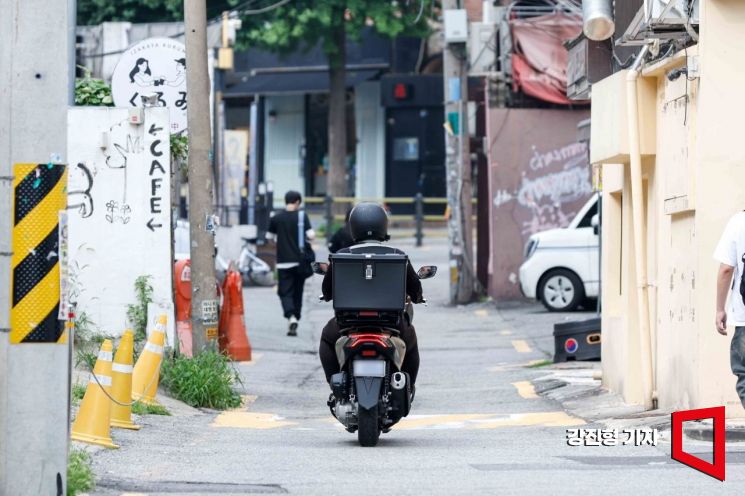
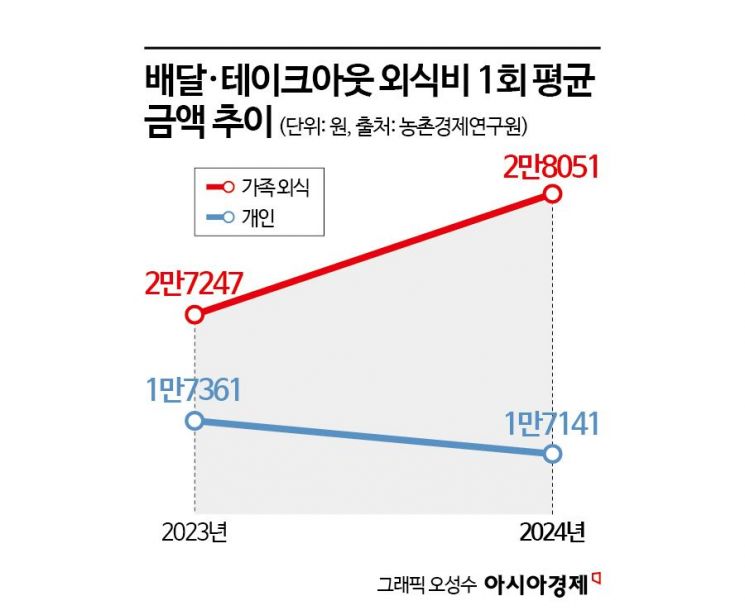
Unlike the decline in restaurant dining out, the use of delivery and takeout services is on the rise. The proportion of family units using delivery or takeout this year was 45.8%, up 3.4 percentage points from 42.4% last year and 8.9 percentage points from 36.9% three years ago in 2021. The increase in delivery and takeout usage is interpreted as being due to the relatively lower cost of dining out this way. The average cost per family-unit delivery or takeout dining occasion this year was 28,051 KRW, 80.4% lower than restaurant dining out, and individual dining out expenses were also 25.7% cheaper at 17,141 KRW.
Dr. Lim Ji-eun of the Korea Rural Economic Institute said, "As dependence on dining out in eating habits continues to rise, and with consumption trends seeking convenience, dining out demand is expected to continuously increase. If issues related to dining out prices stabilize, the effect of expanding dining out will be even greater."
© The Asia Business Daily(www.asiae.co.kr). All rights reserved.













