Industrial Federation Forum and Industry "Concerns Over Expansion of Directors' Duty of Loyalty"
The industrial sector urged the political sphere to reconsider legislative measures such as the amendment of the Commercial Act to expand directors' duty of loyalty from the company to shareholders, as the number of reports of breach of trust in the course of business reaches 2,000 cases annually under current laws.
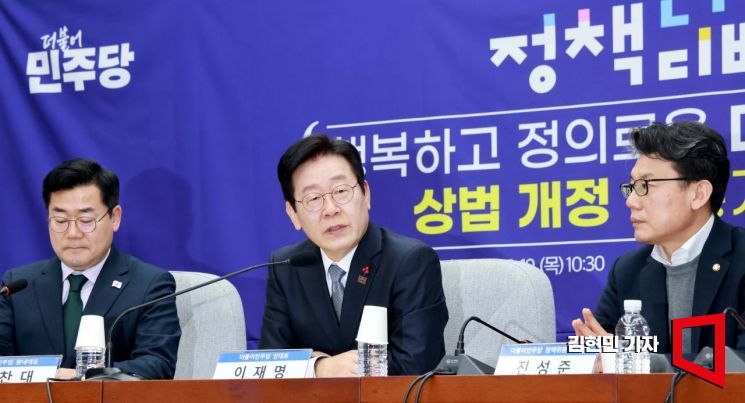 Lee Jae-myung, leader of the Democratic Party of Korea, is speaking at the Democratic Party policy debate held at the National Assembly on the 19th, on the topic of "How to Amend the Commercial Act." Photo by Kim Hyun-min
The Korea Industrial Federation expressed deep concerns on the 23rd regarding the proposed amendments to the Commercial Act and the enactment of the Act on the Governance of Listed Companies, together with industry representative associations. Eighteen industry associations participated, including the Korea Bio Association, Korea Battery Industry Association, Korea Automobile Mobility Industry Association, Korea Electronics and Telecommunications Industry Promotion Association, and Korea Chemical Industry Association.
The amendment to the Commercial Act, primarily proposed by lawmakers from the Democratic Party of Korea, includes changes to Article 382-3 of the Commercial Act, which currently states, "A director shall faithfully perform his/her duties for the company in accordance with laws and the articles of incorporation." The proposals suggest replacing "company" with "the interests of the company and shareholders" (proposed by Assemblyman Kang Hoon-sik), "the company and majority shareholders" (proposed by Assemblyman Park Joo-min), or "the proportional interests of shareholders and the company" (proposed by Assemblyman Jeong Jun-ho).
The industrial sector pointed out, "Even under current laws, there are judicial risks related to directors' management actions, such as shareholder derivative lawsuits under the Commercial Act, liability to third parties, and criminal breach of trust under the Criminal Act. In particular, the number of reports of breach of trust in the course of business is frequent, reaching about 2,000 cases annually."
They added, "It will be up to the courts to determine to what extent directors' legal responsibilities are recognized under the duty to protect shareholders," and "Until precedents are established, companies and shareholders will face risks of conducting management activities and investments amid uncertain circumstances."
The industrial sector criticized that amending the law would restrain corporate management. They stated, "Companies with poor profitability are facing lawsuits and breach of trust reports depending on investment outcomes due to shareholder opposition to mergers and acquisitions, even if they have high growth potential," and "If the amendment to the Commercial Act passes, there is a greater likelihood that management will focus solely on stable operations in response to shareholders' demands for short-term gains and dividends."
Furthermore, the industrial sector warned that if the Commercial Act is amended, it could trigger issues such as unlisted companies avoiding listing, attacks on domestic companies' management rights by foreign speculative capital, and hindrance to management initiatives of small and medium-sized listed companies. They urged the National Assembly to conduct further discussions and carefully adjust the bill.
© The Asia Business Daily(www.asiae.co.kr). All rights reserved.

















