668 System Semiconductor Design Graduates from 2022-24... Employment Rate 86%
"Semiconductor Department 61.6%, Electronic Engineering Department 54.9%... Employment Rate Up 25-31%P"
"Seoul Competition Rate 3.8:1 in First Half... Focus on Company-Linked Practical Training"
#Mr. Namo faced repeated rejections in job interviews after graduating from university. While attending the Korea Chamber of Commerce and Industry Seoul Technical Education Center's 'Intel Edge Artificial Intelligence Software (AI SW)' course, he learned both embedded semiconductors and AI, and directly handled Intel Microcontroller Unit (MCU) computing devices. After completing the course, he was employed by a large corporation's affiliate and is currently working as a software developer related to vehicle platform MCUs.
#Mr. Kang graduated from the Department of Electronic Engineering at a university in Seoul but was not familiar with semiconductor design automation (EDA) tools and programming languages. While attending the center's 'Harman Semicon Academy Course,' he learned EDA tools in analog and digital design fields and acquired various design languages such as C and Verilog. After completing the course, he joined a large corporation.
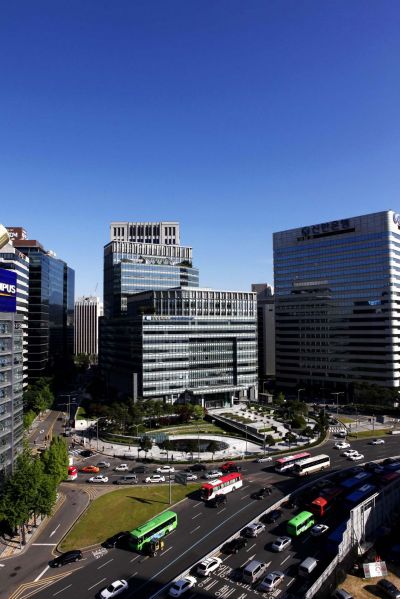 Seoul Jung-gu Korea Chamber of Commerce and Industry Sangyohwa Building exterior. Provided by Korea Chamber of Commerce and Industry
The Korea Chamber of Commerce and Industry announced on the 23rd that from 2022 through this year, the center has produced 668 semiconductor specialists over three years, achieving an average employment rate of 86%. Of the 170 graduates so far this year, 144 (84.7%) have been employed by semiconductor specialized companies, and the employment rate is expected to increase as more graduates complete the program by the end of the year. According to the Korea Educational Development Institute, the average employment rate for semiconductor and ceramic engineering majors was 61.6% in 2022, and for electronic engineering majors, it was 54.9%. This means the center's graduates have an employment rate 24.4 to 31.1 percentage points higher than that of majors.
The Korea Chamber of Commerce and Industry cited the strengths of the center's educational programs as practical, hands-on training and corporate-linked educational programs. The center provides trainees with practical education focused on semiconductor design and verification processes such as planning, development, and testing rather than theory. This cultivates job competencies that can be immediately applied upon entering the workplace.
Through consultation with semiconductor specialized companies, the curriculum is designed to focus on technical and practical skills. All trainees undertake company-customized projects and have opportunities to learn design programs and programming languages used in the field. This also increases the likelihood of employment with related companies. For example, over the past two years from last year to this year, 33 out of 161 graduates (20%) of the 'Harman Semicon Academy' were hired by Harman. Mid-sized fabless companies such as Nextchip (12 hires) and Telechips (7 hires) also recruited graduates.
Tuition is free, fully supported by the government. Kim Kyung-soo, chairman of the Korea Fabless Industry Association, said, "Graduates from the center are adapting faster on-site than employees who joined immediately after university graduation. The innovative ideas from projects conducted during training will play an important role in strengthening competitiveness by contributing to member companies' new technology development and product efficiency improvement."
The Chamber announced plans to significantly increase semiconductor specialist training next year. Starting next year, in cooperation with the Fabless Association, which has 140 member companies, the number of mid-sized and small semiconductor practical talent development will be increased to 400. Customized education for employees at semiconductor design companies will be promoted.
Center Director Kim Yeon-seon said, "The center will continue to expand semiconductor education courses not only in design and verification but also in automation robotics and software development. To address the shortage of personnel in the small and mid-sized semiconductor industry, we will continuously increase corporate-linked practical education so that capable young people can challenge themselves more in the semiconductor field."
The center has been recruiting 90 trainees for two semiconductor courses since the 6th. The application period runs until February 14 of next year. During the interview, applicants are evaluated for their basic understanding of the course and employment motivation in about 15 minutes. Detailed eligibility and application methods can be found on the Chamber's Human Resources Development Project website. The competition rate for the center's recruitment in the first half of the year was 3.8 to 1.
© The Asia Business Daily(www.asiae.co.kr). All rights reserved.
![Clutching a Stolen Dior Bag, Saying "I Hate Being Poor but Real"... The Grotesque Con of a "Human Knockoff" [Slate]](https://cwcontent.asiae.co.kr/asiaresize/183/2026021902243444107_1771435474.jpg)
















