Education Authorities "Not Even an Inch of Adjustment Possible" vs Medical Community "Recruitment Halt"
As the medical community demands the suspension of new medical school admissions for the 2025 academic year and the government insists that even minor adjustments are difficult, the finalization of the regular admission quota is rapidly approaching.
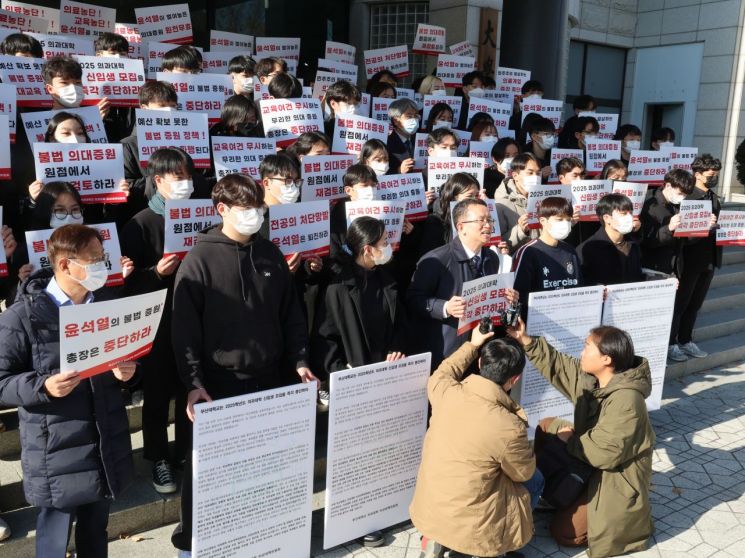 On the afternoon of the 10th, the Emergency Measures Committee of the Medical School held a press conference in front of the main building of Pusan National University in Geumjeong-gu, Busan, announcing a declaration on the current situation of Busan Medical School. The declaration called for halting the procedure to increase the medical school quota and seeking reasonable alternatives to ensure the normal operation of the medical school. Photo by Yonhap News
Each university will finalize and announce the number of regular admission slots reflecting the unfilled spots from early admissions later this week. Once announced, adjusting the number of new student admissions will be impossible.
According to education sources on the 22nd, universities completed the announcement of early admission successful candidates by the 13th, and from the 16th to the 18th, during the early admission registration period, those who did not register are being replaced by additional successful candidates announced from the 19th onward.
Under current regulations, any unfilled spots from the early additional admissions will be carried over to the regular admissions.
Universities will finalize the number of regular admission slots reflecting unfilled spots between the 27th, after completing the announcement of additional early admission successful candidates, and the 30th, before the start of regular admissions, and publish this on their respective websites.
The previously announced total number of new medical school admissions nationwide for next year is 4,610, which is 1,497 more than last year. By admission type, 3,118 students (67.7%) will be admitted through early admissions, and the remaining 1,492 (32.4%) through regular admissions.
Due to the increase in medical school quotas, top-tier universities such as Yonsei University and Korea University have seen a surge in early admission successful candidates withdrawing their registrations.
According to Jongno Academy, Yonsei University had a withdrawal rate of 47.5% among early admission successful candidates, and Korea University had 44.9%. Compared to the 2024 academic year, Yonsei University’s rate increased by 11.1 percentage points, and Korea University’s by 0.8 percentage points.
Seoul National University’s withdrawal rate decreased from 7.3% last year to 6.1% this year, which is presumed to be because students with excellent academic records focused more on applying to medical schools including those in provincial areas rather than Seoul National University.
Unfilled spots from the initial admissions will be filled through first and second additional admissions. If the planned number is still not met, the regular admission quota will increase accordingly.
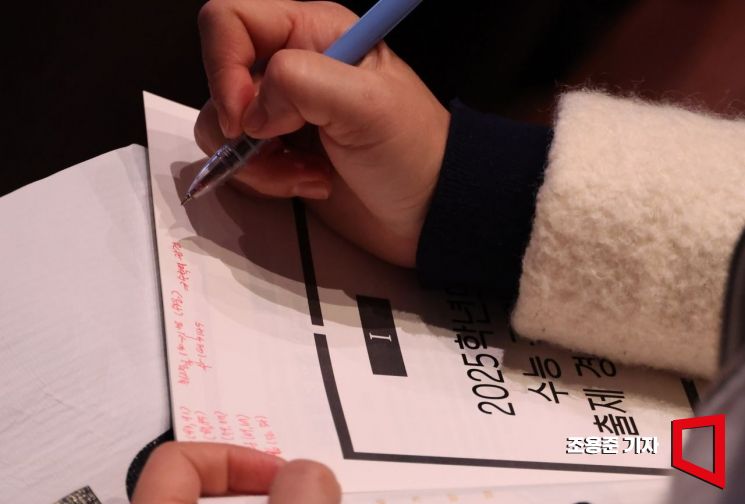 On the 21st, parents and students attending the "2025 College Scholastic Ability Test Analysis and Regular Admission, Medical School Application Strategy Entrance Exam Briefing," co-hosted by the Korean Council for University Education and EBS at Samsung Hall, Ewha Womans University in Seoul, are taking notes while listening to the instructor's explanation. Photo by Jo Yong-jun
Representatives of medical organizations met with the chairs of the National Assembly’s Education Committee and Health and Welfare Committee on the 19th to reiterate their demand to halt medical school admissions for next year.
With early admissions concluded, the only option the medical community can propose to adjust medical school quotas is to prevent the carryover of unfilled early admission spots to regular admissions. Last year, 41 students nationwide were carried over from early to regular admissions in medical schools.
However, with less than a week remaining before the finalization of regular admission numbers, changing regulations to prevent carryover from early to regular admissions could cause further confusion. In particular, students who gave up early admissions aiming for regular admissions to medical schools might face disadvantages.
Accordingly, the education authorities are showing reluctance. On the 18th, during a National Assembly Education Committee inquiry, Lee Ju-ho, Deputy Prime Minister and Minister of Education, stated, “(We have) reviewed and examined the relevant laws and regulations multiple times, but considering the possibility of lawsuits, the government cannot make even the slightest adjustment.”
The medical community, centered around residents and medical students, continues to demand the suspension of next year’s admissions, so the conflict is expected to persist for the time being.
© The Asia Business Daily(www.asiae.co.kr). All rights reserved.


















