Statistics Korea Announces 2023 Regional Income Statistics
Last year, the nominal personal income per capita of the people was recorded at 25.54 million won, an increase of 560,000 won (2.3%) compared to the previous year. Seoul ranked first in personal income per capita nationwide for the eighth consecutive year.
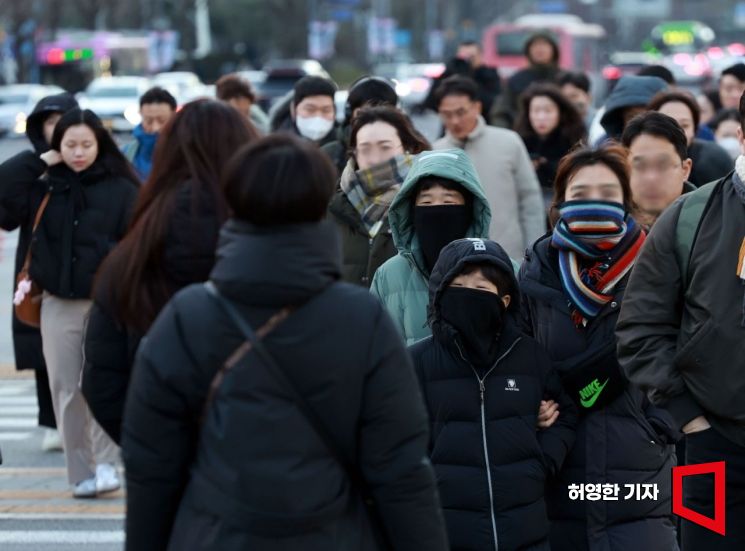 On the 18th, when the morning temperature in the Seoul area dropped to minus 6 degrees Celsius and some parts of Gangwon Province fell below minus 10 degrees Celsius, marking the coldest day of this winter, citizens dressed in thick clothing were walking through the Sejongno intersection in Seoul. Photo by Heo Young-han
According to the '2023 Regional Income Statistics (GRDP·Provisional)' announced by Statistics Korea on the 20th, the personal income per capita was recorded at 25.54 million won, an increase of 560,000 won (2.3%) from the previous year. By region, Seoul's personal income per capita was 29.37 million won, the highest among the 17 cities and provinces nationwide, showing a 4.2% increase from the previous year.
Seoul has maintained the top position for eight consecutive years from 2016 to last year. Statistics Korea analyzed that this is because the wage level in Seoul is higher than in other regions, and the population of Seoul is decreasing, which results in a higher growth rate when calculating personal income per capita.
Following Seoul, the regions with high income were Ulsan (28.10 million won), Daejeon (26.49 million won), and Sejong (26.00 million won) in order.
Gyeongnam (22.77 million won) and Jeju (22.89 million won) were below the national average. Personal income refers to income that households can freely dispose of and is an indicator showing household purchasing power. It is calculated by dividing by the estimated population to determine personal income per capita.
The total regional gross income nationwide was 2,446 trillion won, an increase of 91 trillion won (3.8%) compared to the previous year. By region, Gyeonggi had the highest total income at 660 trillion won, followed by Seoul (620 trillion won) and Gyeongnam (127 trillion won).
Last year, the real gross regional domestic product (GRDP) increased by 1.4% nationwide. Looking into details, Incheon grew by 4.8%, the highest growth rate in the country. The transportation and manufacturing industries led Incheon's growth rate. Daejeon (3.6%) and Ulsan (3.2%) also showed high growth rates. On the other hand, Chungbuk (-0.4%) and Jeonbuk (-0.2%) experienced 'negative growth' due to sluggish manufacturing and agriculture, forestry, and fisheries sectors.
© The Asia Business Daily(www.asiae.co.kr). All rights reserved.
![Clutching a Stolen Dior Bag, Saying "I Hate Being Poor but Real"... The Grotesque Con of a "Human Knockoff" [Slate]](https://cwcontent.asiae.co.kr/asiaresize/183/2026021902243444107_1771435474.jpg)
















