Won-Dollar Exchange Rate Rises to 1450 Won Level for the First Time in 15 Years
More Than Half of Costs in Fuel and Lease Fees Paid in Dollars
LCCs Especially Struggling... "Even Recording a Surplus Is Considered a Good Performance"
The won-dollar exchange rate has reached its highest level since the financial crisis, leaving the aviation industry distressed. Since fuel costs and lease fees are all paid in foreign currency, the cost burden has increased. Coupled with the off-season for winter travel, concerns about fourth-quarter earnings are growing.
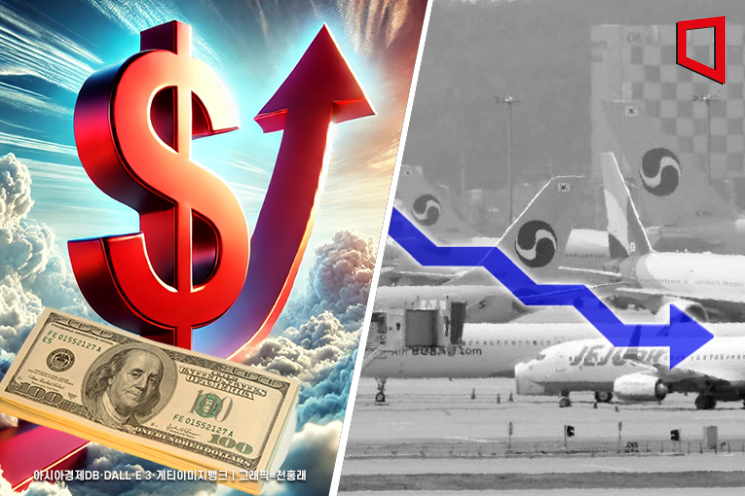
According to the Seoul foreign exchange market on the 20th, the won-dollar exchange rate is hovering around 1,450 won. The closing price the previous day was 1,451.9 won, the highest in 15 years since March 16, 2009. This was triggered by Jerome Powell, Chairman of the U.S. Federal Reserve (Fed), signaling a slowdown in the pace of interest rate cuts, which shocked the financial market.
Concerns among airlines are also increasing as this coincides with the winter off-season. Major airline expenses such as fuel costs, lease fees, and local handling fees are all paid in dollars. With the won-dollar exchange rate rising more than 10% compared to the end of the third quarter, the cost burden has also increased. Korean Air analyzed in its third-quarter business report that every 10 won increase in the won-dollar exchange rate results in approximately 27 billion won in foreign currency valuation losses. It also estimated that cash flow could fluctuate by about 14 billion won. Since the exchange rate at the end of the third quarter was in the 1,319 won range, foreign currency valuation losses have already increased by about 350 billion won. However, the industry believes that for large full-service carriers (FSC) like Korean Air, about 40% of passenger revenue and 75% of cargo revenue are generated overseas, so foreign currency income can serve as a buffer.
The conditions for low-cost carriers (LCC) are worse. Their revenue base mainly depends on outbound demand from Koreans traveling abroad, and the proportion of cargo revenue is not large. This means they have significantly fewer opportunities to earn dollar income compared to Korean Air. Since most aircraft are procured through leases (both financial leases and operating leases), when the won-dollar exchange rate rises, the scale of aircraft lease liabilities also increases accordingly. Interest expenses on foreign currency borrowings and maintenance provisions for leased aircraft also rise.
An aviation industry official said, "In the past, even during the impeachment crisis, the won-dollar exchange rate did not stay high for long, but recently, with forecasts that it will settle in the 1,400 won range per dollar, concerns about foreign exchange hedging are growing," adding, "In the fourth quarter, there is a reaction that just recording a profit would be considered a good performance."
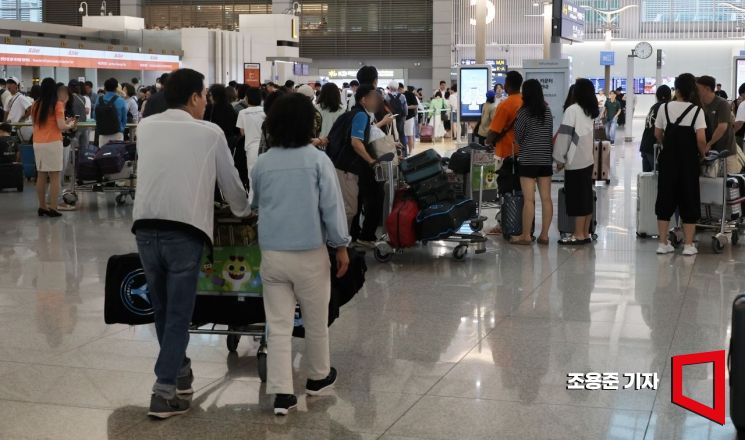 On the 13th, one day before the Chuseok holiday, the departure hall of Terminal 1 at Incheon International Airport is bustling with crowds heading overseas for the holiday period. Photo by Jo Yongjun jun21@
© The Asia Business Daily(www.asiae.co.kr). All rights reserved.
![Clutching a Stolen Dior Bag, Saying "I Hate Being Poor but Real"... The Grotesque Con of a "Human Knockoff" [Slate]](https://cwcontent.asiae.co.kr/asiaresize/183/2026021902243444107_1771435474.jpg)











