Ulaanbaator Seobu Dragon Terminal Branch Opens on the 20th
Small Stores in the Center, Large Stores in New Town Target Distribution Market
Emart announced on the 20th that it will open its 5th franchise store, Dragon Terminal Branch, in Ulaanbaatar, the capital of Mongolia. It has been 1 year and 3 months since the 4th store opened in September last year.
Ulaanbaatar is a place where Korean culture has spread so much that it is called the ‘Mongtan (Mongolia + Dongtan) New City.’ There are four Emart stores operating in the form of large discount stores in downtown Ulaanbaatar, and this 5th store is the first to be prepared in a small format.
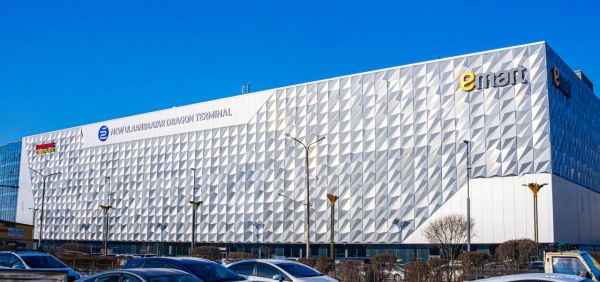
The 5th store will be located on the first floor of the newly built shopping mall at Dragon Bus Terminal, the center of the largest commercial district in western Ulaanbaatar and a transportation hub connecting the capital and provinces, with an area of 1,090㎡ (330 pyeong). The Dragon Bus Terminal shopping mall has been undergoing expansion construction since last year and has become the largest shopping mall in Ulaanbaatar, housing fashion, food and beverage, and a cinema. Emart, with its diverse shopping content, is expected to play the role of a key tenant (anchor tenant).
Reflecting its small size, the 5th store increased the area of processed food sections to about 70% of the total area. It also operates convenience store products such as simple travel items for terminal customers and small-sized Korean snacks and beverages. Reflecting the K-food craze, it has a deli and bakery selling Korean-style menus, and the No Brand store, a differentiated competitive advantage, is placed prominently at the entrance.
At the deli and bakery corners, local Mongolian menus as well as Korean foods such as gimbap, tteokbokki, and fried chicken are sold. Large pizzas with a diameter of 45 cm are also made and sold directly in the store, just like domestic Emart stores. The No Brand store is set up in a 99㎡ (30 pyeong) 'shop-in-shop' format at the entrance of the Emart store. This year (January to November), sales of Emart No Brand in Mongolia increased by 24%, showing great popularity. Customer response is especially high for No Brand’s cost-effective products such as potato chips, butter cookies, and rice snacks.
Earlier, in November last year, Emart established a food processing factory in Ulaanbaatar to strengthen the competitiveness of deli products. It directly manufactures foods that had depended on imports and preprocesses necessary ingredients, serving as a central hub supplying uniform quality to all Emart stores in Mongolia. Various products tailored to Mongolian tastes are also being localized and developed. For example, ‘Mongchi,’ a Mongolian-style localized kimchi, has become a major product. The strategy is to develop 100 key products in the future to strengthen Emart’s unique competitiveness.
Going forward, starting with the 5th store, Emart plans to accelerate the opening of small stores in downtown Ulaanbaatar to penetrate the center of Mongolia more quickly, while simultaneously opening large stores such as shopping mall types in the outer new towns through a two-track strategy, aiming to become a leading company in the Mongolian distribution market. Choi Jong-geon, head of Emart’s overseas business, said, “The 5th store, opened at the bus terminal connecting the capital and provinces of Mongolia, will be a good opportunity to test the small discount store format in Mongolia,” and added, “Emart aims to open more than 10 additional stores in Mongolia by 2030 and establish itself as a representative discount store in Mongolia to spread K-distribution.”
© The Asia Business Daily(www.asiae.co.kr). All rights reserved.
![Clutching a Stolen Dior Bag, Saying "I Hate Being Poor but Real"... The Grotesque Con of a "Human Knockoff" [Slate]](https://cwcontent.asiae.co.kr/asiaresize/183/2026021902243444107_1771435474.jpg)
















